


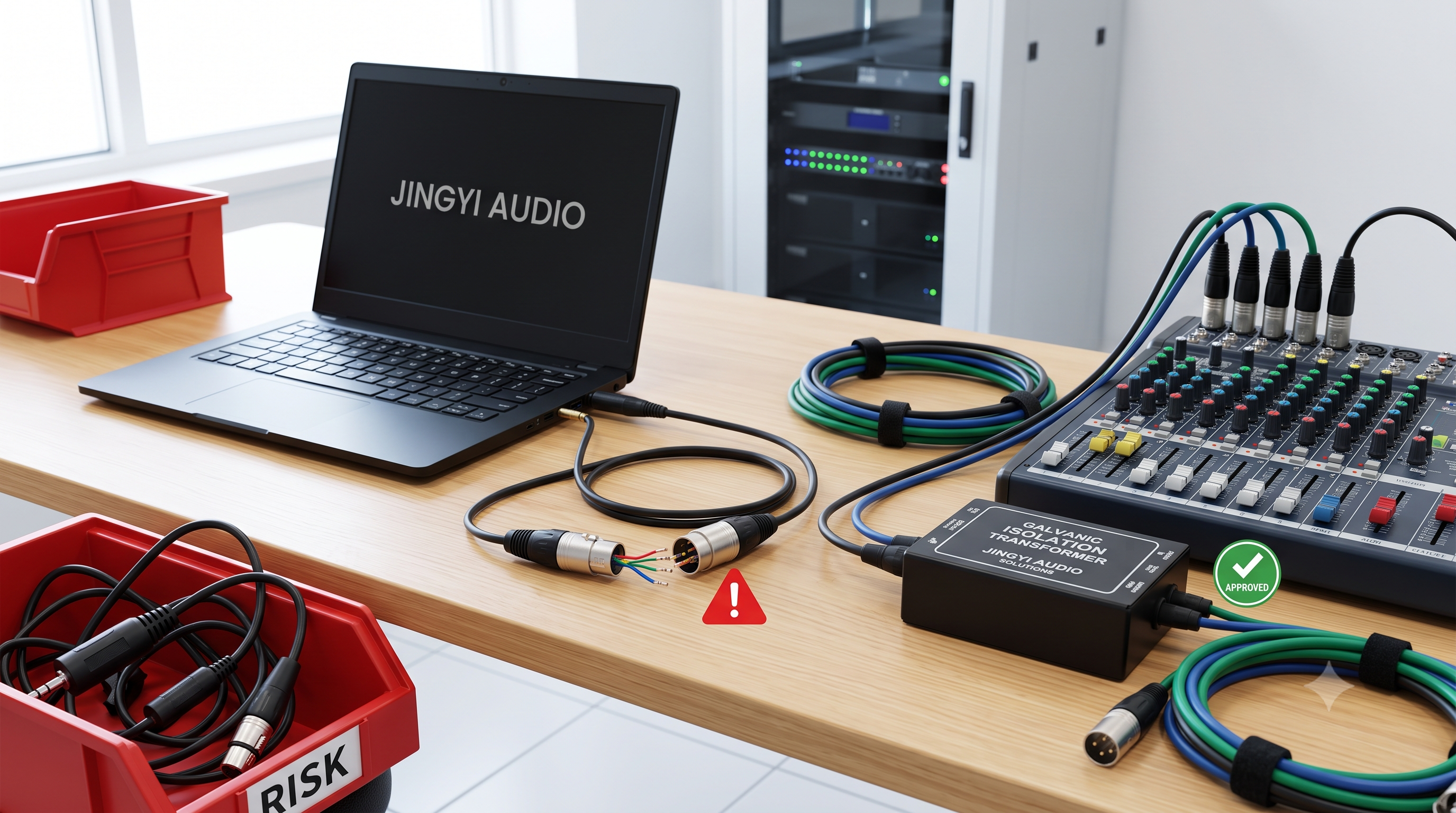
Custom Audio Cables in 2026: B2B Market Dynamics, Engineering Standards, and Professional Integration
Author: Lynn Zhang, CEO at Jingyi Audio
Published: April 2, 2026
Last Updated: April 2, 2026
Reviewed by: Jingyi Audio content and engineering team
Company: Jingyi Audio
Quick Answer
Custom audio cables in 2026 are no longer just accessories. In broadcast, live sound, studios, enterprise AV, and industrial systems, they are core infrastructure. Buyers now care less about the lowest price and more about signal integrity, shielding, fit-for-use design, exact tolerances, quality control, redundancy, and long-term operating cost because cable failure still causes some of the most expensive problems in modern AV systems.
TL;DR
- Custom audio cables have become a core part of B2B AV system reliability.
- Rising copper prices and demand from EVs, grid upgrades, and AI data centers are changing sourcing and pricing.
- Professional buyers are moving toward pure OFC, stronger shielding, better testing, and direct manufacturing relationships.
- Analog XLR still matters for redundancy, splitting, phantom power safety, and fail-safe routing.
- Many real-world pro audio failures still start at the cable and connector layer.
Professional audio in 2026 looks highly digital. Audio rides over networks. Conferencing is hybrid. Video, power, control, and data often live in the same environment. Yet the physical layer has not become less important. It has become less forgiving.
That is why custom audio cables now carry much more weight than they used to.
Why do custom audio cables matter more than ever in 2026?
Short answer: Because the more advanced an AV system becomes, the more damage a weak cable can do.
There is a real contradiction in the market right now. Wireless workflows are expanding. Cloud-based media processing is growing. Digital-over-IP is standard in many facilities. Yet physical cabling has become more critical, more technical, and more heavily checked than before.
The global audio cable market is valued at more than $1.16 billion and is projected to reach $2.36 billion by 2035, with a CAGR of 8.27%. At the same time, the broader professional audio-visual systems market is projected to reach $308.23 billion in 2026.
That growth is not reducing pressure on cabling. It is increasing it.
A few years ago, many buyers still treated cable as a commodity purchase. If it passed signal, that was often enough. In 2026, that thinking causes trouble. In a broadcast room, a hybrid corporate campus, a touring rig, or a large education deployment, cable issues can lead to:
- signal loss
- clocking failures
- grounding noise
- repeated truck rolls
- damaged ports
- service downtime
- replacement labor
- workflow breakdowns across connected systems
That is why custom audio cabling is no longer a side item. It is the nervous system of the system.
What is changing in the B2B market for custom audio cables?
Short answer: Buyers are moving away from cheap, generic cable and toward reliability-driven, engineering-led cable sourcing.
The market conversation has shifted. Procurement used to lean heavily on initial purchase price. Now buyers are asking different questions:
- Will this cable hold signal under load?
- Is the shielding right for this environment?
- Can the supplier keep quality steady across large runs?
- What happens when the cable sits in a tough environment for years?
- Will this reduce service calls over the full life of the system?
That shift matters because modern B2B deployments now combine:
- immersive audio formats such as Dolby Atmos
- multi-camera video systems
- hybrid conferencing platforms
- digital signal processing
- dense backend routing
- shared infrastructure across rooms and buildings
As those environments become more complex, weak cabling stops being a minor problem and starts becoming an operating risk.
The real buying focus in 2026 is no longer just “does it work?” It is:
- signal reliability
- telemetry readiness
- total cost of ownership
- quality consistency
- maintenance impact
- system uptime
How are copper prices and supply pressures affecting custom audio cables?
Short answer: Copper cost and copper availability are now shaping both pricing and procurement strategy.
Cable pricing remains high in 2026, and the pressure is not just general inflation. The bigger issue is competition for high-grade copper across major industries.
In the first quarter of 2026, the Producer Price Index for Copper Wire and Cable reached 540.124 points, a 22.4% year-over-year increase. During the same period, COMEX copper traded around $5.43 per pound.
Those numbers matter because custom audio cable manufacturing depends on refined conductor material, and the audio sector is now competing with much larger buyers.
Which industries are competing for the same copper?
The biggest ones include:
- electric vehicle manufacturing
- grid modernization projects
- hyperscale AI data centers
- broader electrification and infrastructure work
This creates a tough reality for cable manufacturers and B2B buyers. Better copper is harder to lock in. Prices stay high. Supply can become less predictable.
That is one reason many buyers are moving away from anonymous low-cost sourcing and toward long-term manufacturer relationships.
Why does conductor material matter so much in professional audio?
Short answer: Because conductor material affects conductivity, noise control, corrosion risk, heat behavior, flexibility, and long-term failure risk.
In professional use, conductor choice is not just a spec-sheet detail. It directly affects how the cable performs in the field.
|
Conductor Material |
Conductivity (IACS%) |
Oxidation Resistance |
Mechanical Flexibility |
Primary B2B Application Context |
|
Pure Oxygen-Free Copper (OFC) |
100%–102% |
Excellent |
High |
Enterprise AV, EV audio, touring PA systems |
|
Tinned / Silver-Plated Copper |
104%–108% |
Outstanding |
Very High |
Marine, engine bay, broadcast OB vans, high-frequency data |
|
Copper-Clad Aluminum (CCA) |
61%–65% |
Poor |
Low / brittle |
Budget consumer audio, widely falling out of favor in professional use |
Why is OFC the standard in serious applications?
Pure OFC gives buyers the combination they usually need:
- high conductivity
- strong corrosion resistance
- stable long-term performance
- good flexibility for installation and handling
Where do tinned or silver-plated conductors fit?
These are often a better choice in harsh environments, including:
- marine use
- corrosive installations
- engine-bay conditions
- OB vans
- high-frequency data environments
Why is CCA a problem?
CCA is cheaper, but it comes with major tradeoffs. It offers only 61% to 65% of the conductivity of pure OFC, and it is more brittle and more vulnerable to oxidation and long-term failure. In professional environments, those tradeoffs can become expensive fast.
That problem is even clearer in EV audio environments. Electric vehicle platforms bring dense electronics, high-voltage inverter systems, and more EMI/RFI pressure. In that setting, cheap CCA wiring is not good enough. Buyers need 100% to 102% IACS pure OFC to hold clean signal behavior and steady transient response.
How should B2B buyers source custom audio cables in 2026?
Short answer: The safer move is direct sourcing from specialized manufacturers with clear QA, not low-visibility dropshipping models.
Many serious buyers are leaving behind the old offshore dropshipping model because it often fails on the things that matter most in real deployments:
- quality consistency
- engineering accuracy
- predictable lead times
- accountability
- repeatability at scale
A specialized custom cable manufacturer gives buyers tighter control over:
- exact lengths
- shielding design
- connector combinations
- tolerance control
- batch consistency
- test procedures
That matters a lot in large installs, multi-room projects, studio builds, and enterprise AV packages.
What lead times are normal for custom cable orders?
In 2026, lead times depend heavily on complexity and order volume.
|
Order Volume and Complexity |
Typical Configuration Example |
Estimated Production Lead Time (2026) |
|
Low Volume / Standard Custom |
1–2 individual cables or 1 DB25 to DB25 |
3–4 weeks |
|
Medium Volume / Moderate Custom |
3–8 individual cables or 2–4 DB25 snakes |
4–6 weeks |
|
High Volume / Complex Custom |
9–16 individual cables or 5–8 DB25 snakes |
6–8 weeks |
|
Enterprise Facility / Bulk Custom |
Full studio wiring or multi-room infrastructure |
8–10+ weeks |
These timelines are not a sign that custom work is slow. They reflect the real work involved in material planning, assembly, testing, and inspection.
What should quality assurance include?
By 2026, buyers should expect more than a simple continuity check. Strong QA now includes:
- continuity testing
- resistance testing
- signal integrity verification
- time-domain reflectometry for digital lines
- connector durability testing
- pull testing
- pre-shipment inspections
Why does total cost of ownership matter more than initial price?
Because the cost of a failed cable in the field is usually much higher than the savings from buying a cheaper one.
Low-cost, poorly controlled cable sourcing can lead to:
- ground loops
- signal degradation
- intermittent failures
- repeated diagnostics
- unnecessary labor
- expensive service visits
That is why many B2B buyers are now thinking in terms of operating cost, not just unit cost.
How have engineering standards changed for custom audio cables?
Short answer: The goal is no longer just continuity. The goal is protecting signal integrity in difficult real-world conditions.
Today’s custom cable engineering must account for:
- digital and analog coexistence
- strict impedance behavior
- EMI/RFI exposure
- power and data in the same pathway
- environmental stress
- digital clock sensitivity
- grounding and shield continuity
- connector durability
That means cable design now sits in the overlap between electrical physics, materials, mechanical fit, and systems integration.
Why does analog XLR still matter in a networked audio world?
Short answer: Because analog XLR still provides the fallback, isolation, and workflow freedom that digital networking cannot always guarantee.
Audio-over-IP systems like Dante, AES67, and AVB/Milan are now common. They move many channels over Cat5e, Cat6, or fiber and bring huge routing flexibility.
But networked systems also bring new risk points:
- shared preamplifier gain stages
- IP conflicts
- switch configuration errors
- packet latency
- network switch failure
That is exactly why analog XLR remains critical in live events, touring, and broadcast.
Why is analog still the fail-safe layer?
When a show cannot stop, analog copper still matters. Many professional devices now provide both analog and digital outputs at the same time so processors can receive parallel feeds. If a network switch fails, the analog path can keep the signal alive.
Why does analog splitting still matter?
If a single microphone has to feed FOH, monitors, and a remote broadcast truck, digital splitting creates a shared-gain problem. One engineer’s gain change can affect everyone else.
A good transformer-isolated analog split avoids that.
|
Routing Protocol / Physical Medium |
Channel Capacity |
Electrical Isolation |
Phantom Power Safety |
Workflow Independence |
|
Analog Passive Y-Split (Copper) |
1 per cable |
None |
High Risk |
Poor |
|
Analog Transformer Split (Copper) |
1 per cable |
Excellent (Galvanic) |
Completely Safe |
Strong |
|
Digital AoIP (Cat5e/Cat6/Fiber) |
Hundreds |
Strong in digital domain |
Safe |
Limited by shared preamp headroom |
Transformer-isolated analog splitting gives users:
- galvanic isolation
- phantom power protection
- ground loop reduction
- independent workflow control
Why does star-quad geometry matter?
In RF-heavy environments such as arenas, convention centers, and dense event spaces, premium systems often use star-quad cable geometry. Star-quad uses four tightly woven internal conductors to improve Common Mode Rejection Ratio (CMRR) compared with standard twisted pair cable.
That extra noise rejection matters when the environment is electrically busy.
How is USB-C changing custom audio cable design?
Short answer: USB-C is turning many cables into active system components that manage power, heat, data, and shielding at the same time.
USB-C is no longer just a connector standard. In 2026, a USB-C audio cable may carry digital audio and up to 240W of power through PD 3.1 Extended Power Range, or 48V/5A.
That matters for:
- portable studio gear
- active speakers
- DSP devices
- conferencing hubs
- integrated B2B installations
Why are many premium USB-C cables no longer passive?
Because high power levels create safety and performance issues that require active management.
Modern premium USB-C cables often include E-Marker chips that help manage:
- power negotiation
- connector-level thermal conditions
- current flow optimization
- overheating prevention
- device-to-device power handshakes
What is the core engineering problem?
Running high voltage power next to high-speed data and digital audio increases the risk of:
- crosstalk
- power-supply noise bleed
- heat issues
- unstable data behavior
That is why custom builders use stronger internal shielding, often combining:
- braided copper shielding
- aluminum Mylar foil
- separation between power and data conductors
Why are buyers asking about sustainability?
More B2B buyers now want jacket materials made from:
- bio-based polymers from renewable inputs like corn and sugarcane
- post-consumer recycled ocean plastics
These materials can reduce carbon emissions by more than 40% compared with traditional PVC manufacturing, which is becoming a meaningful procurement point in some markets.
What do real-world case studies tell us about custom audio cable value?
Short answer: They show that standard cable often fails when the job gets technically or environmentally demanding.
Case Study 1: Eliminating crosstalk in a multi-sensor array
A major industrial manufacturing client worked with Southrock Engineering to fix a specialized acoustic and environmental monitoring system. The system needed to carry power, high-speed data, and isolated signals across four arrays, funneling 32 total connections, or 8 wires per sensor, into a single 44-pin connector feeding a central processor.
The first solution used standard off-the-shelf multi-core audio cable. It failed badly.
The failure points included:
- capacitive crosstalk between sensors
- hum from nearby power lines
- weak dielectric isolation
- unstable signal integrity over distance
The fix required a full rethink. The team moved from standard audio multi-pair to industrial-grade CAT6a with:
- tighter internal twist structure
- pair isolation using an internal spline
- stronger double shielding
They also used military-spec gold crimp pins for lower resistance and stronger mechanical retention.
The result was a durable single-cable solution that eliminated crosstalk and interference.
Case Study 2: Improving production floor efficiency
A professional studio monitor manufacturer was spending around 60 hours a week having skilled technicians hand-assemble internal wire harnesses to maintain audio consistency.
This was a hidden labor problem.
Studio monitors are precision products, and internal wiring tolerance matters. Poor harness consistency can create:
- impedance mismatch
- phase shift
- RF intrusion
- inconsistent signal behavior
The company had tried outsourcing before, but the quality was so inconsistent that the internal team still had to do too much QC.
The better solution came from switching to a specialized domestic cable assembly partner using:
- automated high-precision termination
- stricter computerized continuity testing
That move cut repetitive labor, improved consistency, and let the engineering team spend more time on product development.
Case Study 3: Environmental resilience in underwater and corrosive installations
Sommer Cable’s SC-AQUA MARINEX ARAMID MIKRO14 microphone cable shows how demanding some cable environments have become.
It was designed for:
- amusement parks
- OB vans
- coastal installations
- permanent underwater installations
It supports permanent installation at depths up to 20 meters (66 feet).
Instead of standard PVC jacketing, it uses a synthetic blend designed to resist:
- salt water
- UV radiation
- microbial degradation
Internally, it uses aramid fibers, the same class of material used in body armor and aerospace work, to provide:
- high tensile strength
- heavy-duty strain relief
- anti-rodent protection
Its diameter was matched precisely to HICON HI-MARLIN XLR connectors, which allowed a true IP67 waterproof rating without extra sealing compounds or heat-shrink workarounds.
It is also a 110-ohm cable, so it can support:
- analog microphone use
- digital AES/EBU audio
- 3-pole DMX lighting data
Why do so many integration problems still start at the cable layer?
Short answer: Because many failures blamed on major hardware are really caused by cable choice, shielding, grounding, or connector issues.
Across professional forums and industry discussions, one theme keeps showing up: the headline equipment gets blamed first, but the real fault often sits in the physical connection layer.
That includes:
- wrong cable category
- poor shielding
- broken shield continuity
- grounding mistakes
- unsafe signal routing
- protocol mismatch
- power mismatch
- copper run lengths beyond safe limits
Below are the five most heavily discussed frontline issues, presented as FAQs.
FAQ 1: Why do AES50 systems suffer synchronization dropouts and damaged ports?
Short answer: Because AES50 is sensitive to timing skew and static discharge, and many “higher-category” cables are actually the wrong fit.
Live sound engineers using systems like the Midas M32 and Behringer X32 often report mid-show dropouts, clock sync loss between the console and stagebox, and in some cases permanently damaged Ethernet ports.
Many users assume expensive Cat6 or Cat7 cable must be better than older cable. That is not always true for AES50.
What is happening physically?
AES50 runs at 100 Mbps, but its clocking is rigid. Cat6 often uses a more aggressive and uneven internal twist rate, sometimes more than two twists per centimeter, to reduce crosstalk at higher network speeds.
For AES50, this can create skew by physically changing internal conductor path lengths. That skew can misalign the audio data and sync clock, especially beyond 75 feet.
The other major issue is electrostatic discharge. If users run unshielded cable, static can build up from dragging cable across carpet or stage surfaces. Without a path to ground, that static can discharge directly into the console logic and destroy the AES50 port.
What is the right fix?
AES50 systems should use:
- Shielded Twisted Pair (STP or FTP) Cat5e
- proper Neutrik Ethercon shells
- full continuity between the cable shield and the metal shell
- grounding to the console chassis
A recently discussed failure point is that some newer black Neutrik Ethercon connectors may fail to pass shield continuity the way the original silver versions do, which can cause sync problems even when the cable appears premium.
That is why builders should test end-to-end shield continuity, not only data pairs.
FAQ 2: When should a 12G-SDI run switch from copper to fiber?
Short answer: Once a 12G-SDI run gets close to 150–200 feet, fiber becomes the safer long-term option.
Commercial AV and enterprise broadcast projects increasingly want 12G-SDI to support uncompressed 4K video with embedded multi-channel audio.
That creates distance problems.
Why is copper risky at that point?
12G-SDI operates around 12 GHz, which makes it very sensitive to insertion loss over distance. The SMPTE limit is 30 dB of maximum loss at 6 GHz, which is half the clock frequency.
Premium coax such as Belden 4694R, an 18 AWG RG-6 class cable, can get close to 200 feet in ideal conditions.
But real-world installs are not lab conditions. Small bends, temperature changes, connector wear, or imperfect handling can push the signal beyond the safe loss threshold.
What is the better solution?
For long commercial runs, professional consensus increasingly supports single-mode tactical fiber optic cable (TAC).
Fiber gives users:
- very low attenuation over long distance
- full immunity to surrounding EMI
- much more bandwidth overhead
- easier long-term expansion
A smart installation method is to pull more fiber than is needed on day one. For example, a project may terminate 12 strands while physically pulling 24 strands to leave room for future Dante, IP control, or later video expansion.
|
Transmission Medium |
Effective 12G-SDI Distance |
EMI/RFI Immunity |
Bandwidth Future-Proofing |
Relative Material / Termination Cost |
|
Standard RG-59 Coax |
<100 feet |
Moderate |
Very Low |
Low |
|
Premium RG-6 Coax (e.g., Belden 4694R) |
150–200 feet, marginal |
Moderate |
Low |
Medium |
|
Single-Mode Tactical Fiber Optic |
>10,000 feet |
Absolute |
Exceptionally High |
High |
FAQ 3: Can speaker-level amplifier output go through a standard patchbay?
Short answer: No. That is unsafe and can damage both the patchbay and the amplifier.
Studio engineers sometimes want to patch amplifier heads and passive cabinets through a rack-mounted patchbay so they can swap amp-to-cab combinations without moving heavy gear.
It sounds convenient. It is also dangerous if done with standard line-level patchbays.
Why is it dangerous?
TT and 1/4-inch TRS patchbays are designed for line-level signal. They are not built to carry speaker-level current.
Speaker-level output carries enough current and wattage to move a speaker cone. If that current passes through the small contacts and PCB traces of a standard patchbay, resistance builds up and the patchbay becomes a heat source.
That can create:
- melting
- fire risk
- unstable impedance loading
- output transformer damage in the amplifier
What is the correct way to do it?
Speaker-level routing should use:
- dedicated 1RU Speakon panel mounts
- purpose-built amp-switching matrices with heavy-duty relays
- custom 10-gauge or 12-gauge speaker cable
Speakon connectors were built for this category of current and should be treated as the correct standard.
FAQ 4: Why do powered studio monitors pick up GPU or CPU noise from a PC?
Short answer: Because the PC, interface, and monitors often share a noisy ground path, and unbalanced-to-balanced connections make the problem worse.
Users often hear:
- buzzing
- whining
- static
- noise that changes when scrolling or rendering
That is a classic clue.
What is causing it?
This is usually a mix of common-impedance coupling and high-frequency ground loop behavior.
Modern GPUs and CPUs draw rapidly changing current. When the PC motherboard, USB audio interface, and active studio monitors share a safety ground, high-frequency current noise can ride on that shared grounding plane.
If an unbalanced source feeds a balanced monitor input the wrong way, the audio path ends up carrying both the program audio and the computer noise.
Why don’t common fixes solve it?
A lot of users try:
- external USB DACs
- consumer power conditioners
- random cable swaps
Those often miss the real cause.
What works?
One authoritative fix is a custom pseudo-balanced cable, described in Rane Note 110.
In that cable:
- the unbalanced signal goes to Pin 2 (Hot) on the XLR
- Pin 3 (Cold) is not hard-tied to ground
- a precision 1% resistor matching the source output impedance is placed between Pin 3 and Pin 1 (Ground)
That lets the balanced receiver see matched impedance on both legs, which improves common-mode rejection and helps cancel the PC noise.
The other solution is a true 1:1 line isolation transformer, which breaks the electrical ground relationship while passing audio magnetically.
FAQ 5: Why can’t a TRRS lavalier mic connect to a pro interface with a simple adapter?
Short answer: Because the connector wiring, signal format, and power requirements do not match.
This problem shows up all the time with products like:
- Deity V.Lav
- Rode Wireless GO
- DJI Mic
Users try to connect them to a pro interface like a Focusrite Scarlett using a simple 3.5 mm to 1/4-inch adapter.
It usually ends badly.
What is mismatched?
Consumer lav and wireless systems often use:
- TRRS 3.5 mm wiring intended for phones
- or TRS wiring for low-voltage plug-in power, usually 3V to 5V
A professional interface expects:
- microphone input through balanced XLR
- or line/instrument input through the 1/4-inch TRS portion of a combo jack
The 1/4-inch TRS side of that combo jack is not designed to power or receive a lav mic properly.
Then there is the bigger danger.
If the user switches to XLR and sends 48V phantom power into a lav capsule designed for 3V, the microphone can be permanently damaged.
What is the right solution?
The correct interface requires an active inline preamplifier adapter, such as:
- Shure WA310
- Rode VXLR+
These adapters:
- accept 48V phantom power
- step it down to a safe 3–5V bias voltage
- convert the unbalanced high-impedance signal into a balanced low-impedance signal
- allow proper transmission into the pro preamp
A passive adapter cannot solve that problem.
What role will AI, automation, and telemetry play in custom audio cables?
Short answer: AI will not replace cables, but it will make cable condition and cable failure easier to track before a full outage happens.
The next phase of infrastructure management is about better visibility.
B2B operators are already moving beyond simple device health checks and toward service-level telemetry that reflects how users actually experience the system. That includes data from:
- DOCSIS networks
- fiber PON infrastructure
- video delivery nodes
- physical copper pathways
As monitoring gets better, smart patchbays and advanced routers will increasingly watch for physical-layer changes such as:
- rising resistance
- impedance shifts
- capacitance drift
- connector wear
- corrosion buildup
- gradual signal loss
That creates a more predictive maintenance model.
A cable feeding a critical monitor path may show tiny resistance changes before a person hears high-frequency loss. Instead of waiting for a visible failure during a live event or broadcast, the system can flag that cable for replacement during planned maintenance.
That is where custom cable management is heading.
The goal is not just reacting faster. It is avoiding the failure in the first place.
What should B2B buyers look for in a custom audio cable partner?
Short answer: Buyers should look for a supplier with strong materials, real engineering knowledge, solid testing, and repeatable production quality.
A good custom cable partner should offer more than product availability.
Materials
Look for:
- pure OFC in serious professional builds
- plated copper where corrosion resistance or high-frequency performance matters
- clear avoidance of CCA in pro-level assemblies
Engineering ability
The manufacturer should understand:
- shielding structure
- impedance behavior
- analog and digital signal requirements
- connector fit and continuity
- environmental jacket needs
- strain relief design
- protocol-specific concerns
QA and testing
Ask about:
- continuity testing
- resistance testing
- digital-line validation
- pull testing
- shield continuity testing
- pre-shipment inspection
Production stability
Check for:
- realistic lead times
- consistent quality across volume orders
- clear documentation
- repeatable assembly methods
Long-term business value
A strong supplier reduces:
- downtime risk
- service labor
- replacement frequency
- troubleshooting cost
- system instability
The value of a custom audio cable is not only what it carries. It is also what it helps you avoid.
Final Takeaway
Custom audio cables in 2026 sit right in the middle of modern B2B AV performance.
They are shaped by copper market pressure, EV competition, AI infrastructure growth, tougher digital signal demands, high-power USB-C design, environmental resilience needs, and much stricter expectations around testing and uptime. Analog XLR still matters. Transformer splitting still matters. Shield continuity still matters. Material choice still matters. The five real-world troubleshooting issues discussed by working professionals all point back to the same thing: the physical layer still decides whether the wider system performs cleanly under real conditions.
That is the real business lesson here.
Buying the cheapest wire is not a savings strategy when failure at the cable layer can take down a room, a truck, a stagebox chain, a monitor path, or an entire facility workflow. The better move is to use task-specific, quality-verified, properly engineered custom cabling built for the actual environment it will live in.
In professional audio, the system only performs as well as the cable carrying the signal.
Author Bio
Lynn Zhang is the CEO at Jingyi Audio. She works with B2B buyers, OEM partners, distributors, AV integrators, and professional audio customers on custom cable manufacturing and application-specific connectivity solutions. Her work focuses on signal reliability, conductor standards, shielding design, production consistency, and helping customers reduce long-term risk in commercial and professional AV deployments.
Editorial Note
This article is for educational and industry reference purposes. Results in professional audio systems depend on equipment design, signal type, electrical environment, installation method, connector compatibility, and overall system architecture. Critical deployments should always be reviewed against the technical requirements of the specific installation before procurement or integration.