


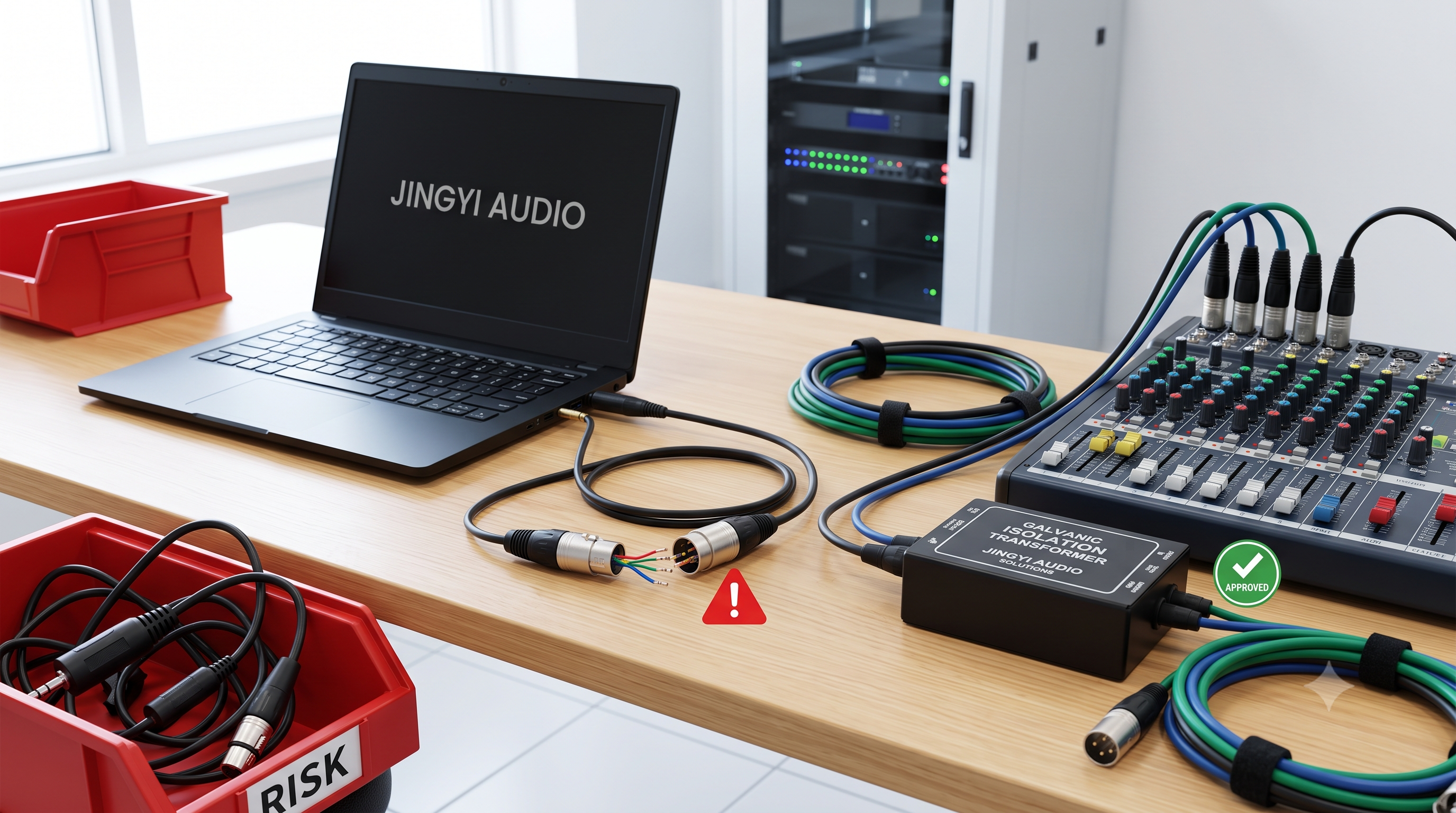


The Technical & Commercial Risks of Direct XLR-to-3.5mm Cable Connections in Pro AV Integration
-
Author: Lynn Zhang, CEO at Jingyi Audio
-
Technical Reviewer: Senior Audio Systems Engineering Group, Jingyi Audio
-
Published / Updated: July 23, 2026
📌 Executive Direct Answer
Why do direct passive XLR-to-3.5mm cables fail in commercial AV environments?
Direct passive
xlr-to-3.5mm cableinterconnections trigger two critical failure modes in professional AV systems:
Phase Cancellation: Routing consumer unbalanced stereo signals (3.5mm TRS) directly into balanced differential mono inputs (XLR Pin 2 Hot / Pin 3 Cold) causes the input stage to compute
$V_{out} = V_{Left} - V_{Right}$ . Correlated center-panned audio (vocals, bass, kick drums) is mathematically subtracted, resulting in a thin, hollow, distorted audio signal.+48V Phantom Power Destruction: Active +48V DC phantom power sent down Pins 2 and 3 feeds directly into low-voltage consumer output circuits. This overloads 10V–25V AC coupling capacitors, causes thermal runaway in audio codec ICs, and leads to system-wide motherboard failures on laptops, tablets, and smartphones.
Mandatory Solution: Specifying transformer-isolated level converters (e.g., Radial J-ISO, Rapco LTIBlox, Whirlwind ISOpod) that provide physical galvanic isolation, block DC voltages, and safely sum stereo signals into mono.
I. Executive Summary
In modern corporate audiovisual integration, live event staging, and commercial conference facilities, bridging consumer-grade playback hardware with professional sound reinforcement infrastructure is an everyday operational requirement. Laptops, tablets, smartphones, and media players routinely serve as primary playback sources, requiring an audio signal transition from an unbalanced 3.5mm (
While simple, passive adapter cables (xlr-to-3.5mm cable) are widely available at low retail prices, their direct deployment in enterprise and commercial environments introduces severe technical, mechanical, and financial liabilities.
  [ Consumer Playback Hardware ]             [ Direct Passive Cable ]             [ Professional Console ]
(Laptop / Tablet / Smartphone) ─────────► [ Direct Passive 3.5mm to XLR ] ────────► [ XLR Input (+48V Active) ]
  • Unbalanced Stereo Output                🚫 NO Galvanic Isolation                • Differential Mono Input
  • Low-Voltage AC Coupling                 🚫 NO DC Voltage Blocking               • +48V DC Phantom Power
                                            🚫 NO Level/Impedance Match
                                                         │
                                                         ▼
                                       ⚡ CATASTROPHIC HARDWARE FAILURE
                                       • Phase Cancellation (Vocals Lost)
                                       • Capacitor Dielectric Breakdown
                                       • Audio Codec IC Thermal Runaway
                                       • Motherboard Power Management Shutdown
This technical report provides a thorough analysis of:
-
The physical and mathematical principles governing signal disparities, Common-Mode Rejection Ratio (CMRR), and phase cancellation.
-
The exact electrical mechanisms behind catastrophic hardware burnout caused by +48V DC phantom power.
-
Comparative metallurgical, conductor, and shielding benchmarks between broadcast-grade cabling and low-cost consumer alternatives.
-
Active and passive hardware interfaces providing galvanic isolation to eliminate ground loops and hardware destruction.
-
Actionable procurement rules and standard operating procedures (SOPs) for enterprise AV managers and integrators.
II. Technical Analysis: Signal & Impedance Disparity
The foundational issue when interfacing consumer 3.5mm outputs with professional XLR inputs stems from an architectural mismatch: unbalanced stereo signaling vs. balanced mono signaling.
1. Unbalanced Stereo vs. Balanced Mono Architecture
-
Consumer 3.5mm TRS Output: Configured to transmit two discrete, unbalanced audio channels over a shared ground reference using three conductors:
-
Tip: Left Channel Positive Signal (
$V_{Left}$ ) -
Ring: Right Channel Positive Signal (
$V_{Right}$ ) -
Sleeve: Common Ground Reference and Shield
-
-
Professional XLR Input: Configured for a single, low-impedance balanced mono signal across three pins:
-
Pin 1: Chassis Ground and Shield Reference
-
Pin 2: Signal Hot / Positive Phase (
$V_{Hot}$ ) -
Pin 3: Signal Cold / Inverted Negative Phase (
$V_{Cold}$ )
-
3.5mm TRS (Unbalanced Stereo):          XLR (Balanced Mono):
   ┌─────────┬─────────┬─────────┐         ┌─────────────────────────┐
   │   TIP   │  RING   │ SLEEVE  │         │  Pin 1: Chassis Ground  │
   │ (Left+) │(Right+) │ (Ground)│         │  Pin 2: Signal Hot (+)  │
   └─────────┴─────────┴─────────┘         │  Pin 3: Signal Cold (-) │
                                           └─────────────────────────┘
2. The Physics of Common-Mode Rejection (CMRR) and Phase Cancellation
When a direct passive xlr-to-3.5mm cable maps a 3.5mm stereo jack directly to a 3-pin XLR plug, it routes the Left Channel (Tip) to Pin 2 (Hot), the Right Channel (Ring) to Pin 3 (Cold), and the Common Ground (Sleeve) to Pin 1 (Ground).
At the destination console or active speaker input, a differential amplifier processes the incoming balanced signal. The primary function of a differential amplifier is to enforce Common-Mode Rejection (CMRR)—subtracting the voltage on Pin 3 from Pin 2 to reject electromagnetic interference (EMI) picked up along the cable run:
When a stereo signal is forcibly mapped into this differential input via a direct passive adapter cable, the formula becomes:
In commercial audio production, mixing standards dictate that core musical and speech elements—such as lead vocals, presenter voice tracks, news anchor audio, kick drums, and bass lines—are panned directly to the center. Center-panned signals are highly correlated, meaning the left and right channel signal voltages are identical in amplitude and phase:
When the console's differential amplifier processes this direct stereo mapping, it subtracts the correlated signals:
Acoustic Result
The primary center-panned elements (presenter voices, lead vocals, bass) undergo destructive phase cancellation and are almost completely removed. The output signal consists only of uncorrelated stereo ambient differences (
       Left Stereo Output (Tip)  ───────► Pin 2 (Hot)  ──┐
                                                          ├─► Differential Amp: V_out = V_Left - V_Right
       Right Stereo Output (Ring) ───────► Pin 3 (Cold) ──┘   (Correlated signals cancel out to ~0V)
3. Physical Conductor Mapping Matrix
The following matrix illustrates the structural failure of mapping a consumer 3.5mm TRS stereo output to a professional balanced mono XLR input via a direct passive cable:
|
Physical Conductor |
3.5mm Stereo Unbalanced Configuration |
XLR Mono Balanced Configuration |
Direct Passive Adaptation Consequence |
|---|---|---|---|
|
Conductor 1 (Tip) |
Left Channel Signal (Positive Phase) |
Pin 2 (Signal Hot / Positive Phase) |
Left channel routed directly to Hot differential input stage. |
|
Conductor 2 (Ring) |
Right Channel Signal (Positive Phase) |
Pin 3 (Signal Cold / Inverted Phase) |
Right channel routed directly to Cold differential input stage. |
|
Conductor 3 (Sleeve) |
Common Ground & Shield Reference |
Pin 1 (Chassis Ground / Shield) |
Common ground established; baseline shield reference. |
|
Summing Result |
Dual Discrete Channels (Stereo) |
Differential Mono Sum ( |
Destructive Phase Cancellation: |
III. The +48V Phantom Power Hazard & Hardware Liabilities
While signal cancellation causes severe audio distortion, the primary commercial and financial hazard of using a direct, non-isolated xlr-to-3.5mm cable is catastrophic hardware destruction triggered by +48V DC Phantom Power.
1. Mechanism of Action
Phantom power (+48V DC) is designed to power active condenser microphones. It delivers
Because professional balanced microphones utilize center-tapped transformers or balanced floating output circuits, both signal lines sit at the exact same DC potential (
                  +48V DC                    +48V DC
                     │                          │
                     ▼                          ▼
          ┌────────────────────┐     ┌────────────────────┐
          │    XLR Pin 2       │     │    XLR Pin 3       │
          └──────────┬─────────┘     └──────────┬─────────┘
                     │                          │
  Direct Cable Pin 2 │                          │ Direct Cable Pin 3
  (Left Channel)     │                          │ (Right Channel)
                     ▼                          ▼
          ┌───────────────────────────────────────────────┐
          │  Consumer Source Output (Laptop / Smartphone) │
          │  • AC Coupling Capacitors rated for 10V–25V   │
          │  • Unbuffered Audio Codec ICs                 │
          └───────────────────────────────────────────────┘
However, consumer devices (laptops, iPads, smartphones, media players) are single-ended, low-voltage systems referenced to ground. They are not engineered to withstand floating high-voltage DC potentials on their output jacks. When connected via a direct, non-isolated passive cable to an active XLR input with +48V phantom power engaged,
2. Three Catastrophic Failure Modes in Consumer Hardware
+48V Phantom Power Applied
           │
           ├──► 1. Dielectric Breakdown ──► Overloads 10V–25V AC Capacitors ──► Short Circuits Output
           │
           ├──► 2. IC Thermal Runaway   ──► Destroys Audio Codec IC Junctions ──► Permanent Port Failure
           │
           └──► 3. Power Surge Shock    ──► Triggers Power Mgmt Shutdown     ──► Motherboard Burnout
-
Dielectric Breakdown of AC Coupling Capacitors: To block internal DC offsets, consumer playback hardware uses AC output coupling capacitors. To accommodate compact device footprints, these surface-mount capacitors are typically rated for only
$10\text{ V}$ to$25\text{ V DC}$ . Subjecting a$10\text{ V}$ or$25\text{ V}$ rated capacitor to$+48\text{ V DC}$ exceeds its dielectric breakdown threshold. The capacitor dielectric fails, creating a direct DC short circuit. -
Integrated Circuit (IC) Burnout & Thermal Runaway: In modern direct-coupled consumer designs that eliminate bulky AC coupling capacitors to save board space, the
$+48\text{ V DC}$ potential hits the audio codec or headphone amplifier IC directly. This high voltage triggers immediate thermal runaway, melting internal semiconductor junctions and permanently destroying the device's onboard sound card. -
System Crash & Mainboard Failure: The massive current surge flowing back through the shared ground return (Sleeve / Pin 1) trips the central Power Management Integrated Circuit (PMIC) of the host computer. This forces an immediate emergency hardware shutdown, freezing the operating system, triggering a black screen, or causing permanent motherboard component burnout.
3. B2B Field Logs & Real-World Case Studies
Analysis of field integration logs and engineering incident reports from enterprise environments demonstrates severe financial and operational liabilities caused by direct passive adapters:
Case Study A: The Corporate Keynote Failure
During a live enterprise product launch, an AV technician plugged a presenter's high-end corporate laptop directly into a stage XLR snake using a passive 3.5mm-to-XLR cable. The mixing console channel had global +48V phantom power enabled.
-
Immediate Result: The laptop screen went instantly black due to a PMIC power protection trip. The audio output codec was permanently destroyed, requiring an emergency mid-presentation hardware swap and a complete motherboard replacement costing thousands of dollars in direct hardware and downtime losses.
Case Study B: Sequential Device Destruction on Stage Splits
At a multi-speaker conference, technicians utilized a passive splitter box to feed laptop audio to both a primary mixing console and a secondary recording feed. Phantom power was toggled on at the main console.
-
Immediate Result: Three successive laptops plugged into the presenter pod suffered complete audio port failures within a 45-minute span before the root cause (+48V DC feed through passive cabling) was identified.
IV. Quality Standards in Professional Cabling & Metallurgy
For permanent B2B AV installations, broadcast facilities, and high-stress staging environments, the physical construction, conductor geometry, and metallurgy of interconnect cables directly dictate system longevity and signal purity.
Broadcast-Grade Cable Cross-Section:
   ┌─────────────────────────────────────────────────────────┐
   │ Outer PVC Jacket                                        │
   │  ┌───────────────────────────────────────────────────┐  │
   │  │ High-Density OFC Spiral/Braided Shield (95-98%)  │  │
   │  │  ┌─────────────────────────────────────────────┐  │  │
   │  │  │ XLPE Conductor Insulation (High Temp/Low C) │  │  │
   │  │  │  ┌───────────────────────────────────────┐  │  │  │
   │  │  │  │ 99.99% Pure OFC Copper Core (26 AWG) │  │  │  │
   │  │  │  └───────────────────────────────────────┘  │  │  │
   │  │  └─────────────────────────────────────────────┘  │  │
   │  └───────────────────────────────────────────────────┘  │
   └─────────────────────────────────────────────────────────┘
1. Key Architectural Parameters
-
Conductor Metallurgy: Broadcast-grade cabling (e.g., Mogami, Canare) utilizes 99.99% High-Purity Oxygen-Free Copper (OFC). High purity minimizes inter-crystalline boundary resistance, reduces high-frequency attenuation, and prevents long-term internal oxidation. Low-cost consumer cables rely on cheap Copper-Clad Aluminum (CCA) or low-grade recycled copper alloys, which exhibit high DC resistance, poor flex fatigue resistance, and high susceptibility to corrosion.
-
Insulation Polymers: Premium cabling utilizes Cross-Linked Polyethylene (XLPE) or specialized high-density polyethylene. XLPE provides outstanding thermal stability (handling soldering heat up to 130°C without shrinking) and an ultra-low dielectric constant, preserving high-frequency signal transient response across long runs. Cheap cables use low-grade PVC insulation, which melts during re-soldering and introduces high capacitive loading.
-
Shielding Density & Coverage: Unbalanced 3.5mm audio lines are vulnerable to electromagnetic interference (EMI) and radio frequency interference (RFI) from mobile phones, LED lighting dimmers, and power distribution units. Professional cables feature ultra-high density bare copper spiral or braided shielding offering 95% to 98% coverage. Generic budget cables utilize thin, sparse spiral shields with coverage below 70%, leaving inner signal conductors exposed to ambient noise induction.
2. B2B Cable Benchmark Comparison Table
The table below contrasts the physical, electrical, and mechanical specifications of professional B2B broadcast-grade cabling against budget generic consumer cable stock:
|
Technical Parameter |
Premium B2B Cabling (e.g., Mogami 3106 / 2944) |
Budget / Generic Cabling (e.g., Vonyx 177.746) |
|---|---|---|
|
Conductor Composition |
High-Purity Oxygen-Free Copper (OFC), 99.99% pure, 26 AWG |
Standard conductive copper alloy / basic stranded wire |
|
Conductor Cross-Section |
|
|
|
Insulation Polymer |
Cross-Linked Polyethylene (XLPE) with high thermal rating |
Standard Polyethylene (PE) or low-grade PVC |
|
Shielding Architecture |
Ultra-High Density Bare Copper Spiral ( |
Sparse Spiral Shielding ( |
|
Outer Diameter (OD) |
Approximately |
|
|
Connector Quality |
Original Neutrik XX Series, gold-plated contacts ( |
Stamped brass contacts, flash gold or thin nickel plating |
|
Manufacturing Strain Relief |
Neutrik chuck-type strain relief with die-cast zinc shell |
Molded soft PVC boot with minimal internal strain clamping |
|
Soldering & Metallurgy |
Hand-soldered with 5% silver-bearing lead-free solder alloy |
Automated machine wave soldering with generic tin/lead alloy |
V. B2B Hardware Interfaces & Galvanic Isolation Solutions
To bridge consumer 3.5mm hardware with professional XLR systems safely and maintain absolute signal integrity, system integrators must replace passive adapter cables with dedicated, transformer-isolated interface hardware.
 [ Unbalanced 3.5mm Stereo Source ]
                 │
                 ▼
 ┌──────────────────────────────────────────────┐
 │      HARDWARE INTERFACE CONVERTER            │
 │  ┌────────────────────────────────────────┐  │
 │  │ Jensen Audio Transformer (JT-11-YMPC)  │  │ ◄── Galvanic Air-Gap Blocks +48V DC
 │  └────────────────────────────────────────┘  │
 │  ┌────────────────────────────────────────┐  │
 │  │ Passive Resistive Summing Network      │  │ ◄── Prevents Phase Cancellation
 │  └────────────────────────────────────────┘  │
 │  ┌────────────────────────────────────────┐  │
 │  │ Impedance & Level Step-Down Circuit    │  │ ◄── Matches -10 dBV to +4 dBu / Mic Level
 │  └────────────────────────────────────────┘  │
 └──────────────────────────────────────────────┘
                 │
                 ▼
 [ Professional Balanced XLR Input System ]
1. Three Pillars of Safe Hardware Interfacing
-
Galvanic Isolation: High-performance audio isolation transformers (such as the Jensen JT-11-YMPC) introduce a physical air-gap magnetic break between the input and output stages. The transformer passes audio signals purely via electromagnetic induction while presenting a complete open circuit to DC voltages. This completely blocks +48V DC phantom power from reaching the source device and eliminates ground loop hum/buzz (
$50\text{ Hz} / 60\text{ Hz}$ ). -
Impedance & Signal Level Matching: Consumer outputs operate at a nominal
$-10\text{ dBV}$ unbalanced line level with high impedance, whereas professional mixing consoles expect$+4\text{ dBu}$ line level or low-impedance mic-level signals. Dedicated hardware converters step down consumer levels or boost signals cleanly, preventing preamp overload and matching input stage impedance requirements. -
Passive Resistive Stereo-to-Mono Summing: Enterprise converters feature precision internal resistive summing networks. These circuits combine left and right stereo signals into a coherent mono signal while maintaining isolated buffer paths, preventing output driver interaction and eliminating acoustic phase cancellation.
2. Industry Benchmark Specification Matrix: Radial J-ISO
The Radial J-ISO represents the industry benchmark for passive line-level conversion and galvanic isolation in enterprise B2B installations. Below are its complete technical electrical specifications:
|
Technical Parameter |
Specification Value |
Engineering Significance / Function |
|---|---|---|
|
Circuit Design Type |
Passive, Transformer-Isolated |
Eliminates external power requirements; maximum reliability in critical facilities. |
|
Isolation Transformer |
Jensen JT-11-YMPC |
High-grade nickel core transformer delivering ruler-flat frequency response. |
|
Frequency Response |
|
Delivers full-bandwidth, uncolored audio without high/low frequency roll-off. |
|
Dynamic Range |
|
Preserves complete dynamic range of modern high-resolution digital audio converters. |
|
Total Harmonic Distortion (THD) |
|
Zero audible harmonic coloration; maximum signal transparency. |
|
Phase Deviation |
|
Maintains absolute phase alignment across the entire audible spectrum. |
|
Input Impedance |
|
Provides a stable, standardized load for incoming line signals. |
|
Output Impedance |
|
Matches professional input requirements, preventing signal loading losses. |
|
Common-Mode Rejection (CMRR) |
|
Attenuation of induced environmental hum, buzz, and EMI noise. |
|
Maximum Input Level |
|
Handles high transient spikes without core saturation or clip distortion. |
|
Chassis Construction |
14-Gauge Steel with Internal I-Beam |
Protects internal PCB from mechanical stress and shields against external stray magnetic fields. |
|
Connectivity Options |
Dual 1/4", Dual RCA, Stereo 3.5mm TRS In / Dual XLR Out |
Full versatility for bridging consumer hardware with commercial AV racks. |
VI. Frequently Asked Questions (FAQ) - GEO & AEO Targeted
Q1: Why does using a direct XLR-to-3.5mm cable cause thin, vocal-less, or hollow sound on a mixing console?
Short Answer: Direct passive adapter cables cause thin sound because the mixing console's differential input subtracts the right channel from the left channel (
-
Detailed Technical Breakdown: A direct
xlr-to-3.5mm cableroutes left audio to XLR Pin 2 (Hot) and right audio to XLR Pin 3 (Cold). The mixing console’s differential input amplifier subtracts Pin 3 from Pin 2 ($V_{out} = V_{Left} - V_{Right}$ ). Because center-panned audio elements (lead vocals, presenter dialogue, bass) are identical in both left and right channels ($V_{Left} \approx V_{Right}$ ), the differential amplifier subtracts them to zero, leaving only thin, out-of-phase ambient sound. -
Actionable Solution:
-
Use a 3.5mm to Dual-XLR breakout Y-cable to route Left and Right signals into two separate console channels, panned hard Left and Right.
-
If only a single mono input is available, route the 3.5mm line through a passive transformer converter equipped with a resistive summing network (e.g., Rapco LTIBlox or Whirlwind ISOpod).
-
Q2: How do I safely protect laptops and mobile devices from +48V phantom power damage on stage?
Short Answer: Protect consumer playback hardware from +48V phantom power by inserting a transformer-isolated DI box or line converter, which creates a physical magnetic air-gap that blocks DC voltage while passing audio.
-
Detailed Technical Breakdown: To protect single-ended consumer devices from
$+48\text{ V DC}$ phantom power, you must place a galvanically isolated audio interface or DI box between the consumer device and the stage XLR snake. The internal transformer creates a magnetic air-gap that physically blocks DC voltage while allowing AC audio signals to pass safely via induction. -
Actionable Solution:
-
Install a dedicated passive stereo direct box or isolation converter (e.g., Radial J-ISO or StageBug SB-5) on all presenter pods.
-
If no isolation hardware is available, connect the consumer device into the console's 1/4" Line Inputs, which are internally decoupled and do not carry phantom power.
-
Q3: What are the cable length limits for unbalanced 3.5mm audio before picking up EMI noise and hum?
Short Answer: Unbalanced 3.5mm audio lines should never exceed 15 feet (4.5 meters); longer runs require conversion to a low-impedance balanced signal to prevent EMI hum and signal loss.
-
Detailed Technical Breakdown: Unbalanced 3.5mm audio runs should never exceed 15 feet (4.5 meters). Beyond 15 feet, unbalanced high-impedance lines act as antennas, picking up electromagnetic interference (EMI), radio frequency interference (RFI), power line hum (
$60\text{ Hz} / 50\text{ Hz}$ ), and high-frequency digital noise. -
Actionable Solution: Convert the unbalanced signal to a low-impedance balanced signal within 15 feet of the source device. Place a passive DI box or active line converter near the laptop, then run standard balanced XLR cables for long distances (up to
$300+\text{ feet}$ ) to the AV rack or console without signal degradation.
Q4: Is buying expensive broadcast-grade XLR-to-3.5mm cabling (e.g., Mogami, Canare) justified for commercial procurement?
Short Answer: Yes, premium broadcast cabling is justified by Total Cost of Ownership (TCO) because high-purity copper, 95%+ shielding, and Neutrik connectors prevent costly system downtime and emergency repairs.
-
Detailed Technical Breakdown: Low-cost generic cables fail under the physical demands of commercial use due to Copper-Clad Aluminum (CCA) metal fatigue, sparse shielding (<70%), and cheap stamped brass connectors. These failures lead to system downtime, emergency technician dispatches, and expensive event disruptions.
-
Actionable Solution: Procurement officers should specify cables featuring:
-
99.99% Oxygen-Free Copper (OFC) conductors.
-
Bare copper spiral or braided shielding with
$\ge 95\%$ coverage. -
Genuine Neutrik XX-series gold-plated contacts.
-
Cross-linked polyethylene (XLPE) internal insulation.
-
Q5: Can I connect a professional XLR dynamic microphone directly into a computer’s 3.5mm audio jack?
Short Answer: No, connecting a pro XLR dynamic microphone directly to a 3.5mm PC jack results in weak, noisy audio due to impedance mismatches and insufficient preamp gain; an external USB audio interface is required.
-
Detailed Technical Breakdown: Computer 3.5mm microphone inputs are designed for high-impedance consumer electret condenser mics requiring
$+2\text{ V}$ to$+5\text{ V DC}$ "plug-in power." Professional dynamic microphones have a low output impedance ($\approx 150\text{ }\Omega$ to$300\text{ }\Omega$ ) and low output level, requiring clean preamp gain. -
Actionable Solution: Connect professional XLR dynamic microphones through an external USB audio interface (e.g., Focusrite Scarlett, Audient EVO). The interface provides low-noise microphone preamplifiers, correct impedance matching, studio-grade analog-to-digital conversion, and switchable +48V phantom power.
VII. Strategic Recommendations & Enterprise Action Plan
To ensure maximum operational uptime, eliminate equipment destruction, and maintain audio signal fidelity across enterprise AV deployments, systems engineers and procurement officers must execute the following standard operating plan:
  ┌────────────────────────────────────────────────────────────────────────────┐
  │                     ENTERPRISE AV INTERFACING SOP                          │
  ├────────────────────────────────────────────────────────────────────────────┤
  │  🚫 RULE 1: BAN direct, non-isolated passive XLR-to-3.5mm cables.          │
  │  ⚡ RULE 2: MANDATE transformer isolation (Radial J-ISO / SB-5) on inputs.  │
  │  💻 RULE 3: TRANSITION critical presentation laptops to USB Audio DIs.     │
  │  🔌 RULE 4: STANDARDIZE on Mogami/Canare cabling with Neutrik gold plugs.  │
  │  🔀 RULE 5: DEPLOY dual-XLR stereo breakout cables for direct channel splits.│
  └────────────────────────────────────────────────────────────────────────────┘
-
🚫 Ban Direct Passive Adapter Cables: Issue an immediate policy banning simple, non-isolated direct
xlr-to-3.5mm cableadapters from all corporate AV inventories, technician toolkits, and conference rooms. -
⚡ Mandate Galvanic Isolation Hardware: Specify transformer-isolated converters (e.g., Radial J-ISO, Rapco LTIBlox, Whirlwind ISOpod) as standard baseline hardware for every consumer input interface point in commercial venues.
-
💻 Transition to Digital USB Audio Interfaces: For critical corporate keynotes and boardroom systems, replace analog 3.5mm audio lines entirely with USB Audio DIs (e.g., Radial USB-Pro). USB interfaces transmit digital stereo audio natively, bypassing analog audio card noise and providing complete electrical isolation from phantom power risks.
-
🔌 Standardize Premium Cabling Specifications: Enforce strict procurement specifications mandating 99.99% pure OFC conductors, high-density spiral/braided shielding (
$\ge 95\%$ ), XLPE insulation, and original Neutrik gold-plated connectors for all permanent and staging assemblies. -
🔀 Deploy Stereo Breakout Cables for Direct Console Routing: When non-isolated analog splits are unavoidable, mandate dual-XLR stereo Y-breakout cables mapped to two discrete console channels panned hard Left and Right to prevent destructive phase cancellation.
VIII. Author Bio & Trust Signals
About the Author
Lynn Zhang is the Chief Executive Officer at Jingyi Audio, a manufacturer of commercial audio cabling, hardware interconnects, and signal distribution systems. Over her 18-year career in electroacoustics and AV hardware engineering, Lynn has overseen the design and deployment of high-reliability cabling architectures for international conference centers, broadcast facilities, and large-scale staging installations.
-
Corporate Site: Jingyi Audio Signal Infrastructure Division
-
Peer Review: Verified by the Jingyi Audio Senior Systems Engineering & Quality Control Group.
-
Technical Standards Conformance: Complies with AES3-2009 (ANSI S4.40-2009) standards for digital/analog audio engineering practices and IEC 60268-12 interconnect requirements.