


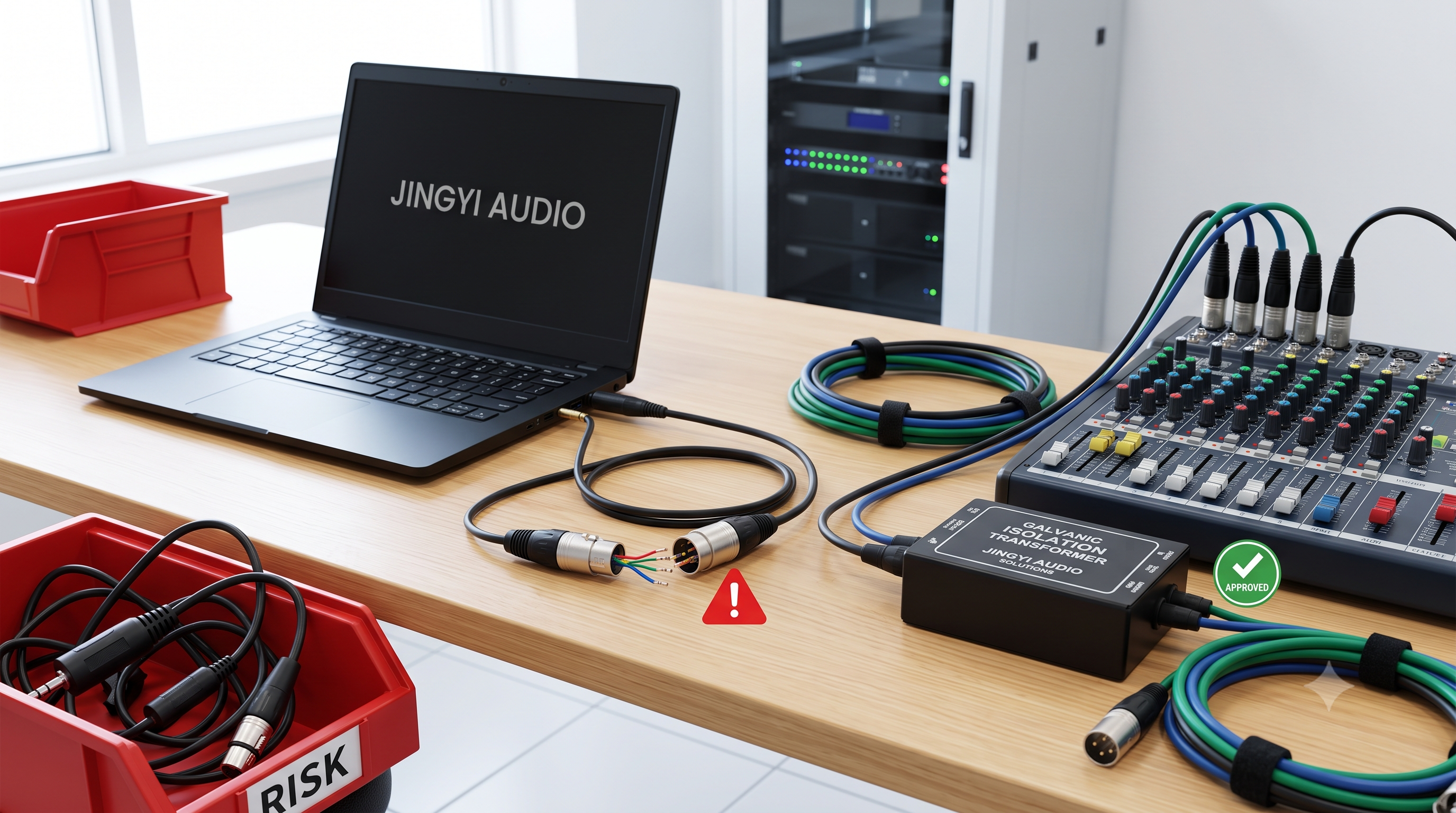
What Is XLR Input? The Complete 2026 Guide to How It Works, Why It Still Matters, and Where It Fits in Professional Audio
Short answer:
An XLR input is a professional connector input built to receive a balanced signal, usually through a 3-pin XLR connection. It is widely used for microphones, mixers, preamps, audio interfaces, stageboxes, broadcast systems, lighting control gear, and other pro AV equipment because it offers strong noise rejection, secure locking, and dependable performance over long cable runs.
A lot of people think of XLR as just “the mic plug.” That is part of the story, but not the whole story. The reason XLR has stayed relevant for so long is that it solves a real signal problem. It helps move fragile audio from one device to another without letting the surrounding electrical mess ruin it.
Last updated: March 26, 2026
Author: Lynn Zhang, CEO at Jingyi Audio
Technical review: Jingyi Audio Engineering Team
Author Note
This article is written by Lynn Zhang, CEO at Jingyi Audio, from the point of view of a manufacturer working with professional connectors, audio cables, and stage support products. It is built for buyers, engineers, system integrators, creators, and audio professionals who want a serious answer to a very common question.
This page is also structured for strong search visibility and better answer extraction. Google’s current documentation says AI features do not need a separate special format beyond strong core SEO, crawlable content, clear structure, and helpful information written for people first. Google also notes that Article structured data can help it understand titles, dates, authors, and page content more clearly.
What Is an XLR Input?
Short answer:
An XLR input is a connector input designed to accept a signal through an XLR connector, most often a 3-pin locking connector used in professional audio.
That simple definition is accurate, but it leaves out what makes XLR important.
An XLR input is part of a larger professional signal standard. It includes:
-
a fixed pin layout
-
balanced signal transmission
-
a shield or ground path
-
a locking connector shell
-
cross-brand physical compatibility
-
the ability to carry low-level signals with far less noise than many unbalanced connections
That is why XLR inputs are found on:
-
microphones
-
audio interfaces
-
microphone preamps
-
mixing consoles
-
stageboxes
-
broadcast equipment
-
stage lighting systems
-
some medical video systems
-
some industrial AV systems
Even in 2026, with AoIP, digital stageboxes, wireless systems, optical links, and more USB-based creator gear on the market, the XLR input is still the foundation at the point where sound enters the system.
Where Did the XLR Connector Come From?
Short answer:
The XLR connector came from the Cannon Electric connector family and grew into the standard professional connector for balanced audio and related signal uses.
Its history goes back to the 1950s, when James H. Cannon, founder of Cannon Electric Company in Los Angeles, developed the original connector line. The design began with the Cannon X series. Later, a locking latch was added, creating the XL series. After that, Cannon added a resilient neoprene rubber compound around the female contacts, which led to the XLR version.
Over time, the connector moved beyond military and high-stress equipment use and became a core part of professional audio systems. It spread into:
-
recording studios
-
live sound
-
broadcast environments
-
stage lighting
-
AV systems
-
some industrial and medical applications
Many people later described XLR as “external line return.” Whether people use that phrase or not, the real point is that XLR became the standard because it worked well in tough real-world conditions.
Why Does XLR Still Matter in 2026?
Short answer:
XLR still matters because digital systems have grown, but the need for a reliable, low-noise, physical input for real-world audio sources has not gone away.
Modern production systems now rely on:
-
Audio-over-IP
-
Dante
-
AES50
-
AES/EBU
-
wireless audio systems
-
optical transfers
-
USB workflows
-
digital routing at scale
Still, microphones, DI boxes, and many source devices begin in the analog world. That means there must be a dependable way to carry those signals cleanly into the wider system.
That is where XLR stays useful. It remains the physical bridge between the acoustic world and the electronic world.
The connector’s continued use is not about habit. It is about a mix of:
-
strong mechanical construction
-
balanced signal handling
-
cross-brand compatibility
-
dependable long-run performance
-
field reliability when systems get complicated
The physical compatibility of XLR connectors continues to be governed by IEC 61076-2-103, which standardizes dimensions and related requirements so connectors from different manufacturers can fit and work together properly.
What Is the Standard 3-Pin XLR Pinout?
Short answer:
A standard 3-pin XLR connection uses Pin 1 for ground/shield, Pin 2 for hot, and Pin 3 for cold.
The common industry pinout is:
| Pin | Designation | Signal Phase | Main Job |
|---|---|---|---|
| Pin 1 | Ground / Shield | None | Carries shield connection and gives noise a path away from the signal conductors |
| Pin 2 | Positive / Hot | 0° | Carries the main non-inverted audio signal |
| Pin 3 | Negative / Cold | 180° inverted | Carries an inverted copy of the audio signal |
The accepted convention in professional audio is pin-2 hot.
This layout is one of the reasons XLR works so well in balanced audio systems.
How Does an XLR Input Work?
Short answer:
An XLR input works by receiving a balanced signal on two signal conductors plus a shield, then using the difference between the two signal lines to cancel shared noise.
To understand that, it helps to compare balanced and unbalanced audio.
Unbalanced audio
An unbalanced line, such as a TS instrument cable or an RCA cable, usually has:
-
one conductor carrying the signal
-
one conductor or shield acting as the return path and ground reference
This is simple, but it is much more open to:
-
electromagnetic interference
-
radio-frequency interference
-
noise pickup from power systems
-
degradation over long cable runs
Any noise picked up by the cable tends to get mixed into the signal itself.
Balanced audio
A balanced XLR line uses three conductors:
-
one for the hot signal
-
one for the cold inverted signal
-
one for the shield or ground
The source device sends two versions of the same audio:
-
the normal signal on Pin 2
-
the inverted signal on Pin 3
As those conductors travel together through the cable, surrounding interference tends to affect both in the same way.
At the receiving XLR input, the device uses a differential amplifier to compare the two signal lines. Because one line is inverted, the desired audio lines up when processed, while the shared noise cancels out.
That is the real strength of XLR.
What Is Common-Mode Rejection?
Short answer:
Common-mode rejection is the process that lets an XLR input cancel noise picked up equally by both signal conductors.
This is the core engineering reason XLR has stayed so useful.
Let the wanted signal be S and the unwanted noise be N.
The hot line carries:
S + N
The cold line carries:
-S + N
At the receiving XLR input, the differential stage subtracts the cold line from the hot line:
Output = (S + N) - (-S + N)
That becomes:
Output = S + N + S - N
So the result is:
Output = 2S
The noise term drops out.
That means the signal remains while the shared interference is removed. This is why XLR can carry weak microphone signals over long distances, often hundreds of feet in live touring environments, with much better noise performance than unbalanced lines.
Why Are the Conductors Twisted Inside an XLR Cable?
Short answer:
The conductors are twisted so both signal lines are exposed to outside interference in a very similar way, which helps the receiving input cancel that noise more cleanly.
Inside a proper XLR cable, the hot and cold conductors are tightly twisted together. This matters because the cable is moving through an environment full of electrical activity.
That might include:
-
power mains
-
lighting dimmers
-
wireless transmitters
-
industrial machinery
-
LED wall systems
-
RF-heavy production spaces
If both conductors pick up the same noise in the same phase, the differential amplifier has a much better chance of canceling it fully.
So yes, the cable acts a bit like an antenna. But the twisted pair design makes the noise shared rather than random, and that is what allows balanced audio to work so well.
What Is the Pin 1 Problem?
Short answer:
The Pin 1 Problem is a grounding design mistake where the cable shield connection is routed incorrectly inside the equipment, which can cause hum, buzz, RF noise, and grounding trouble.
Balanced audio is not magic. It still depends on good implementation inside the equipment.
The accepted best practice is that Pin 1 should bond directly to the metal chassis at the point where the connector enters the device, not wander through sensitive internal signal paths first. AES terminology guidance describes the correct practice in exactly that spirit: bond Pin 1 to chassis immediately at entry and exit, not to signal ground.
Why the Pin 1 Problem matters
If shield-borne noise is allowed into internal audio circuitry, you can get:
-
hum
-
buzz
-
radio pickup
-
unstable interference
-
apparent ground loops
The report also points to AES48 as the important engineering solution here. The point of that approach is simple: shunt shield noise straight to chassis so it does not contaminate the internal audio path.
This matters even more in electrically ugly places, such as venues with:
-
neon signs
-
thyristor-based dimmers
-
lots of RF traffic
-
poorly managed grounding
A connector may look balanced from the outside. That does not mean the gear behind it is implemented well.
Why Is XLR Better Than Many Consumer Audio Connectors?
Short answer:
XLR is better for professional work because it combines noise rejection, locking security, durability, and standardization.
Here is why that matters in practice.
1. Better noise resistance
Balanced XLR lines handle hostile electrical environments much better than many unbalanced alternatives.
That matters in places with:
-
power distribution systems
-
dimmers
-
LED walls
-
wireless microphone systems
-
broadcast electronics
-
long multicore runs
-
stage power and lighting near audio cabling
2. Secure locking
The XLR shell includes a latch that locks the connector in place. That helps stop accidental disconnection caused by:
-
cable pulling
-
performers moving
-
stage foot traffic
-
rushed setup and teardown
-
tight equipment racks
3. Better durability
XLR connectors are designed for repeated use. In pro audio, connectors are plugged and unplugged over and over again. That is normal. XLR was built for that kind of life.
4. Cross-brand compatibility
Because the connector family follows recognized international standards, products from different brands can still work together physically. That is a huge help in multi-vendor systems and rental inventories.
What Materials Make a Good XLR Cable in 2026?
Short answer:
A good XLR cable in 2026 usually depends on high-purity conductors, strong shielding, good connector plating, and reliable strain relief.
The report makes it clear that the XLR format itself is mature. The changes now are happening in materials and build quality.
Oxygen-Free Copper (OFC)
Premium manufacturers increasingly use 99.99% oxygen-free copper (OFC) for the signal conductors.
Why does that matter?
Because better copper can help with:
-
lower resistance
-
more stable long-run conductivity
-
less oxidation over time
-
more dependable performance in pro inventory use
This matters in:
-
fixed installs
-
broadcast rooms
-
premium studio wiring
-
touring systems
-
better creator setups
-
pro AV builds that need long service life
The report treats this as a 2026 baseline for better cable performance, not just a luxury talking point.
What Shielding Design Is Best for XLR in 2026?
Short answer:
For many critical applications in 2026, hybrid shielding that combines foil and braid is the best overall option.
The reason is simple. Audio spaces are now crowded with both low-frequency and high-frequency interference.
The report compares three shielding styles:
| Shielding Type | Frequency Coverage | Physical Traits | Best Use Case in 2026 |
|---|---|---|---|
| Aluminum foil | Very strong high-frequency coverage, close to full coverage | Rigid, more likely to crack with repeated flexing | Permanent installs, internal rack wiring |
| Copper braid | Good for low-frequency hum, flexible and durable | Coverage is often around 70–95% | General live stage use, mobile work |
| Hybrid foil + braid | Broad coverage across low and high interference ranges | Better balance of coverage and real-world use | Broadcast, industrial AV, high-RF spaces, premium touring |
The report’s position is clear: single-layer shielding is often no longer enough for the most demanding work in 2026.
That is because many modern venues now include:
-
large RF-heavy wireless systems
-
LED video walls
-
complex power grids
-
dense digital equipment
-
mixed analog and digital signal infrastructure
For those conditions, hybrid shielding gives broader protection.
What Makes a High-Quality XLR Connector?
Short answer:
A high-quality XLR connector is one that holds up mechanically, maintains clean contact over time, and protects the cable termination under stress.
A good connector is not just a metal shell with pins. The report points to several practical quality factors:
-
tight manufacturing tolerances
-
stable contact pressure
-
smooth latch operation
-
oxidation-resistant plating
-
strong shell construction
-
dependable strain relief
-
long service life under repeated mating cycles
Gold-plated and chrome-plated contacts
The report notes that premium connectors often use gold-plated or chrome-plated contacts.
Gold matters because it resists tarnishing and oxidation. In real use, that helps the connector keep low contact resistance over many mating cycles.
Strain relief systems
Modern premium connectors often use chuck-type strain relief. That system grips the cable jacket and transfers pull force into the connector body instead of the solder points. This can prevent failure in live use where cables get bent, yanked, and moved a lot.
Premium connector brands named in the report
-
Neutrik
-
Switchcraft
-
Cardas Audio
-
Oyaide
These names come up because connector quality still matters a lot in pro systems.
How Are XLR Inputs Used by Podcasters, Streamers, and Content Creators?
Short answer:
Creators use XLR inputs because they want more consistent sound, less noise, and a better upgrade path than basic 3.5 mm or entry-level consumer mics often provide.
The report points to a strong shift in the creator market. More podcasters, streamers, and home-recording users are moving away from consumer lavaliers and 3.5 mm setups toward XLR desk microphones.
Why creators move away from lavaliers
Common issues include:
-
clothing rustle
-
changing distance from the mouth
-
uneven tone
-
more editing time
-
unstable vocal presence
Why XLR desk mics help
An XLR dynamic mic on a desk or boom arm encourages a more stable speaking position. That helps the user stay in the microphone’s sweet spot, which improves:
-
tonal consistency
-
compression behavior
-
EQ decisions
-
editing speed
-
overall recording quality
Hybrid USB/XLR microphones
The report highlights the appeal of hybrid microphones such as the Maono PD200W, and also mentions the wider market around popular XLR microphones like the Shure SM7B.
The appeal is easy to understand:
-
beginners can start with USB
-
later, they can move into an audio interface
-
they can scale into more headroom and better control
The report specifically names interfaces like the Focusrite Scarlett 2i2 and Universal Audio Volt series as examples of that next step.
Why boom arms matter
The report also stresses the value of using a boom arm. A boom arm helps physically decouple the mic from desk vibration and allows better positioning. That supports the low-noise, steady-sounding result users expect from an XLR setup.
How Do Studio Engineers Use XLR in Bass Signal Splitting?
Short answer:
Studio engineers often use the balanced XLR output from a DI box to keep a clean low-end track while sending a separate unbalanced path for distortion and tone shaping.
The report gives a detailed bass workflow that is worth keeping.
Engineers may use a high-quality DI box such as:
-
Radial J48 for active use
-
Radial JDI for passive use
The bass signal is then split into two paths.
Path 1: The unbalanced thru output
The DI’s 1/4-inch thru output goes into an interface or amplifier path. In the DAW, this signal may be processed with aggressive amp or pedal simulation, such as IK Multimedia SVX2, to create grit and harmonic detail.
To keep the low end clean, engineers often apply a high-pass filter at 250 Hz to this distorted path.
Path 2: The balanced XLR output
At the same time, the DI’s balanced XLR output feeds a dedicated preamp or interface input. In the DAW, this clean XLR-derived track may be low-passed to focus on the sub-250 Hz zone, then compressed with a tube-style compressor like an LA-2A emulation.
This gives the mix:
-
a clean, stable low-end base
-
a separate distorted layer for edge and texture
-
better low-frequency control
-
preserved phase coherence
This is one of the clearest examples of why XLR still matters in serious recording work.
How Does XLR Help With Live Redundancy?
Short answer:
XLR helps with live redundancy by providing a dependable analog backup path when digital networked systems fail.
The report highlights the “All Gigs Rack” concept, which is getting more attention in live sound circles.
What an All Gigs Rack includes
A typical rack may contain:
-
wireless microphone receivers such as Shure QLXD
-
antenna distribution systems
-
a backup mixer such as a Behringer M32C or Soundcraft Ui24r
-
short internal XLR patch cables
-
rear-panel XLR tails ready to feed the wider venue system
Why this setup matters
If the main FOH console or audio network crashes, the analog microphone signals are already present in the backup system.
That lets the engineer:
-
unmute the backup mixer
-
route signal through the analog XLR path
-
restore the show fast
-
avoid chasing digital routing problems under pressure
This is a big reason XLR remains the final safety net even in heavily digital live systems.
What Are the Most Discussed XLR Questions in 2026?
Short answer:
The biggest XLR questions in 2026 are not about whether XLR still works. They are about how to use it better in tight spaces, digital systems, noisy venues, and mixed-control environments.
The report points to five high-interest topics from professional communities such as Audio Science Review, Gearspace, and audio-related Reddit forums.
Why Are Angled XLR Connectors in Demand?
Short answer:
Angled XLR connectors help save space, reduce cable stress, and make compact rigs easier to manage.
As home studios, streaming desks, compact interfaces, and mobile rigs get tighter, standard straight XLR plugs can become awkward.
Problems include:
-
wasted desk space
-
blocked screens and meters
-
strain on front-panel connectors
-
extra leverage if the cable gets bumped
The report strongly points to rotatable right-angle XLR connectors, especially the Neutrik NC3MRX and related female models, as a good answer.
These connectors let the user choose the cable exit angle before tightening the body, so the cable can route:
-
upward
-
downward
-
left or right
-
neatly behind gear
For custom studio builds, professionals often solder bulk OFC cable to these connectors themselves so length and routing are exact.
Should DJs Use Analog XLR Outputs or Stay Digital?
Short answer:
In many premium DJ setups, staying digital for the main path is better when the wider sound system is already digital, while analog XLR can remain the backup path.
The report uses the Pioneer DJM-A9 as an example.
The issue
If the mixer creates a digital mix internally, then sends it out through analog XLR, and that analog signal then gets converted back into digital by the venue system, the chain adds:
-
D/A conversion at the mixer output
-
A/D conversion at the system input
That can add:
-
measurable latency
-
slight phase loss
-
more clipping risk if the analog output is overdriven
The preferred approach
The report recommends using the mixer’s digital S/PDIF output as the main path instead of the analog master XLR output.
Because S/PDIF is a 75-ohm unbalanced consumer digital format and professional AES/EBU expects a 110-ohm balanced XLR digital connection, a proper conversion device is needed.
The report names these examples:
-
Neutrik NADITBNC-F
-
Hosa CDL-313
That allows the main path to stay digital, while the analog XLR output stays available as a backup.
Why Can a Shure SM58 Sound Buzzy Through a Digital Stagebox?
Short answer:
A buzzy SM58 through a digital stagebox can be caused by harmonic ground noise, venue electromagnetic fields, or a damaged XLR cable that has lost proper balanced operation.
The report gives a very specific example here:
-
microphone: Shure SM58
-
stagebox: Allen & Heath AB168
Why the noise gets misunderstood
Many people hear buzz and assume it is just ordinary 60 Hz mains hum.
The report explains that the noise can actually come from:
-
higher harmonics of ground-related noise
-
sharper interference components
-
external electromagnetic fields
Hearing-assist loop interference
A newer venue problem in 2026 involves copper hearing-assist loops in upgraded ADA-compliant spaces. These systems can create magnetic fields strong enough to interfere with dynamic microphones.
Broken conductor problem
If the issue happens on only certain channels, the report says a broken conductor inside the XLR cable is a likely cause.
If the hot or cold conductor fails:
-
the line loses proper differential operation
-
common-mode rejection drops out
-
the cable behaves more like an unbalanced antenna
-
buzz and RF contamination get worse
The correct fix
-
use a dedicated cable tester
-
check continuity on all three pins
-
repair or discard bad cables
-
verify correct Pin 1 chassis grounding
-
isolate the issue by channel and location
Do Magnetic Materials in XLR Connectors Cause Audible Distortion?
Short answer:
For normal line-level XLR interconnects, magnetic materials inside the connector hardware are not a meaningful source of audible distortion.
The report addresses a concern raised in analytical audiophile circles about steel retaining tabs and other magnetic parts in TRS-to-XLR adapters or line-level interconnects.
The key point is current.
The report compares:
-
high-power amplifier output testing, where currents can exceed 1 amp
-
a typical line-level XLR connection from a DAC to a preamp, where a signal around 1 volt into a 10 kΩ input works out to roughly 100 microamperes
At that tiny current level, the magnetic field is effectively so small that any distortion effect is far below practical audibility and below the noise floor of serious measurement systems.
So for line-level XLR use, this is not a real-world concern.
Can You Use a 3-Pin Audio XLR Cable for DMX Lighting?
Short answer:
No. Even if the connector fits, a standard audio XLR cable is not the correct cable for DMX lighting data.
This confusion happens because the plugs can look similar.
The official DMX512-A ecosystem is associated with 5-pin XLR, but many lower-cost and prosumer lighting fixtures use 3-pin XLR-style connectors instead.
That leads users to think a mic cable will work.
Why that is a bad idea
DMX is a digital serial data system. It does not behave like analog microphone audio.
The report explains that standard audio cable often has:
-
characteristic impedance around 45–75 ohms
-
higher capacitance than proper DMX cable
DMX expects cable behavior around 120 ohms, and the system also relies on a terminating resistor at the end of the line, usually across pins 2 and 3, to stop reflections.
Industry standards and control-cable guidance continue to reflect those requirements for stable DMX transmission.
What can go wrong if you use audio cable for DMX
-
packet corruption
-
signal reflections
-
random strobing
-
erratic pan or tilt movement
-
sync loss
-
failures that get worse over longer runs
Best practice
Keep separate stock for:
-
analog microphone/audio XLR cables
-
proper 120-ohm DMX cables
Matching connector shape does not mean the cable is suitable.
What Is the Difference Between 3-Pin and 5-Pin XLR?
Short answer:
In audio, 3-pin XLR is standard. In DMX lighting control, the formal standard is tied to 5-pin XLR, even though many lower-cost fixtures use 3-pin connectors in practice.
The main point is that pin count alone does not tell the whole story. The bigger issue is signal type and electrical design.
In audio, the XLR connection is handling balanced analog signal transmission.
In DMX, the cable is part of a digital control system with different impedance, capacitance, and termination needs.
That is why professionals keep audio and lighting cable systems separate.
Which Industries Use XLR Inputs Besides Audio?
Short answer:
XLR inputs and XLR-style connectors are used far beyond microphones and recording gear.
The report makes it clear that in 2026, XLR shows up in:
-
professional audio
-
broadcast video support systems
-
stage lighting control
-
medical video equipment in limited cases
-
industrial AV products
-
OEM and ODM manufacturing applications
The reason is not fashion. It is because the connector is standardized, physically durable, and useful in environments where signal integrity matters.
How Does Manufacturing Support the XLR Market in 2026?
Short answer:
Modern XLR demand depends on manufacturers that can deliver cleaner materials, stronger connectors, tighter tolerances, and scalable custom production.
The report makes a strong point here. XLR is not just a connector topic. It is also a supply chain and manufacturing topic.
Users now expect:
-
lower-noise cable builds
-
hybrid shielding
-
better latch behavior
-
more durable shells
-
right-angle connector options
-
exact custom assemblies
-
high-volume consistency
-
private-label flexibility
That kind of demand needs serious OEM and ODM capacity.
Jingyi Audio as a Manufacturing Example
Short answer:
Jingyi Audio is used in the report as an example of how the pro-audio manufacturing sector is meeting modern XLR requirements at scale.
According to Jingyi’s public company information, Ningbo Jingyi Electronics Corporation was founded in 1992, operates near Ningbo Port, covers roughly 15,000 square meters, and employs more than 120 full-time staff. Jingyi also states that it opened a Thailand factory in 2024 to expand production capacity and improve supply resilience.
Why the Thailand expansion matters
The report frames this as a practical move to reduce supply-chain risk and support steady international delivery.
A dual manufacturing setup can help with:
-
logistics flexibility
-
better continuity for global buyers
-
reduced concentration risk
-
stronger export support
-
more stable fulfillment for just-in-time supply models
Jingyi’s Thailand facility materials also describe production processes tied to extrusion, shielding-related steps, soldering, testing, and final packaging.
What Does Jingyi Audio Make?
Short answer:
The report divides Jingyi’s core production into connectors, audio cables, and stage support products.
1. Precision connectors
This includes:
-
XLR connectors
-
6.3 mm audio jacks
-
RCA connectors
-
Speakon
-
PowerCon
The report says Jingyi uses automated die-casting and robotic assembly, along with a proprietary XLR contact structure and a smooth-latch mechanism intended to reduce jamming and wear.
2. High-fidelity audio cables
The report describes cable production based on:
-
99.99% OFC conductors
-
ultra-low-noise shielding
-
premade mic cables
-
heavy-duty instrument cables
-
speaker cables
-
multi-channel snakes
-
angled XLR cable variants
-
dedicated 120-ohm DMX cables
It also says the materials meet RoHS and REACH requirements.
3. Structural support products
The report states that Jingyi entered the stand business in 1996, making:
-
microphone stands
-
lighting stands
-
adjustable instrument stands
One specific model named is the MC001 microphone stand with secure rubber hand-locks.
What Is Jingyi Audio’s Market Position?
Short answer:
The report presents Jingyi as a competitive OEM/ODM supplier with scale, customization ability, and pricing advantages for B2B buyers.
It specifically mentions:
-
pricing estimated at 10% to 15% lower than similar imported brands
-
customization for cable boots, connector shapes, and sheath printing
-
support for white-label and private-brand projects
-
client feedback from Germany, the UK, and the US
-
reported 100% inspection pass rate for bulk orders
-
strong signal transmission stability
The report also includes order and production details:
-
MOQ of 3,000 meters for bulk cable, or 30 rolls of 100 meters
-
MOQ of 500 units for irregular precision connectors
-
standard lead time of 35 to 40 days
It also notes the launch of Jingyi’s in-house brand ZZYZX in 2023, presented as a sign of confidence in internal design and product development.
Will XLR Inputs Become Obsolete?
Short answer:
No, not anytime soon. XLR is very unlikely to disappear in the foreseeable future because the problem it solves still exists.
Microphones still produce analog signals. DI boxes still need to hand off instrument signals cleanly. Live systems still need a physical fallback path. Broadcast and installed systems still need dependable, low-noise interconnects.
What is changing is not the need for XLR. What is changing is how the format gets refined.
The report’s final direction is very clear:
-
better conductor purity
-
stronger shielding
-
tighter connector tolerances
-
more durable latch systems
-
better strain relief
-
smarter space-saving connector designs
-
cleaner analog and digital integration
-
more resilient global manufacturing
So the future of XLR is not replacement. It is better execution.
Final Answer: What Is XLR Input, Really?
Short answer:
An XLR input is the professional standard for bringing balanced signals into an audio or AV system with less noise, more security, and better reliability than simpler connection types.
A more complete answer is this:
An XLR input is not just a place to plug in a microphone. It is part of a signal standard built around:
-
balanced transmission
-
common-mode rejection
-
shield management
-
strong connector retention
-
field durability
-
long-run reliability
-
broad compatibility across equipment and brands
That is why it still matters in 2026.
You see it in:
-
podcast desks
-
streaming rigs
-
studio bass DI workflows
-
touring backup racks
-
digital DJ systems
-
live troubleshooting work
-
DMX cable discussions
-
OEM connector factories
-
global pro-audio supply chains
So when someone asks, “What is XLR input?”, the best honest answer is simple:
It is still the most trusted way to move fragile real-world signals into a professional system cleanly and securely.
FAQ
What is an XLR input used for?
Short answer:
An XLR input is used to receive balanced audio or related professional signals from microphones, DI boxes, mixers, stageboxes, and other pro AV gear.
In everyday use, XLR inputs are most common for microphones, but they also appear on preamps, interfaces, mixers, powered speakers, lighting gear, and some broadcast systems. The reason they are used so often is that they handle low-level signals cleanly and hold up well under professional use.
Is XLR better than USB?
Short answer:
For pure flexibility and professional signal handling, XLR is usually better. For simplicity, USB is easier.
USB microphones are convenient because they connect directly to a computer. XLR microphones, on the other hand, usually need an interface or mixer. But XLR gives you better upgrade options, stronger signal-chain control, easier integration with professional gear, and more reliable long-run use in studio and live environments.
Why does XLR sound cleaner than 3.5 mm?
Short answer:
XLR often sounds cleaner because it usually carries balanced audio, which rejects noise much better than many 3.5 mm connections.
A typical 3.5 mm setup is often unbalanced and more open to interference, especially over longer runs. XLR uses hot and cold signal conductors plus a shield, so shared noise can be canceled at the receiving input. That is a big reason it stays cleaner in real-world setups.
Can I use any XLR cable for DMX lighting?
Short answer:
No. A microphone XLR cable and a DMX cable may look similar, but they are not the same.
DMX is digital control data and needs cable with the right impedance and termination behavior. Standard audio XLR cable is not built for that job. Using the wrong cable can cause packet errors, reflections, random fixture behavior, and sync trouble.
Do I need an audio interface for an XLR microphone?
Short answer:
Usually yes, unless the microphone also supports USB.
Most standard XLR microphones need an audio interface, mixer, or recorder with an XLR input and suitable gain. Hybrid USB/XLR microphones can work directly over USB at first, then move into a dedicated XLR setup later. That is why they are popular with newer creators who want room to grow.