


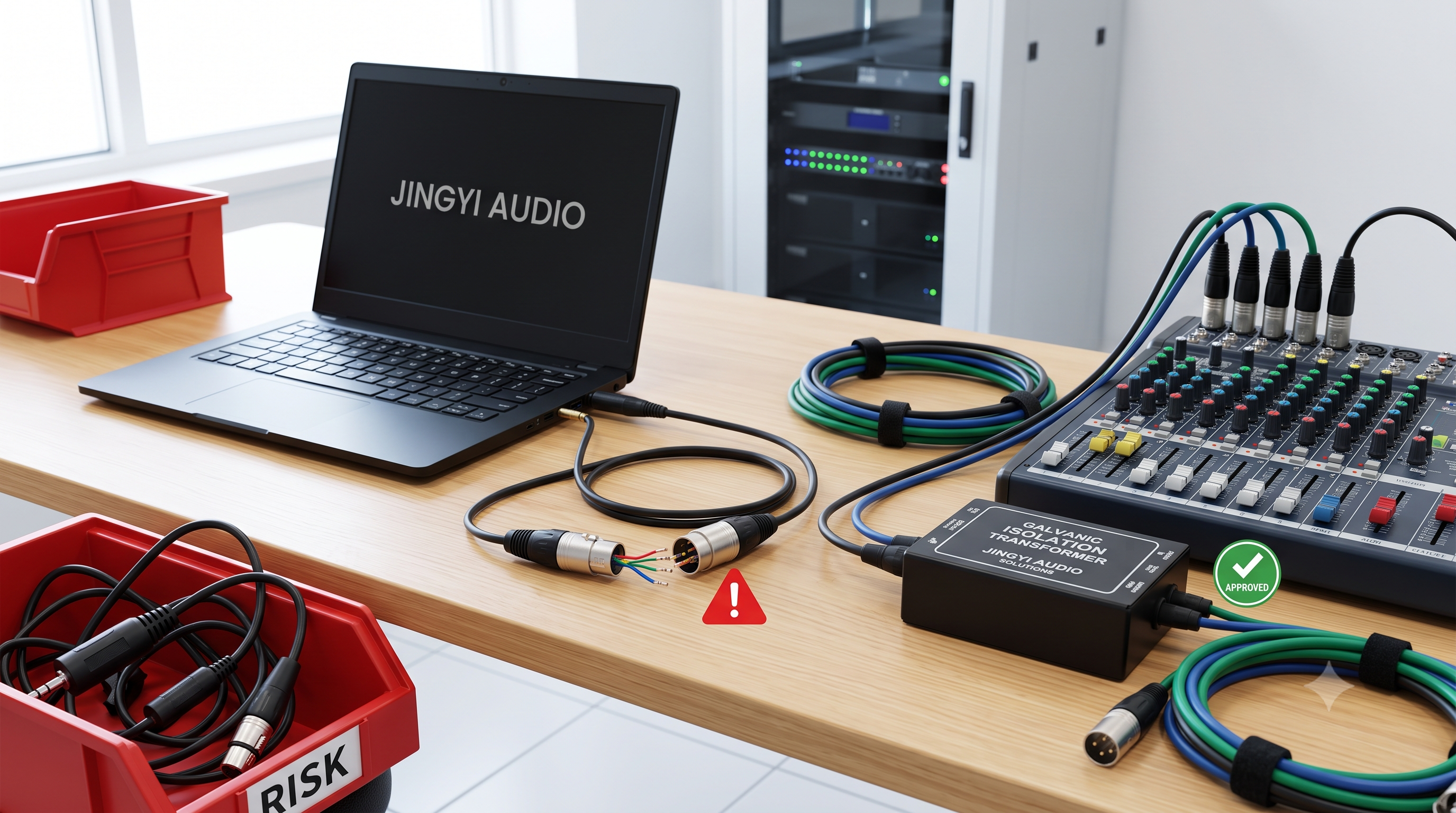


XLR Output on Stage: TRS to XLR Cable or DI for Live Performance?
Author: Lynn Zhang, CEO at Jingyi Audio
If you’re sending an audio interface to a live mixer, the safest answer is simple: a direct TRS-to-XLR or XLR-to-XLR connection can work, but a DI box is often the safer option on stage. For audio cable OEM/ODM customers, the real issue is not just the plug type. It is about signal level, balanced transmission, grounding, phantom-power risk, and how predictable the venue setup is.
Introduction
When people talk about XLR output in live audio, they often focus too much on the connector and not enough on the signal behind it. That is where many stage problems begin. On a real show, what matters is whether the output from the audio interface is balanced, whether it is line level or mic level, and whether the mixer or stage box on the other end is ready to accept that signal properly.
This matters a lot for audio cable OEM/ODM buyers. A customer may ask for “XLR output cables,” but that request usually hides a bigger need. They may be trying to solve a live-performance problem such as long cable runs, noisy power, unclear FOH input specs, or a fast stage change with no time to troubleshoot.
According to Focusrite’s Scarlett hardware guide, common interface outputs are line outputs, and balanced TRS outputs can feed equipment with XLR inputs when the wiring is correct. Sweetwater’s guide to signal levels also explains a point that many users miss: the connector type does not tell you the signal level. An XLR connector may carry mic level or line level, depending on the gear. So just because the plug fits does not mean the setup is ideal.
For OEM/ODM cable suppliers, this is where better product planning helps. A stage customer asking for “XLR output cables” may actually need one of these:
-
Balanced TRS to XLRM interconnects
-
XLRF to TRS balanced adapter leads for DI use
-
Multi-channel fanout snakes for playback rigs
-
Labeled cable sets for FOH handoff
-
Cable assemblies built for use with DI boxes and stage boxes
That is why this topic matters. It is not only about audio theory. It is about helping buyers choose cable solutions that work in the field.
Direct Answer: Interface on Stage. TRS to XLR Cable or Passive/Active DI
The direct answer is this:
Use a direct TRS-to-XLR or XLR-to-XLR connection when you know the mixer or stage box can handle a balanced line-level signal without trouble. Use a DI box when you want better compatibility, cleaner handoff to FOH, less hum, safer gain staging, and more protection against stage mistakes.
So yes, direct connection often works. But on stage, DI is usually the safer choice.
This matches what real users and live engineers say. Recent Reddit discussions around stage playback and live-sound setups show a clear pattern. Some users say they regularly run balanced outputs from interfaces such as MOTU units straight into live systems with no issue, especially on newer digital desks with enough gain range or a pad. At the same time, experienced engineers still suggest stereo DI or multi-channel DI solutions when the venue is unknown, the cable run is long, or the setup has a lot of variables.
From personal experience, this is the point that matters most: something can be technically correct and still be the wrong choice for a fast live setup. If a DI box makes the signal easier for FOH to deal with, lowers the chance of hum, and protects an expensive interface, it often makes sense even if a direct feed might also pass audio.
Why people get confused
Three different ideas get mixed together all the time:
-
Connector type — XLR, TRS, TS, RCA
-
Signal format — balanced or unbalanced
-
Signal level — mic level, instrument level, consumer line level, professional line level
Sweetwater’s signal-level guide explains this well. Professional line level is usually +4 dBu, which is much hotter than mic-level signal. That matters because most audio interfaces send line-level output, even when the output is balanced and even when the user later adapts it to XLR.
What “XLR Output” Really Means in a Live Audio Interface Setup
When users say they want an interface with “XLR output,” they usually mean one of two things:
-
They want a physical XLR connector on the interface
-
They want a balanced output that can connect well to a live mixer
Those are not always the same thing.
Many audio interfaces use balanced 1/4-inch TRS line outputs instead of native XLR output sockets. But those outputs can still be used with an XLR-based live sound system by using properly wired TRS-to-XLR balanced cables. Focusrite’s documentation is useful here because it clearly identifies Scarlett outputs as line outputs, while also showing that balanced outputs can connect to professional gear.
For OEM/ODM customers, this matters in product planning. A buyer asking for “XLR output cable assemblies” may really need:
-
TRS to XLRM balanced cables for interface outputs
-
Low-capacitance shielded cable for long runs
-
Channel-numbered fanouts for playback systems
-
Color-coded identification sleeves
-
Strong strain relief for repeated live use
That is a more useful conversation than focusing only on whether the connector is XLR.
FAQ 1: The mixer I have has two XLR outputs so would I still need a DI box?
Short answer: No, not always. But in many live situations, a DI box is still the safer and more flexible choice.
Just because a mixer or audio interface has XLR outputs does not mean the signal is already in the best format for every venue. The output may still be line level, while the receiving stage box or mixer input may still be set up around a mic-input workflow.
In a recent Reddit discussion about connecting to a house PA, an experienced live engineer suggested taking the mixer’s left and right outputs into a stereo DI before handing them to FOH, even though the mixer already had balanced outputs. The reason was practical: better isolation, easier compatibility with different systems, and fewer surprises when the venue setup is not fully known.
Why a DI can still help even when XLR outputs are already present
A DI box can still make life easier because it adds:
-
Better handling for FOH mic-input workflows
-
Isolation between the source and the PA system
-
Ground-lift options for hum problems
-
A more standard stage handoff
-
Better protection in messy live environments
Radial’s explanation of what a DI does is helpful here. A DI is used to create a balanced, low-impedance mic-level signal that works well for long cable runs and console inputs. That is one reason DI boxes still show up all the time on stage, even when the source device is already balanced.
What this means for OEM/ODM cable buyers
If your customers are keyboard players, playback performers, DJs, churches, touring acts, or rental companies, the better product strategy is not just “sell XLR cables.” It is to build cable solutions around real use cases.
| Use case | Recommended product focus |
|---|---|
| Interface to modern digital mixer | Balanced TRS-to-XLRM cable |
| Interface to unknown venue PA | Balanced cable plus stereo DI workflow |
| Submixer to FOH | XLR loom with DI-friendly setup |
| Playback rig with 4–8 outputs | Numbered fanout snake with stage labels |
| Touring application | Strong jacket, clear channel ID, durable strain relief |
FAQ 2: Is it okay if I plug the line level XLR outputs directly into the mixer since it’s balanced although line level?
Short answer: Yes, often you can. But it is not the best choice in every setup.
Balanced connection helps reject noise over longer cable runs, but it does not fix signal-level mismatch by itself. A balanced line-level signal can still be too hot for a mic input if the receiving channel has limited headroom or no pad.
This is where Sweetwater’s explanation of +4 dBu professional line level helps. Line-level outputs from an interface can hit a mixer input much harder than a mic-level source would. That is why some direct connections work fine, while others create gain-staging trouble.
Recent live-sound discussions on Reddit show this clearly. Some users report direct connection from balanced line-level XLR outputs into mixer or stage-box inputs with no problem, especially with newer digital desks. Others point out that older or simpler analog mixers can be much less forgiving, especially if the XLR path is really meant for mic input only.
When direct balanced connection usually works
Direct connection is more likely to work well when:
-
The console is a modern digital mixer
-
The channel has a pad or broad gain range
-
The mixer can handle line-level input properly
-
The stage power is clean
-
The engineer knows what signal is being sent
-
The venue setup is controlled and predictable
When direct connection is more risky
It becomes more risky when:
-
The mixer is older or basic
-
The XLR path is mainly for mic input
-
There is no pad available
-
You do not know how the stage box is configured
-
The venue is rushed and poorly documented
-
There are already hum or grounding issues
From a practical live-sound point of view, direct connection can absolutely be the right call. But if the goal is a setup that works across many venues with fewer surprises, a DI often gives a better safety margin.
FAQ 3: If I have to use D.I. boxes, is it okay to use XLR female to 1/4" TRS male balanced to plug into D.I. and then connect the mic level output XLR from the D.I. into mixer/stage box? Will it cause any trouble with the signal?
Short answer: Yes. If the cable is wired correctly and the signal stays balanced, this is a valid setup and usually does not cause signal problems.
This question often comes up when the audio interface has XLR outputs but the DI box takes a 1/4-inch input. In that case, an XLR female to 1/4-inch TRS male balanced cable can feed the DI input, and then the DI’s XLR output can feed the mixer or stage box.
In the Reddit cases covered earlier, this kind of setup was treated as technically fine. The main concerns were not about the method itself. They were about cable quality, correct balanced wiring, and keeping the signal path organized when several outputs are involved.
Radial’s ProAV1 product page also helps explain why this setup works. It shows that DI boxes are built to accept line-level or source-device outputs and then provide a transformer-isolated XLR output to the PA system. That means the signal path is designed for this kind of handoff.
What matters most in this setup
The signal path is usually fine if these points are true:
-
The source output is balanced
-
The XLRF-to-TRS cable is wired correctly
-
The DI input can accept the source level
-
The DI output goes to the console as intended
-
Gain staging is checked during soundcheck
For audio cable OEM/ODM buyers, this opens up a good product opportunity. Instead of selling generic adapter cables, you can build purpose-made solutions such as:
-
Balanced XLRF-to-TRS leads for DI use
-
Short patch cables for rack-mounted playback systems
-
Custom-labeled stereo pairs
-
Multi-channel breakout sets for 4/8-output interfaces
-
Touring versions and install versions with different jacket styles
FAQ 4: Do I need to be worried about a FOH or Monitor guy accidentally running phantom power to my outputs if I skip a DI and run TRS->XLR?
Short answer: Yes. This is a real risk, and it is one of the best reasons to use a DI box or another isolated handoff on stage.
Phantom power is not a mystery, but people often apply the wrong rule to the wrong device. Shure’s phantom power explanation says phantom power is usually applied equally to pins 2 and 3 of a balanced XLR line, which is why many balanced microphones can handle it safely. But that does not mean every interface output or every adapter chain should be trusted to receive it.
That is the important difference.
In a Reddit discussion about possible phantom-power damage to interface outputs, several commenters warned that skipping DI isolation can expose expensive equipment to avoidable risk if phantom is sent down the line by mistake. The discussion also included examples of non-microphone outputs being damaged in stage situations. The bigger lesson is simple: on stage, human error is part of the environment.
A practical rule for phantom-power risk
| Situation | Risk level | Better choice |
|---|---|---|
| Known line input, no phantom on path | Lower | Direct may be okay |
| Unknown stage box or rushed setup | Medium to high | Use DI or isolation |
| Improvised setup with several adapters | High | Use DI or isolation |
| Expensive interface output feeding FOH | Avoidable risk | Use DI or isolation |
Why experienced stage engineers still carry DIs
Even when direct balanced output works most of the time, a DI still makes sense because it can:
-
Block many common live-stage variables
-
Give FOH a more familiar feed
-
Reduce hum troubleshooting
-
Lower the chance of damage from phantom-power mistakes
-
Make playback and interface rigs easier to advance with venues
That is why experienced engineers often do not ask only, “Will audio pass?” They ask, “Which method is less likely to fail when the schedule is tight?”
Real-World Stage Experience: What Reddit Cases Suggest
Across the recent and commonly referenced Reddit cases, the pattern is very clear.
First, direct balanced output often works on modern systems. Users with well-designed interfaces and newer digital mixers often report no serious issue sending balanced outputs straight into live inputs.
Second, DI boxes are still the preferred all-purpose stage handoff. Live engineers often suggest stereo DI or multi-channel DI solutions when a signal is being handed off to a venue system that the performer does not control.
Third, phantom power and grounding are the real pain points, not just whether the signal can pass. The deeper concern is not simply “Will I get audio?” It is “Will this hum?” and “Could this damage the interface?”
For audio cable OEM/ODM customers, this matters because the market does not only need cables. It needs application-based connection solutions. That includes better labeling, better channel identification, better shielding, and cable assemblies designed around actual stage workflow.
Best-Practice Recommendations for Audio Cable OEM/ODM Customers
If your buyers serve live-performance users, your product strategy should follow real stage scenarios rather than just connector categories.
1. Balanced interface-to-stage interconnects
These are useful when the customer knows the mixer can accept the line-level signal correctly.
Recommended features:
-
Good balanced cable structure
-
Strong shielding
-
Low handling noise
-
Reliable connector options
-
Custom lengths for stage use
2. DI-friendly patch and adapter leads
These fit users who send interface outputs into DI boxes before FOH handoff.
Recommended features:
-
XLRF to TRS balanced wiring
-
Short rack-friendly lengths
-
Clear channel labels
-
Strong boots or molded strain protection
3. Playback rig fanouts and snakes
These are useful for churches, touring acts, theater, and corporate AV.
Recommended features:
-
4-channel or 8-channel fanout
-
Heat-shrink channel labels
-
Left / Right / Click / Cue / Tracks naming
-
Braided or stage-grade outer jacket
-
Connector spacing that is easy to service
4. Educational support content for buyers
Many B2B customers also need buying guidance. A related internal resource such as your balanced audio cable guide, custom XLR snake guide, or stage wiring solutions page can help customers choose faster and lower the chance of incorrect orders.
Key Takeaways
-
XLR output is not a full technical description by itself. The connector does not tell you whether the signal is mic level or line level.
-
Most audio interface outputs used for stage playback are line level, even when balanced.
-
Direct balanced connection into a mixer or stage box can work very well on many modern live systems.
-
A DI box is still the safer general choice when compatibility, isolation, grounding, and predictability matter.
-
Phantom power is not automatically dangerous to every balanced signal path, but it is not smart to assume every interface output chain is protected from stage mistakes.