


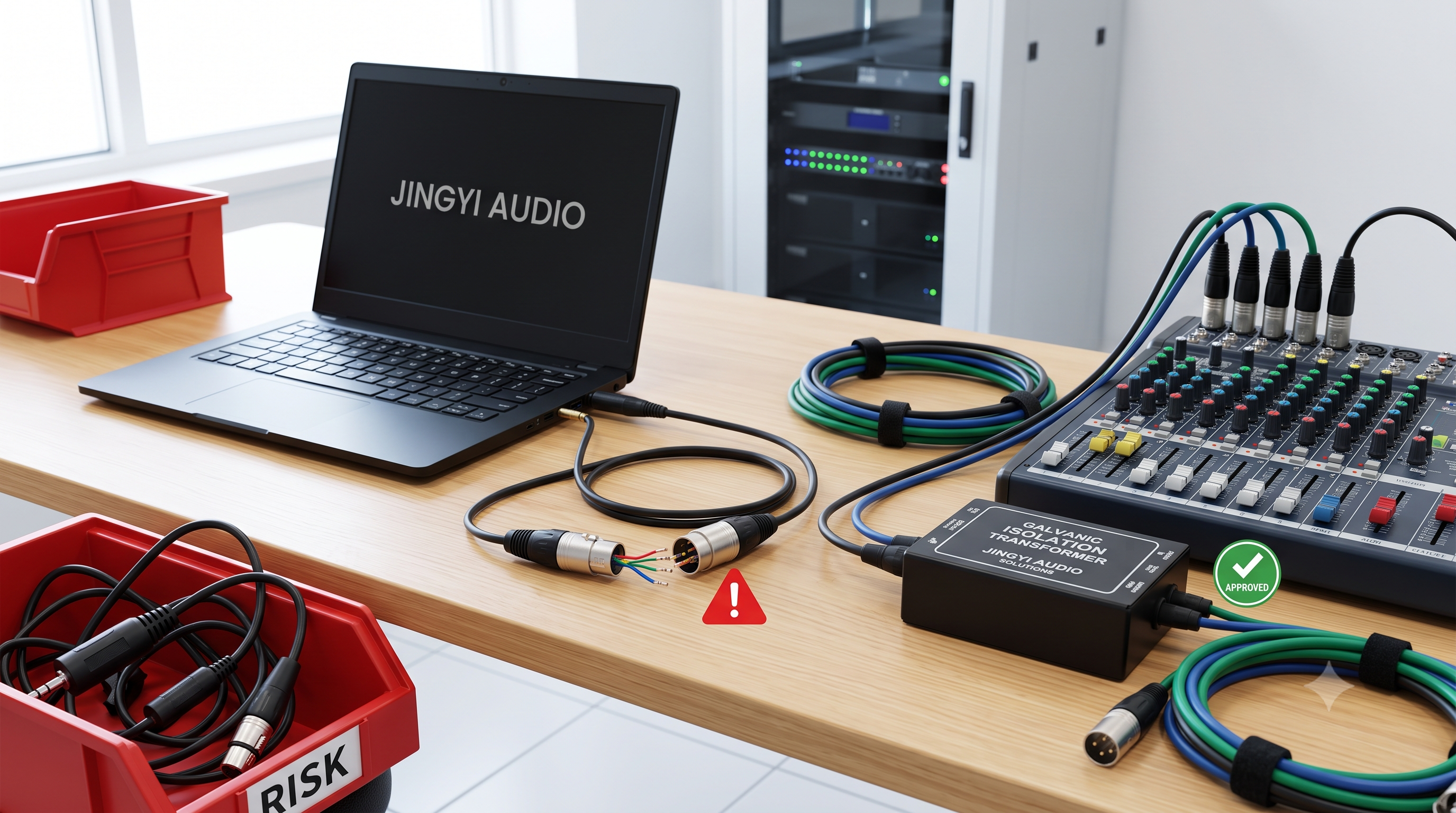


Bridging Consumer and Professional Audio Architectures: The Definitive B2B & Engineering Guide to 3.5mm to XLR Interconnects
Author: Lynn Zhang
Title: CEO, Jingyi Audio
Published: July 13, 2026
Category: Pro Audio Engineering & B2B Sourcing
Read Time: 18 mins
Executive Overview
The convergence of consumer-grade electronics and professional-grade audio equipment has birthed a rapidly expanding global market for highly specialized interface solutions. At the epicenter of this hardware synthesis is the 3.5mm to XLR audio interconnect—often colloquially sought after as a "3.5mm to xlr headphone cable."
Historically, the audio industry was strictly bifurcated:
-
Professional Audio Environments: Recording studios, broadcast television networks, theater systems, and live sound reinforcement relied exclusively on balanced XLR or
$1/4\text{-inch}$ TRS (Tip-Ring-Sleeve) connections. These standards were designed for long cable runs, robust mechanical locking, and superior rejection of electromagnetic interference. -
Consumer Devices: Smartphones, personal computers, DACs, and portable media players utilized the unbalanced
$3.5\text{mm}$ ($1/8\text{-inch}$ ) mini-jack, focusing on compact form factors and cost-efficiency over absolute signal integrity.
Over the past decade, however, the explosive growth of the creator economy, independent filmmaking, podcasting, and the ubiquity of hybrid live events has forced a total convergence of these two once-distinct hardware ecosystems.
This comprehensive guide, authored from a B2B procurement and electrical engineering perspective, provides an exhaustive analysis of the
1. The Global Market Landscape and B2B Sourcing Dynamics
The global market for audio interconnect cables is experiencing sustained and aggressive growth. Macroeconomic projections indicate that the broader audio cable industry will reach an estimated valuation of USD
Global Supply Chain and Manufacturing Hubs
The manufacturing epicenter for audio cables remains heavily concentrated in the Guangdong province of China, specifically within the highly integrated technology and hardware hubs of Shenzhen, Dongguan, and Guangzhou. This region features a highly stratified manufacturing ecosystem capable of serving an extraordinarily wide range of commercial needs, from ultra-low-cost generic requirements to high-end, audiophile-grade Original Equipment Manufacturer (OEM) and Original Design Manufacturer (ODM) specifications.
Key manufacturing entities, such as Dongguan Xieao Industrial Co., Ltd. and Shenzhen Jencent Electronics Technology Co., possess the capacity to supply millions of units globally on a monthly basis. They offer highly flexible Minimum Order Quantities (MOQs) that accommodate both boutique audio brands requiring custom-braided jackets and massive retail distributors requiring high-volume blister packaging. The average lead time for wholesale orders generally ranges from
B2B Pricing Matrices and Market Stratification
For procurement managers, matching the product to the deployment environment is critical. The market is broadly divided into three distinct pricing and material tiers:
|
Market Tier |
Wholesale Price Range (USD) |
Common MOQs |
Component Architecture |
Target Applications & Use Cases |
|---|---|---|---|---|
|
Commodity / Budget |
$0.10 - |
|
Bare copper wire, basic Polyvinyl Chloride (PVC) jackets, unbranded nickel-plated connectors. |
Budget consumer retail, bundled accessories for cheap electronics, and low-fidelity public address systems. |
|
Mid-Market / Prosumer |
$1.29 - |
|
Oxygen-Free Copper (OFC), gold-plated |
Podcasters, semi-professional videographers, home studio setups, and corporate presentation systems. |
|
Premium / Studio-Grade |
|
|
|
High-end recording studios, broadcast television, critical live sound reinforcement, and premium audiophile setups. |
2. Material Science Innovations and Componentry Trends
Modern high-density electronic environments are saturated with wireless signals that can severely compromise analog audio integrity. To combat this, B2B procurement managers and acoustic engineers must specify advanced materials during sourcing.
       TYPICAL HYBRID SHIELDING ARCHITECTURE
   [ Conductor Cores ] ---> [ 4N/6N OFC or Silver-Plated Copper ]
          |
          v
   [ Inner Shielding ] ---> [ Aluminum Foil (100% High-Freq RFI Coverage) ]
          |
          v
   [ Outer Shielding ] ---> [ Tinned Copper Braid (Low-Freq EMI Block) ]
          |
          v
   [ Outer Jacket ]    ---> [ Highly Flexible PVC or LSZH Halogen-Free ]
The Conductor Transformation
Standard electrolytic tough pitch (ETP) copper is rapidly being phased out of mid-market designs in favor of
In premium, audiophile-grade models, manufacturers adopt silver-plated copper cores. Silver possesses the highest electrical conductivity of any metal. Thanks to the "skin effect"—a physical phenomenon where high-frequency AC signals travel predominantly along the outer surface of a conductor rather than its core—silver plating ensures superior high-frequency signal integrity, reduced parasitic capacitance, and crystal-clear high-frequency transients.
Shielding Architecture Against Modern EMI/RFI
To block electromagnetic interference (EMI) and radio frequency interference (RFI) generated by ubiquitous smartphones, Wi-Fi
-
The inner aluminum foil layer provides
$100\%$ physical coverage, acting as an electrostatic barrier against high-frequency RFI. -
The outer tinned copper braid provides exceptional structural integrity, low DC resistance to ground, and reliable shielding against lower-frequency electromagnetic fields generated by power cables, lighting dimmers, and transformers.
Connector Durability and Strain Relief
Connector designs now focus heavily on field longevity. Gold-plated
3. Electrical Engineering Principles: Bridging the Consumer-Pro Audio Divide
The fundamental challenge inherent in a
        UNBALANCED STEREO (3.5mm TRS)
        Tip   [========== Left (+) ==========]
        Ring  [========= Right (+) ==========]
        Sleeve[============ Ground ==========]
                          VS.
        BALANCED MONO (XLR 3-PIN)
        Pin 2 [========== Hot (+) ===========]
        Pin 3 [========== Cold (-) ==========] (Phase Inverted 180 deg)
        Pin 1 [========== Ground ============]
The Physics of Balanced vs. Unbalanced Signal Architectures
The source of the most significant technical issues in the field is the structural difference between unbalanced and balanced signal paths.
-
The Unbalanced Stereo Interface (
$3.5\text{mm}$ TRS): A standard$3.5\text{mm}$ headphone output utilizes Tip (Left channel positive voltage), Ring (Right channel positive voltage), and Sleeve (shared Ground reference). The signal relies entirely on the voltage difference between the live wire and the ground. If EMI/RFI is introduced along the cable run, it is simply added to the audio signal and amplified by the destination equipment. -
The Balanced Mono Interface (XLR 3-Pin): XLR is designed for balanced, noise-canceling mono signal transmission over long distances. Pin 1 is the Chassis Ground, Pin 2 is the Positive (Hot) audio signal, and Pin 3 is the Negative (Cold) audio signal.
The source device transmits identical audio signals down both Pin 2 and Pin 3, but the phase of the signal on Pin 3 is inverted by exactly
$180^{\circ}$ . At the receiving end, a differential amplifier processes the signals by subtracting Pin 3 from Pin 2:$$S_{\text{out}} = S_{\text{Pin2}} - S_{\text{Pin3}}$$ Because the signal on Pin 3 was inverted (
$S_{\text{Pin3}} = -S_{\text{Pin2}}$ ), this subtraction reconstructs the original signal at double the amplitude:$$S_{\text{out}} = S_{\text{Pin2}} - (-S_{\text{Pin2}}) = 2S_{\text{Pin2}}$$ If any EMI or RFI noise (
$N$ ) is picked up along the cable, it affects both Pin 2 and Pin 3 equally and in-phase ($N_{\text{Pin2}} = N_{\text{Pin3}}$ ). When the differential amplifier performs its subtraction, the noise is canceled out:$$(S_{\text{Pin2}} + N) - (S_{\text{Pin3}} + N) = S_{\text{Pin2}} - S_{\text{Pin3}}$$ This rejection ratio is known as the Common Mode Rejection Ratio (CMRR). Attempting to force an unbalanced stereo signal from a consumer device directly into a balanced mono input via a standard passive adapter leads to severe phase cancellation.
Signal Mismatch and the Phase Cancellation Phenomenon
When a standard, passively wired
Because the console's XLR input expects a balanced signal, its input circuitry applies the standard differential calculation: Pin 2 minus Pin 3 (Left minus Right).
In a typical commercially mastered music track, the lead vocals, kick drum, and bass guitar are panned dead-center, meaning their waveforms are identical in both the Left and Right channels (
The center-panned elements completely cancel out. The listener will hear the wide-panned stereo backing vocals, reverbs, and double-tracked guitars, but the lead vocals and bass will completely disappear, resulting in a hollow, echoing, and unusable soundscape.
Operating Voltages: Mic-Level, Consumer Line-Level, and Professional Line-Level
Beyond signal balancing,
-
Consumer Line Level (
$-10\text{ dBV}$ ): Devices like smartphones and laptops output a nominal voltage of approximately$\approx 0.316\text{ V}_{\text{RMS}}$ . This standard is designed for short cable runs connecting consumer hi-fi equipment. -
Professional Line Level (
$+4\text{ dBu}$ ): Studio gear, professional mixing consoles, and high-end interfaces output a much stronger nominal voltage of$\approx 1.228\text{ V}_{\text{RMS}}$ , providing a higher signal-to-noise ratio. -
Microphone Level (
$-60\text{ dBu}$ to$-40\text{ dBu}$ ): Microphones generate incredibly weak output voltages (merely a few millivolts) via electromagnetism or electrostatic capacitance.
       OPERATING VOLTAGE LEVELS (RMS SCALE)
   +4 dBu  [====================== 1.228 V ] (Professional Line Level)
   -10 dBV [====== 0.316 V ]                 (Consumer Line Level)
   Mic Lvl [.] (0.001 V - 0.010 V)           (Microphone Level)
These voltage disparities create massive integration challenges:
-
Plugging a
$-10\text{ dBV}$ smartphone output directly into an XLR microphone input on a mixing console will overwhelm the highly sensitive preamplifier, causing harsh clipping and square-wave distortion. -
Plugging an XLR dynamic microphone into a computer's
$3.5\text{mm}$ unbalanced mic input yields an incredibly weak signal. Boosting the cheap internal preamplifier to its maximum digital gain amplifies the inherent thermal noise of the motherboard circuitry, introducing overwhelming digital hash and electrical hiss.
4. In-Depth Analysis: Top 5 Industry Questions from Professional Forums
To equip AV installation teams, B2B integrators, and technical support departments with clear operational guidelines, we have synthesized and answered the five most common technical inquiries from professional audio engineering forums (including r/audioengineering, r/livesound, and r/audio) and Quora.
Question 1: "Why does my music sound hollow, echoing, and lose all the vocals when I connect my phone to a PA system mixer using a 3.5mm to XLR cable?"
-
Direct Answer: Connecting a stereo 3.5mm output directly to a balanced mono XLR input causes phase cancellation, which mutes all center-panned audio like vocals and bass.
-
The Core Technical Issue: Severe phase cancellation resulting from feeding an unbalanced stereo signal into a balanced mono differential input.
-
Authoritative Diagnosis: As established in our electrical analysis, mixing consoles interpret the signal on XLR Pin 3 as an inverted audio signal intended exclusively for noise cancellation. When a user outputs a standard stereo track from a phone via a standard
$3.5\text{mm}$ to XLR cable, the vocals and bass are identical in both the Left (Tip/Pin 2) and Right (Ring/Pin 3) channels. The console's balanced input differential amplifier subtracts the Right channel from the Left channel, muting anything panned to the center of the stereo image. -
Actionable B2B Solution: To resolve this permanently, integrators must deploy one of two specific hardware solutions:
-
Stereo Breakout Y-Cable (a
$3.5\text{mm}$ TRS to Dual XLR Male cable): This cable physically splits the signal, routing the Left channel to one XLR connector (patched into mixer Channel 1) and the Right channel to a second XLR connector (patched into mixer Channel 2). These channels must be panned left and right on the console, bypassing the differential phase issue entirely. -
Summing DI (Direct Injection) Box: Utilizing a passive or active summing DI box (such as the ART CLEANBoxPro, Radial ProAV, or Whirlwind PCDI) safely sums the stereo signal to a true balanced mono signal using an internal isolation transformer before it ever reaches the XLR input of the console.
Warning: Never use simple passive "Y-cables" wired in reverse to sum signals; directly shorting two output amplifier stages together can create impedance mismatches that permanently damage the consumer device's operational amplifiers over time.
-
Question 2: "Is there a legitimate risk of permanently damaging my laptop or smartphone if I plug it into an XLR mixing console?"
-
Direct Answer: Yes. If
$+48\text{V}$ Phantom Power is active on the mixer channel, that high DC voltage will travel directly into your device's headphone jack and destroy its internal audio chips. -
The Core Technical Issue: The catastrophic accidental deployment of
$+48\text{ V}$ Phantom Power into consumer electronics. -
Authoritative Diagnosis: Yes, there is a severe and highly documented risk of catastrophic hardware damage. Professional mixing consoles and audio interfaces are designed to supply
$+48\text{ V}$ of direct current (DC)—known as Phantom Power—down Pins 2 and 3 of the XLR cable to power condenser microphones and active DI boxes.If a standard
$3.5\text{mm}$ to XLR cable is connected from a laptop or smartphone to the console, and a sound engineer accidentally engages the global phantom power switch on the console (a common occurrence on older or budget analog boards that lack per-channel phantom toggles),$+48\text{ V}$ DC will travel directly up the cable and into the consumer device's headphone output stage. Consumer headphone amplifiers and DACs are typically designed to handle maximum voltages of only$1\text{ to }3\text{ V}$ . The sudden introduction of$+48\text{ V}$ will instantly fry the delicate silicon of the DAC and output op-amps, permanently destroying the device's audio capabilities and potentially rendering the entire motherboard inoperable. -
Actionable B2B Solution: For corporate AV deployments, strict operating procedures must be enforced:
-
Instruct teams to connect consumer devices to the console's
$1/4\text{-inch}$ Line-In or RCA inputs rather than the XLR inputs, as line inputs universally bypass the console's phantom power circuitry. -
If an XLR input must be used due to a lack of available channels, a DI box featuring an isolation transformer is absolutely mandatory. The transformer physically decouples the electrical connection, completely blocking any DC voltage from traveling backward into the consumer device.
-
Question 3: "Can I connect a professional XLR studio microphone directly into the 3.5mm microphone jack on a PC motherboard for gaming, streaming, or podcasting?"
-
Direct Answer: Yes, but the sound quality will be very poor due to high electrical noise, weak gain, and a lack of phantom power for condenser microphones.
-
The Core Technical Issue: Severe preamplifier noise floors, impedance mismatches, and the lack of necessary operating power.
-
Authoritative Diagnosis: While a passive XLR female to
$3.5\text{mm}$ male adapter physically completes the circuit, the resulting audio quality is generally sub-standard to the point of being unusable for professional applications.First, the built-in preamplifiers on consumer PC motherboards are notoriously low quality, generating high levels of thermal noise, and are poorly shielded from the massive amounts of electromagnetic interference generated by adjacent GPUs and power supplies inside the PC chassis. Dynamic microphones (such as the industry-standard Shure SM58 or the budget-friendly Behringer XM8500) have exceptionally low output voltages. Feeding this weak signal into a PC forces the user to apply massive amounts of digital gain in the operating system's sound settings, which drastically raises the noise floor, resulting in a recording dominated by electrical hiss and static.
Secondly, if the user attempts to connect a professional condenser microphone, it will not function at all. Condenser microphones strictly require
$+48\text{ V}$ phantom power to charge their internal backplate and power their impedance converter. A PC's$3.5\text{mm}$ jack cannot provide this; it typically only provides$3\text{ V to }5\text{ V}$ of "plug-in power" designed for cheap electret headsets. -
Actionable B2B Solution: B2B environments must bypass the computer's internal audio architecture entirely:
-
For condenser mics, a dedicated external USB Audio Interface (e.g., Focusrite Scarlett or Universal Audio Volt) is an absolute requirement to provide the necessary
$+48\text{ V}$ power and clean analog-to-digital conversion. -
Even for dynamic mics, utilizing an external USB audio interface is highly recommended over a direct
$3.5\text{mm}$ analog connection, as it removes the sensitive mic-level signal from the digitally noisy environment of the PC chassis.
-
Question 4: "I need to connect a consumer on-camera 3.5mm shotgun mic to a professional cinema camera equipped with XLR inputs. What cable do I need, and what specific settings should I use to avoid damage?"
-
Direct Answer: You must use an active voltage-stepping adapter like the Deity D-XLR or Rode VXLR Pro. Standard passive cables will pass dangerous 48V phantom power to your consumer microphone and destroy it.
-
The Core Technical Issue: The critical voltage mismatch between consumer mic plug-in power (
$3\text{ V}-5\text{ V}$ ) and professional camera phantom power ($48\text{ V}$ ). -
Authoritative Diagnosis: Connecting a consumer-grade
$3.5\text{mm}$ shotgun or lavalier microphone (such as a Rode VideoMic, Deity V-Mic, or Comica CVM-VM20) to a professional cinema camera (such as the Sony FX9, FS7, or Panasonic GH6 with a DMW-XLR1 adapter) requires specialized active adapters.Professional cameras output
$+48\text{ V}$ phantom power via their XLR ports to power broadcast-grade shotgun mics. Sending$+48\text{ V}$ into a consumer$3.5\text{mm}$ microphone designed strictly for$3\text{ V}-5\text{ V}$ plug-in power will instantly overload and destroy the microphone's internal circuitry. Standard passive$3.5\text{mm}$ to XLR cables cannot be used in this scenario under any circumstances. -
Actionable B2B Solution: Procurement teams must procure intelligent active adapters:
-
Deity Microphones D-XLR or Movo F-XLR-PRO: These active adapters contain internal step-down circuitry that takes the
$12\text{ to }48\text{ V}$ phantom power generated by the camera's XLR port and safely steps it down to the$3\text{ V}-5\text{ V}$ plug-in power required to drive the consumer$3.5\text{mm}$ microphone. -
Rode VXLR Pro: For passive microphones that do not require power but need a balanced signal run to the camera, the VXLR Pro includes an internal transformer that actively balances the unbalanced
$3.5\text{mm}$ signal, dropping the noise floor significantly and ensuring clear audio quality over longer cable runs while simultaneously blocking any accidental phantom power from reaching the microphone.
-
Question 5: "Does using a 3.5mm to XLR adapter inherently degrade the audio quality compared to a pure XLR to XLR balanced connection?"
-
Direct Answer: Not over short runs (under 6 feet). However, over long distances, converting to 3.5mm strips the signal of its balanced noise-rejection, introducing hum, hiss, and wireless interference.
-
The Core Technical Issue: The total loss of balanced signal integrity and Common Mode Rejection over long physical distances.
-
Authoritative Diagnosis: A high-quality passive adapter cable itself does not inherently degrade audio quality, as it is simply a conduit of conductive copper wire. However, the type of connection it forces does profoundly affect audio quality over long physical distances. Because a
$3.5\text{mm}$ connection is overwhelmingly unbalanced by design, converting an XLR microphone output to a$3.5\text{mm}$ input strips the signal of its balanced architecture (the cold pin, Pin 3, is typically bridged directly to the ground sleeve).Without a true balanced connection, the cable loses its Common Mode Rejection Ratio (CMRR). Therefore, any electromagnetic interference (EMI) or radio frequency interference (RFI) picked up by the cable along its length—from lighting dimmers, power cables, or wireless devices—will be permanently embedded into the audio signal, unable to be canceled out at the destination.
-
Actionable B2B Solution: For AV integrators, the operational guideline is based purely on physical distance:
-
Short cable runs (under
$6\text{ feet}$ or$2\text{ meters}$ ): In relatively clean electrical environments, an unbalanced$3.5\text{mm}$ to XLR connection is perfectly acceptable and will exhibit no perceptible quality loss to the human ear. -
Long cable runs (over
$50\text{ feet}$ ): To avoid profound noise floor issues and hum on stages, in stadiums, or in large studio installations, maintaining a fully balanced XLR-to-XLR connection is critical. If a long run must ultimately terminate in a$3.5\text{mm}$ input, the standard practice is to run a balanced XLR cable for$99\%$ of the distance, and then utilize a balancing transformer or a very short$3.5\text{mm}$ adapter right at the final input destination, minimizing the length of the unbalanced portion of the run.
-
5. Real-World Applications and Enterprise Case Studies
Analyzing real-world case studies highlights the diverse and highly creative deployment strategies of these cables across modern AV workflows.
       CASE STUDY 1: GENELEC MONITOR INTEGRATION
   [ TV Headphone Out (3.5mm) ]
               |
               v (High-Quality 3.5mm to Dual XLR Breakout)
   [ Left Monitor XLR ]   [ Right Monitor XLR ]
               |                    |
   ==========================================
     * ISS (Intelligent Signal Sensing) Auto-Power
     * TV Remote Variable Volume Control
Case Study 1: Audiophile and Broadcast Integration (Genelec Studio Monitors)
In high-end consumer audio and broadcast monitoring, professional active studio monitors are increasingly deployed in non-traditional spaces. A technical case study sourced from the Audio Science Review community details the integration of Genelec 8341A SAM™ Studio Monitors—coaxial active speakers costing several thousands of dollars each—into a standard residential television setup.
Rather than deploying a complex, expensive home theater receiver to act as a preamplifier, the acoustic engineer bypassed the traditional signal chain entirely. They connected the television's
Because the Genelec speakers feature Intelligent Signal Sensing (ISS) technology, they automatically power on and enter standby states based purely on the physical presence of the analog audio signal arriving via the XLR cable. The television's standard remote control seamlessly handles the variable volume output of the
While audio purists in the forum noted that this workflow introduces arguably unnecessary digital-to-analog and analog-to-digital conversions (as the TV DAC converts to analog for the
Case Study 2: ENG and Independent Filmmaking (Sennheiser Wireless Systems)
Electronic News Gathering (ENG), documentary filmmaking, and corporate videography rely heavily on robust wireless audio ecosystems. Industry-standard systems like the Sennheiser EW 112P G4 and the RODELink Filmmaker kit utilize compact belt-pack receivers that output captured audio via a locking
When camera operators utilize mirrorless consumer cameras (which natively feature
Products like the Sennheiser CL35-XLR are deemed mission-critical in these scenarios. The
Case Study 3: Next-Generation 32-Bit Float Audio Workflows (Zoom M3 MicTrak)
The recent rise of
In modern workflows, filmmakers utilize a high-quality
The
6. Brand Showdown: Tier-1 Manufacturers vs. Active Converters
For professional touring companies, commercial recording studios, and global broadcast networks, generic audio cables introduce an unacceptable point of failure. B2B procurement in these high-stakes sectors relies heavily on established, Tier-1 brands that engineer their products to rigorous tolerances.
Mogami (The Gold Standard)
Mogami cables, meticulously manufactured in Nagano, Japan, are widely considered the gold standard for audio fidelity and longevity. Their "Gold" and "Platinum" series
The reason for this pricing lies in their special manufacturing processes and material science:
-
XLPE Insulation: Mogami utilizes ultra-high-density cross-linked polyethylene (XLPE) insulation, which vastly reduces parasitic capacitance compared to standard PVC. This allows high-frequency audio transients to pass completely un-attenuated, preserving the "air" and spatial characteristics of acoustic recordings.
-
Star Quad Geometry: Mogami employs quad-conductor geometries in many of their XLR lines. This geometry improves the Common Mode Rejection of electromagnetic interference by an additional
$10\text{ to }20\text{ dB}$ compared to standard twisted-pair cables, making them indispensable in highly noisy environments like television studios filled with lighting ballasts. -
Premium Models: Interconnects like the Gold-XLRF-MINI-018 utilize heavily gold-plated contacts and highly specialized, low-profile strain relief to ensure decades of longevity in dense studio patch bays.
Hosa Technology (The Stage Workhorse)
Hosa Technology is a major player in the mid-to-high professional tier, offering a massive catalog of specialized audio interconnects that serve as the backbone for thousands of AV integrators globally. Their XVM series (e.g., the XVM-101M and XVM-305M) provides essential, highly reliable bridging solutions for complex setups.
Hosa's engineering focus is heavily oriented toward robust utility and field reliability. Their cables feature distinct architectural choices:
-
OFC Spiral Shielding: Unlike braided shields, which can be mechanically rigid and prone to internal breakage under stress, Hosa predominantly utilizes Oxygen-Free Copper spiral shielding. This design provides a minimum of
$90\%$ physical coverage against EMI and RFI while allowing the cable to remain exceptionally flexible. This flexibility prevents the cable from coiling, kinking, or retaining "memory" when deployed and wrapped on live stages. -
Right-Angle Connectors: Recognizing the severe physical space constraints of DSLR/Mirrorless camera rigs and tight rack-mount travel cases, Hosa frequently implements right-angle
$3.5\text{mm}$ TRS plugs. This low-profile design prevents the cable from protruding outward, protecting the highly fragile, surface-mounted$3.5\text{mm}$ port on the consumer device from being sheared off by lateral impacts or snags. -
Neutrik and REAN Connectors: In their premium "Pro" lines, Hosa upgrades from generic OEM connectors to silver-plated XLR housings manufactured by Neutrik or their subsidiary REAN. These connectors guarantee thousands of mating cycles without mechanical failure or loss of contact pressure, an essential metric for touring professionals.
Active Converter Pioneers: Deity and Movo
For specialized active conversion, brands like Deity Microphones (D-XLR) and Movo (F-XLR-PRO) have carved out highly lucrative sub-niches. By engineering active adapters, they solve specific voltage mismatch problems that traditional cable manufacturers ignore. These units are milled from solid aluminum for durability, feature internal step-down transformers and voltage regulators, and represent a vital piece of procurement for any corporate videography team transitioning between consumer mics and professional cinema cameras.
7. Strategic Action Plan for B2B Procurement and AV Integration
Navigating the dense and often confusing
1. Conduct Rigorous Signal Flow Auditing
Before issuing bulk purchase orders, technical teams must identify the exact, directional signal path of the intended deployment.
-
Consumer Output to Pro Input: If the goal is connecting a consumer output (such as a laptop presentation computer or an executive's smartphone) to a professional input (a boardroom mixer or PA system), standard stereo-to-mono summing cables represent a massive risk due to phase cancellation and phantom power threats. Procurement must specify
$3.5\text{mm}$ TRS to Dual XLR Male breakout cables to preserve stereo separation across two console channels, or alternatively, mandate the integration of hardware DI boxes at every podium. -
Pro Output to Consumer Input: If the goal is connecting a professional output (an XLR dynamic microphone) to a consumer input (a camera's
$3.5\text{mm}$ port), ensure the sourced cable is wired to handle the mono-to-dual-mono split internally. This ensures the single microphone audio track records onto both the left and right audio channels of the video file, saving substantial time in post-production routing.
2. Mandate Active Adapters for Condenser Microphone Workflows
When outfitting videography teams, journalism units, or corporate communications departments who utilize professional XLR condenser or shotgun microphones in tandem with consumer mirrorless cameras, procurement must strictly ban the use of passive cables. Budgets must accommodate active impedance and voltage-matching adapters like the Deity D-XLR. Allowing teams to attempt to use a passive
3. Focus on Mechanical Durability Over Absolute Metallurgical Purity
For mobile AV setups, live event staging, and rental houses, the mechanical durability of the cable assembly is vastly more critical than the ultimate theoretical purity of the copper core. Audiophile cables are fragile; touring cables must survive abuse. Specify procurement parameters that demand:
-
Locking
$3.5\text{mm}$ collars (where compatible with devices like Sennheiser wireless packs) to absolutely prevent accidental disconnects when talent is moving on stage. -
Molded or Spring-Reinforced Strain Relief at the junction where the flexible PVC cable meets the rigid metal connector housing. This is the single most common point of failure due to repetitive metal fatigue.
-
Right-angle
$3.5\text{mm}$ jacks for device-side connections to drastically reduce the leverage forces that can snap the internal logic board of portable recorders or laptops if the cable is tripped over.
4. Optimize Wholesale Vendor Relationships and Quality Control
When sourcing at high volumes directly from major B2B hubs, integrators must vet suppliers rigorously based on their shielding architecture and compliance with international certifications (such as RoHS and ISO 27001).
The current baseline benchmark for a reliable wholesale cable involves at least
Crucially, procurement officers must request sample runs to physically verify that the XLR locking pins and housing dimensions mate smoothly with standard Neutrik chassis mounts. Poorly machined, budget XLR clones from unvetted factories frequently jam inside expensive mixing consoles, necessitating destructive removal and costly hardware repairs that far exceed any savings gained from cheap cables.
Final Thoughts
The
The market's robust
By standardizing on purpose-built wiring configurations, deploying active voltage transformers where necessary, and mandating high-quality mechanical shielding from reputable OEMs or Tier-1 brands like Mogami and Hosa, enterprise integrators can seamlessly and safely bridge the divide between the consumer and professional audio ecosystems.