


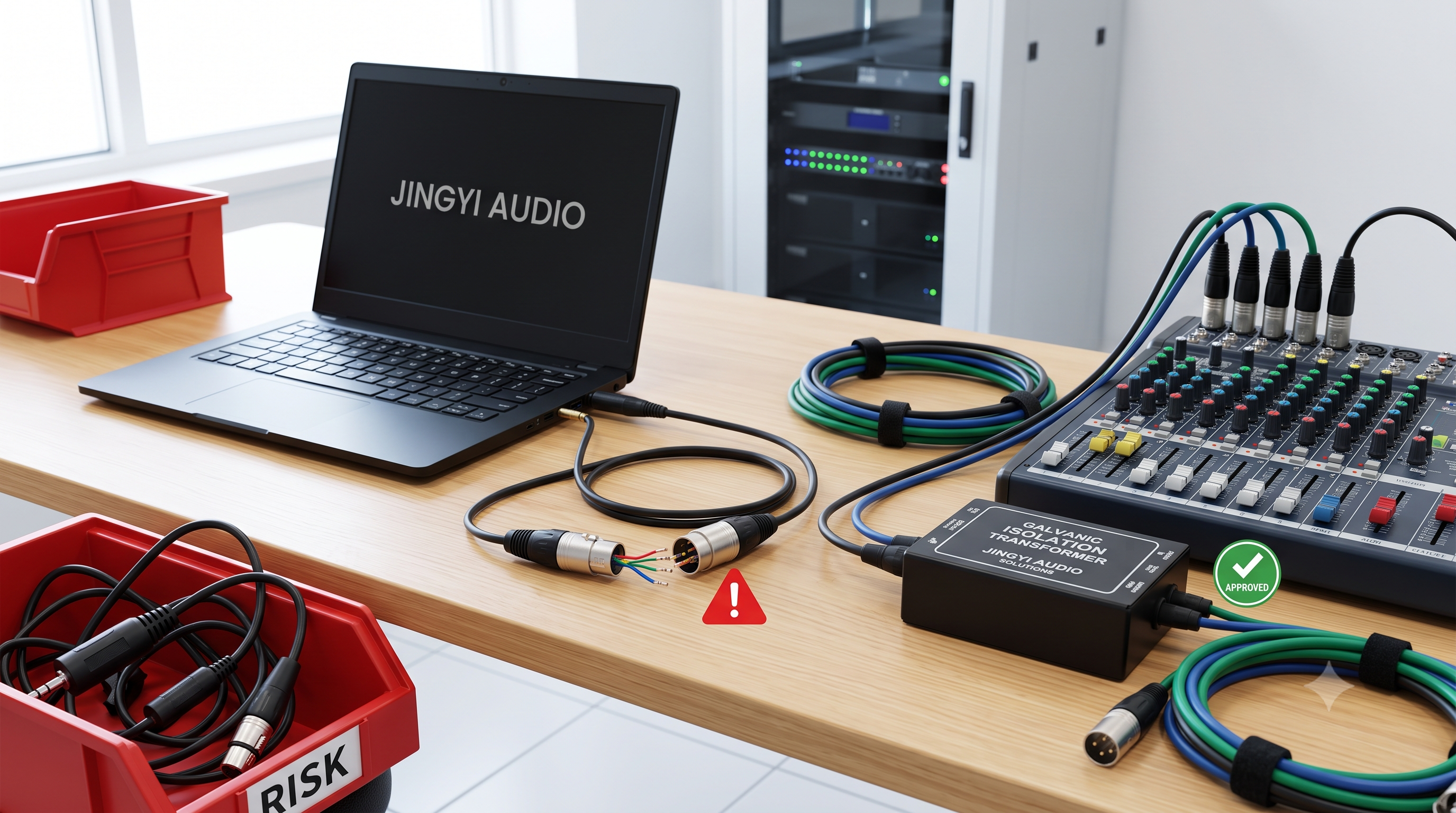


Can I Use a DMX Cable as an XLR Cable? The Definitive Guide to AV Interoperability
-
Author: Lynn Zhang, CEO at Jingyi Audio
-
Published: July 14, 2026
-
Category: Commercial AV Infrastructure & Sourcing
About the Author
Lynn Zhang is the Chief Executive Officer of Jingyi Audio, a premier provider of commercial sound systems, B2B procurement solutions, and high-performance signal routing infrastructure. With over 15 years of experience in system integration, electro-acoustics, and B2B supply chain optimization, Lynn has advised hundreds of theatrical venues, broadcast networks, and corporate enterprise hubs on inventory standardization and transmission line engineering.
Fact-Checked & Reviewed by the Jingyi Audio Technical Engineering Division.
1. Quick Answer (AEO Summary & Search Snippet)
If you are on a busy stage and need an immediate answer, here is the technical reality:
-
Can you use a DMX cable for analog audio (as an XLR mic cable)? Yes. A DMX cable can safely carry analog audio signals up to 20 kHz without any audible or physical acoustic degradation. However, because DMX cables are mechanically stiffer, continuous stage abuse (coiling and pulling) may eventually damage the internal conductors.
-
Can you use an analog XLR microphone cable for digital DMX lighting? No. You should never use an analog XLR microphone cable to run DMX lighting fixtures. Doing so introduces severe impedance mismatches, high-frequency signal reflections ("digital echoes"), and capacitive filtering, which cause erratic fixture behavior, flickering, strobe glitches, and complete control system lockups.
2. Introduction: The Great Cable Confusion in Commercial AV
In the worlds of commercial audiovisual integration, corporate event staging, and rental house logistics, physical similarity frequently masks electrical incompatibility. This issue is nowhere more pronounced than in the comparison of cables terminated with 3-pin XLR connectors.
To the untrained eye, a standard 3-pin XLR analog microphone cable and a 3-pin Digital Multiplex (DMX) lighting cable appear identical. They share the same connector shells, standard pin assignments, and rugged outer jackets. This visual symmetry has birthed a persistent, costly industry myth: "It has three pins, it fits the jack, so it must work."
Under the hood, however, these two cables are engineered to completely opposing physical tolerances. Interchanging them—specifically, utilizing analog mic cables within digital DMX networks—creates hidden operational liabilities, increases on-site troubleshooting labor, and risks catastrophic equipment failures. This guide delivers a physics-based evaluation of DMX and XLR cabling interoperability, designed to guide B2B buyers, procurement officers, and lead AV engineers toward reliable system standardization.
3. Technical Architecture: Digital Multiplex (DMX) vs. Analog Audio (XLR) Physics
To understand why these cables behave so differently, we must examine the physics governing low-frequency analog voltage transmission versus high-frequency digital signal propagation.
+-------------------------------------------------------------------------+
|                  HIGH-FREQUENCY DIGITAL SIGNAL PROPAGATION               |
|                                                                         |
|  [DMX Transceiver] ======[ 120-Ohm Cable ]======> [DMX Terminal Light]  |
|                         (Impedance Matched)                             |
|                                                                         |
|                  LOW-FREQUENCY ANALOG VOLTAGE PROPAGATION               |
|                                                                         |
|  [Microphone] ========[ Variable Cable ]========> [Mixing Console]       |
|                       (Voltage Transfer Mode)                           |
+-------------------------------------------------------------------------+
Transmission Line Physics and Impedance Matching
The DMX512-A lighting protocol is a high-speed, serial digital communication standard built on the EIA-485 (RS-485) differential signaling physical layer. It operates at a fixed, continuous baud rate of 250 kbps. At these rates, the transition times of the digital square waves are incredibly fast (occurring in nanoseconds). Because of this high-frequency component, a DMX cable cannot be treated simply as a simple set of copper wires; it must be treated as a transmission line.
The characteristic impedance (
The full mathematical equation for characteristic impedance (
For high-frequency digital signals, where the operating frequency (
Where:
-
$L$ represents the distributed inductance per unit length. -
$C$ represents the distributed capacitance per unit length.
To prevent signal degradation, the ANSI E1.11 (DMX512-A) standard mandates a nominal characteristic impedance of
Conversely, analog microphone cables are built for low-frequency voltage transfer up to
The Result of Mismatch: Impedance Reflections
When a high-frequency digital DMX signal leaves a
These "digital echoes" collide with subsequent incoming data packets on the line. The result is timing jitter, corrupted data packets, and erratic command signals arriving at the microcontrollers inside your lighting fixtures.
Distributed Capacitance and Waveform Distortions
Analog audio cables are built for ruggedness, extreme flexibility, and electromagnetic noise rejection. To optimize noise cancellation at audible frequencies, standard microphone cables are manufactured with a relatively high distributed capacitance, typically ranging from
HIGH-CAPACITANCE MIC CABLE (Analog XLR)
Original Square Wave:  [__]  --> Low-Pass Filtering -->  Rounded Waveform:  /\_
(Blurs the logic boundaries between "0" and "1", causing packet loss)

LOW-CAPACITANCE DMX CABLE (Belden 3105A)
Original Square Wave:  [__]  --> Low Capacitance --> Clean Square Wave: [__]
(Sharp rise/fall times maintained over long distances)
At the megahertz frequencies present during DMX square wave transition edges, this high capacitance behaves as an aggressive low-pass filter. It absorbs the high-frequency energy required to maintain the sharp, near-vertical rise and fall times of the digital pulses.
As the digital data stream travels through a high-capacitance microphone cable:
-
The sharp vertical edges of the square waves are rounded off.
-
The logic thresholds between digital state "0" and digital state "1" become blurred.
-
The internal microcontrollers in downstream light fixtures can no longer reliably decode the corrupted frame headers, causing communication dropouts.
To counteract this, DMX-compliant cables—such as Belden 3105A or Belden 9841—utilize highly specialized, advanced insulation materials, such as Foam Skin Polyethylene dielectrics. This physical engineering keeps the distributed capacitance under an ultra-low
4. Head-to-Head Comparison: Comparative Technical Parameters
This structured B2B comparison matrix highlights the electrical and structural variances between standard DMX, XLR analog microphone, and AES/EBU digital audio cables:
|
Technical Parameter |
Standard DMX Cable (EIA-485 Standard) |
XLR Analog Microphone Cable |
AES/EBU Digital Audio Cable |
|---|---|---|---|
|
Primary Application |
Digital Lighting Control (DMX512-A) |
Low-Frequency Balanced Audio |
Digital Stereo/Mono Audio & DMX |
|
Nominal Impedance ( |
|
|
|
|
Typical Capacitance |
Ultra-Low ( |
High ( |
Low ( |
|
Conductor Geometry |
Precision Twisted-Pair |
Loose Twist / Non-Standard |
Controlled Twisted-Pair |
|
Conductor Gauge |
|
|
|
|
Shielding Type |
Double Shield (Al Foil + TC Braid) |
Single Shield (Spiral or Braid) |
High-Coverage Foil or French Braid |
|
Physical Outer Jacket |
Stiff, Rugged PVC / Polyurethane |
Saturated, Highly Flexible Rubber / PVC |
Flexible, Low-Temperature PVC |
|
Sourcing Cost Tier |
High Premium |
Standard Utility |
Moderate-High Premium |
5. Real-World Case Studies: When Cabling Errors Halt Production
To contextualize these electrical properties, we examine two practical scenarios reported by staging systems integrators and touring professionals on platforms like LinkedIn and Reddit’s r/techtheatre and r/livesound.
Case Study 1: The High-Profile Event Failure (Crowdsourced from Reddit r/techtheatre)
-
The Scenario: A live event production company was contracted to execute a corporate gala utilizing a newly acquired fleet of LED moving head fixtures. Due to a warehouse packing oversight, the lighting crew arrived on-site short of proper
$120\ \Omega$ 5-pin DMX lines. To complete the installation quickly, they deployed standard 3-pin XLR analog microphone cables to extend a$150\text{-foot}$ run from the stage box to the first overhead truss. -
The Symptoms: During rehearsals with static, single-color scenes, the system operated flawlessly. However, as soon as the live show commenced and the lighting console began transmitting high-speed, continuous multi-channel commands (moving pans, fast tilts, and dynamic color fades), the fixtures on the truss began to strobe randomly, lose pan/tilt synchronization, and lock up.
-
The Diagnostic & Cure: The on-site systems integrator diagnosed the issue as an un-terminated DMX line combined with the high capacitance and incorrect impedance of the analog microphone cable. The fast digital transitions had degenerated into chaotic reflections. The immediate solution was replacing the microphone line with proper
$120\ \Omega$ data cabling and applying a physical termination plug ($120\ \Omega$ resistor across pins 2 and 3) to the last fixture, which instantly stabilized the network.
Case Study 2: Unified Inventory Standardization in Broadcast/Enterprise (LinkedIn Integration Case Study)
-
The Scenario: A major commercial AV systems integration firm was contracted to troubleshoot an enterprise broadcast studio. The facility suffered from persistent, intermittent dropouts affecting both their studio communications (comms) and architectural LED control systems. The primary culprit was identified as a mixed warehouse inventory: standard 3-pin microphone cables and 3-pin DMX cables were visually identical and regularly cross-contamination during fast-paced setups.
-
The Strategic Pivot: Rather than attempting to manage and segregate two separate 3-pin cable lines, the integrator implemented a facility-wide inventory standard: they replaced all 3-pin cables with a single, premium
$110\ \Omega$ AES/EBU digital audio cable (Belden 1800F). -
The ROI: Because AES/EBU cabling is manufactured to meet tight digital data tolerances (matching the electrical specifications of DMX data lines while remaining fully compatible with analog audio signals), the studio achieved immediate zero-fault operation. This change eliminated human setup errors, slashed on-site troubleshooting labor by
$40\%$ , and drastically increased overall infrastructure reliability.
6. Strategic Sourcing and the S-Curve Procurement Model (For B2B Buyers)
For purchasing managers, enterprise integration leads, and B2B clients, choosing a cabling standard requires balancing initial capital expenditure (CapEx) against long-term maintenance overhead and the financial risks of live system failures.
The Cost & Reliability Lifecycle Curve
Below is a visual representation mapping the relationship between initial procurement choices and total operational reliability:
High |                                                 [Unified 110-Ohm AES/EBU]
     |                                                 - Zero operational risk
     |                                                 - Higher initial purchase cost
     |                                                 - Half the inventory overhead
     |
     |                       [Split Inventory]
     |                       - Strict color-coding
     |                       - Risk of on-site mix-ups
     |                       - Mid-range cost
     |
     | [Cheap Mic Cables]
     | - High failure rate on DMX
     | - Low initial cost
Low  └─────────────────────────────────────────────────────────────────────────────
     Low Reliability                                                 High Reliability
To guide procurement, we analyze three distinct B2B purchasing models:
Option 1: The Unified Inventory Model (Recommended for Touring & Broadcast)
Standardize your entire 3-pin XLR inventory on high-end
-
Action: Phase out separate analog microphone lines in favor of a universal
$110\ \Omega$ digital audio line. -
Strategic Advantage: Completely eliminates the risk of on-site cable cross-contamination. One cable type handles analog microphones, digital audio networks, and 3-pin DMX lines.
-
Financial Impact: Requires a
$15\%\text{ to }30\%$ higher initial capital outlay on bulk wire, but generates long-term cost savings by reducing troubleshooting labor, simplifying inventory tracking, and avoiding costly show-stopping failures.
Option 2: The Color-Coded Split Inventory Model (Recommended for Rental Houses)
Maintain separate, discrete bulk inventories of cheap, high-flex analog mic cables and dedicated
-
Action: Enforce a rigid color-coding and labeling discipline across all rental inventory.
-
Strategic Advantage: Minimizes initial CapEx by utilizing inexpensive copper for standard vocal mics, while reserving high-spec lines for data networks.
-
Financial Impact: Low purchasing costs. However, this model carries an ongoing operational risk. It demands strict warehouse discipline (e.g., standardizing on all-black jackets for audio and purple or high-visibility blue jackets for DMX) to prevent accidental mix-ups on site.
Option 3: The Structured Category Cable Model (Recommended for Permanent Installations)
Utilize Shielded Category 5e or Category 6 (F/UTP or STP) structured copper cabling for all long-distance infrastructure runs.
-
Action: Run shielded Cat5e/Cat6 bulk cable through building conduits, terminating in local wall-mounted XLR plates.
-
Strategic Advantage: Shielded Cat5e/Cat6 naturally exhibits a nominal impedance of
$100\ \Omega$ , which falls well within acceptable DMX tolerances. It is highly resistant to external electromagnetic interference, is easily sourced in bulk, and complies with modern building codes. -
Financial Impact: Drastically reduces total installation and raw materials costs for permanent venues, allowing budgets to be reallocated toward premium chassis connectors and terminal interfaces.
7. Comprehensive FAQ Section (SEO/Schema Optimized)
Q1: Can I safely run digital DMX signals through spare channels on an analog copper stage snake?
Short Answer: No. This causes signal degradation and severe noise crosstalk into your audio lines.
Detailed Explanation: A standard copper audio snake is a bundled cluster of individual balanced microphone lines sharing a single outer jacket. Each of these internal lines exhibits the high capacitance (
Routing high-speed digital DMX through an analog snake will heavily degrade the signal over long distances, causing timing jitter and data reflections. Furthermore, the high-frequency transitions of the digital DMX protocol can easily bleed into adjacent analog audio channels within the snake bundle via capacitive and inductive coupling. This crosstalk manifests as an audible, high-frequency digital whine or buzz in the PA system, compromising both lighting and audio signals.
Q2: What are the physical and electrical risks of plugging a DMX fixture into a line carrying active +48V phantom power?
Short Answer: You risk instantly burning out the transceiver chip inside the lighting fixture.
Detailed Explanation: Plugging a lighting fixture into an audio line carrying active
If a 3-pin lighting fixture is accidentally connected to a console or stage box output with active phantom power, the
Q3: If 3-pin DMX uses the same pins as 3-pin audio, why does the official ANSI E1.11 standard explicitly prohibit 3-pin XLR connectors?
Short Answer: To physically prevent users from cross-connecting sensitive digital control lines to high-voltage audio systems.
Detailed Explanation: The ANSI E1.11 (USITT DMX512-A) standard explicitly prohibits 3-pin XLR connectors to protect equipment and maintain clear separation between lighting and audio networks. Originally, pins 4 and 5 in the 5-pin configuration were reserved for a secondary data link or for Remote Device Management (RDM) telemetry.
Even if a fixture only utilizes pins 1, 2, and 3, maintaining the 5-pin standard prevents inexperienced crews from cross-connecting low-voltage digital control ports into high-voltage intercom lines, speaker outputs, or
ANSI E1.11 Compliant 5-Pin XLR Pinout Reference:
-
Pin 1: Signal Common / Shield
-
Pin 2: Data 1- (Primary Digital Link Negative)
-
Pin 3: Data 1+ (Primary Digital Link Positive)
-
Pin 4: Data 2- (Optional Auxiliary Link Negative)
-
Pin 5: Data 2+ (Optional Auxiliary Link Positive)
Q4: Why do my LED fixtures perform perfectly with standard mic cables until I start executing slow color fades or dimming ranges?
Short Answer: Dynamic changes flood the cable with high-frequency data transitions, which trigger packet-corrupting echoes on mismatched cables.
Detailed Explanation: This is a classic symptom of impedance mismatch and digital echoes. When your lighting fixtures are in a static, unchanging scene, the DMX controller is transmitting repetitive, unchanging command packets. Even if the waveform is heavily rounded and distorted by high-capacitance microphone cable, the receiving fixture's microcontroller can easily latch onto the static state because the data values are constant.
However, once you execute a slow color fade or a smooth dimming sweep, the controller must transmit continuously changing, high-resolution values across dozens of channels simultaneously. This dynamic state vastly increases the frequency of transitions on the data line. Without a proper
Q5: Is there any measurable acoustic or physical degradation when using DMX or AES/EBU cables for analog microphones?
Short Answer: There is zero acoustic loss, but the stiffer jackets of digital cables make them prone to physical wear and internal wire breaks on a busy stage.
Detailed Explanation: Acoustically, there is zero audible degradation. The higher characteristic impedance (
Physically, however, degradation can occur over time. Digital DMX and AES/EBU cables are built with stiffer physical outer jackets and tighter internal shielding to maintain their precise conductor geometry. They are not engineered for the continuous coiling, uncoiling, and mechanical twisting typical of a live stage microphone. Under heavy stage abuse, the internal conductors of a stiff digital cable can fatigue and break, leading to hard-to-diagnose, intermittent audio dropouts.
8. Strategic Action Plan & Verdict
To guarantee signal integrity, protect capital equipment, and optimize your AV cabling budget across commercial projects, B2B operators should implement this immediate action plan:
-
For Permanent AV Installations:
-
Always specify Shielded Cat5e/Cat6 cabling for all long-distance structural DMX distribution runs through conduits.
-
Terminate these runs into standard 5-pin XLR wall plates at all stage pockets and structural locations, keeping lighting control paths physically isolated from the audio network from day one.
-
-
For Touring Fleets and Broadcast Operations:
-
Transition and standardize your entire 3-pin XLR inventory to
$110\ \Omega$ AES/EBU digital audio cable. -
While this carries a minor CapEx premium, it simplifies warehouse logistics, guarantees
$100\%$ interoperability, and completely eliminates show-stopping field failures caused by incorrect cable selection.
-
-
For Dedicated Lighting Crews:
-
Enforce the absolute rule of physical termination: ensure a physical
$120\ \Omega$ terminating plug is connected to the output jack of the very last fixture in every daisy chain. -
Standardize on a strict color-coding system (such as purple or blue outer jackets for lighting and black for audio) to help technicians quickly identify lines on dark stages.
-
-
For Hardware Managers & Rental Houses:
-
Establish a system-wide plan to phase out legacy 3-pin DMX lighting connections where possible.
-
Where 3-pin budget fixtures must be integrated into professional 5-pin DMX networks, mandate the use of high-quality 5-pin to 3-pin adapters directly at the fixture interface, rather than running long, non-compliant 3-pin analog XLR cables back to the distribution box.
-
Technical Resources & Schema References
For further reading and compliance standards verification, refer to:
-
ANSI E1.11 - DMX512-A Standard Specifications
-
EIA-485 Differential Signaling Physical Layer Protocol
-
Belden Technical Data Sheets (Belden 3105A, 9841, 1800F)