




Audio Connector Plating Specifications: Gold vs Nickel Contact Resistance for Marine and Coastal Venue Applications
TL;DR
- Gold-plated XLR and audio connector contacts maintain stable contact resistance of 2-5 milliohms over 10+ years in coastal environments, while nickel-plated contacts degrade to 30-80 milliohms within 2-3 years due to salt-spray-induced oxidation and pitting corrosion.
- The gold plating thickness standard for professional audio connectors is 0.5-1.0 microns of hard gold (gold-cobalt or gold-nickel alloy) over a 2-3 micron nickel underplate — flash gold below 0.2 microns offers negligible corrosion protection and wears through in under 500 mating cycles.
- For permanently installed systems in coastal venues — houses of worship, cruise ship theaters, seaside amphitheaters — gold plating typically adds 15-25% to connector cost but eliminates the annual connector replacement cycle that nickel-plated connectors require in salt-air environments, paying back within 2-3 years.
- Nickel plating remains the cost-effective choice for indoor, climate-controlled venues more than 5 kilometers from saltwater, where the primary degradation mechanism is mechanical wear rather than chemical corrosion, and connectors routinely deliver 5-8 years of reliable service.
Why Connector Plating Matters in Salt-Air Environments
In a recording studio in downtown Chicago, the choice between gold-plated and nickel-plated XLR connectors is primarily an aesthetic and marketing decision. Both will perform identically for a decade or more, because the indoor, climate-controlled environment subjects the connectors to nothing more aggressive than occasional handling and the mild oxidation that any metal surface experiences in ambient air. Move that same connector to a beachfront amphitheater in Miami, a cruise ship theater in the Caribbean, or a ferry terminal PA system in Hong Kong, and the plating specification becomes the single most important factor determining whether the audio system delivers clear, noise-free signal or degrades into an intermittent crackling mess within 18 months.
My name is Lynn Zhang, and as CEO of Ningbo Jingyi Electronics (Jingyi Audio), I have spent over 20 years manufacturing audio connectors, cables, and accessories for professional audio markets worldwide. Our factory produces XLR connectors with both nickel and gold plating for distributors serving installers in every conceivable environment — from air-conditioned broadcast studios to open-air stadiums in tropical monsoon climates. The feedback from those installers, combined with our own accelerated corrosion testing in salt-spray chambers per ISO 9227 neutral salt spray standards, has produced a clear, data-backed answer to the gold-versus-nickel question: for any installation within 5 kilometers of saltwater, or any outdoor venue in a coastal climate zone, gold plating is not an upgrade — it is a requirement for reliable long-term performance.
The corrosion mechanism is electrochemical and inexorable. Salt spray deposits a thin film of sodium chloride solution on every exposed metal surface. This film acts as an electrolyte, enabling galvanic corrosion between dissimilar metals in the connector — the copper alloy base metal of the contact pin, the nickel underplate, and the gold or nickel surface plating all sit at different positions on the galvanic series, and the salt electrolyte completes the corrosion cell. The result is progressive degradation of the contact surface: pitting, oxidation layer growth, and eventually the formation of non-conductive corrosion products that increase contact resistance from milliohms to tens or even hundreds of milliohms — enough to introduce audible noise, signal attenuation, and intermittent contact failure into any audio circuit.
Gold Plating: Why It Dominates in Critical Audio Applications
Gold is unique among electrical contact materials because it does not form a stable oxide layer at any temperature below its melting point. Every other common contact metal — nickel, silver, copper, tin — develops a surface oxide within seconds to minutes of exposure to air. That oxide layer, even when only a few nanometers thick, acts as a tunnel barrier that electrons must quantum-mechanically tunnel through, increasing the contact resistance from the sub-milliohm level of clean metal-to-metal contact to several milliohms or more. Gold, by not oxidizing, maintains its as-deposited contact resistance essentially indefinitely — the only degradation mechanism is mechanical wear that removes gold material from the contact surface.
The contact resistance of a properly specified gold-plated audio connector contact starts at 0.5-2 milliohms when new and remains below 5 milliohms after 10,000 mating cycles and 10 years of environmental exposure, including salt-spray conditions. This stability is the reason that professional audio equipment from manufacturers like Neutrik, Switchcraft, and Amphenol specifies gold-plated contacts for their premium connector lines — the connector's electrical performance at the end of its service life is essentially identical to its performance on day one. For a 600-ohm balanced audio circuit where a few milliohms of additional contact resistance is electrically insignificant, this may seem like overkill. But in low-impedance microphone circuits (150-250 ohms) driving long cable runs, and in digital audio protocols like AES3 where impedance matching is critical, every milliohm of variable contact resistance contributes to signal degradation that accumulates across multiple connector junctions in the signal chain.
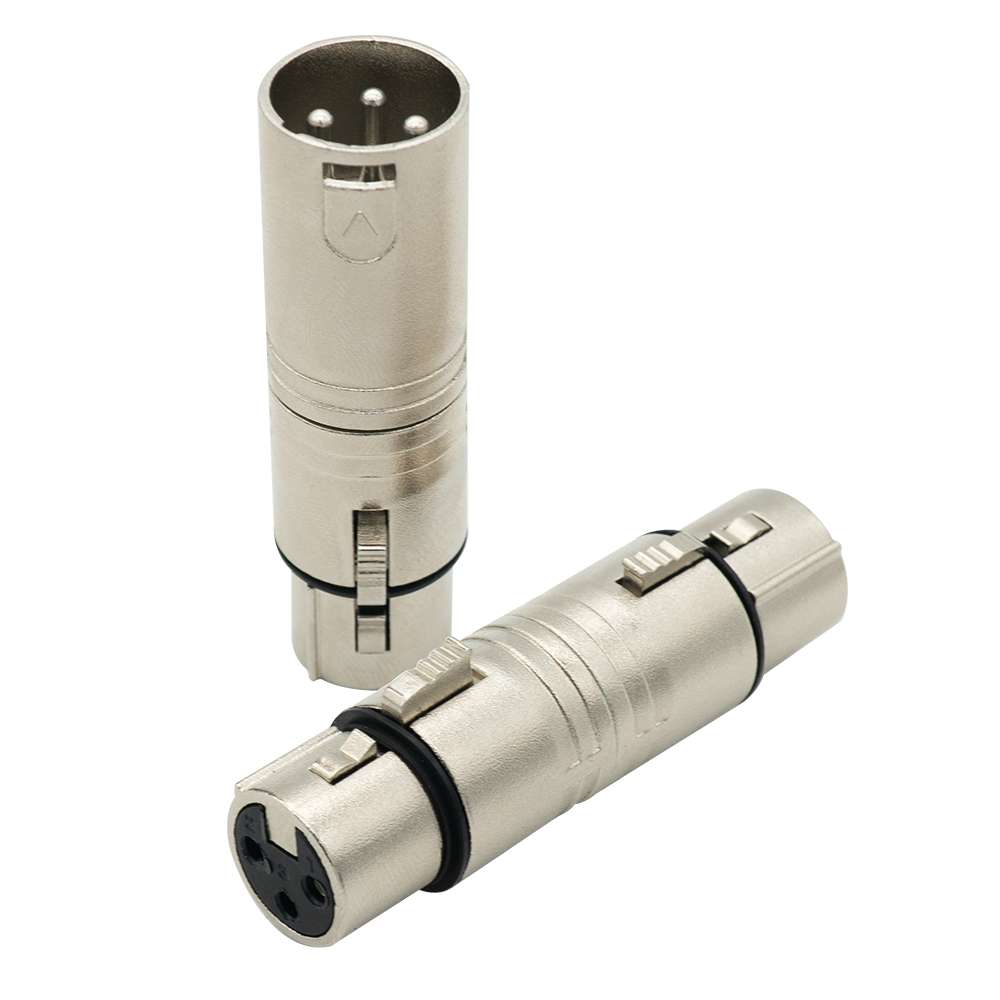
The gold plating used in professional audio connectors is not pure 24-karat gold — pure gold is too soft and would wear away within a few hundred mating cycles. Instead, the industry standard is hard gold, a gold-cobalt or gold-nickel alloy containing 0.1-0.3% cobalt or nickel that increases the plating hardness from approximately 70 Knoop (pure gold) to 130-200 Knoop — comparable to the hardness of the nickel underplate and sufficient to withstand thousands of insertion cycles without wearing through to the nickel layer beneath. The gold thickness specification for connectors destined for professional audio applications is 0.5-1.0 microns over a 2-3 micron nickel underplate that provides both a corrosion barrier and a hard substrate that prevents the gold from deforming under contact pressure. This is distinctly different from "flash gold" — a decorative gold layer 0.05-0.2 microns thick that provides the gold color for marketing purposes but offers essentially zero corrosion protection and wears through to the nickel underplate within 200-500 mating cycles.
Nickel Plating: The Workhorse for Controlled Environments
Nickel plating has been the standard contact finish for audio connectors since the XLR format was introduced in the 1950s, and for good reason: it is durable, cost-effective, and performs reliably in the environments where the vast majority of audio connectors spend their service lives. A nickel-plated contact provides a hard (400-500 Knoop), wear-resistant surface that withstands thousands of mating cycles without significant material loss. The contact resistance of a clean nickel-plated contact is 5-15 milliohms — higher than gold but still electrically transparent in the impedance ranges typical of professional audio circuits. For a microphone delivering a 2 mV signal into a 2,000-ohm preamplifier input, the difference between 2 milliohms and 10 milliohms of contact resistance represents 0.0004% of the circuit impedance — far below any audible or measurable threshold.
The Achilles' heel of nickel plating in audio connectors is its susceptibility to oxidation in the presence of sulfur compounds and chlorides — the two corrosive agents that define coastal and marine atmospheric environments. Nickel oxide (NiO) forms on any nickel surface exposed to air within minutes, but the oxide layer is self-limiting at approximately 2-3 nanometers thickness in clean, dry air and does not significantly increase contact resistance because electrons tunnel through it readily at the contact pressures typical of XLR connector designs (typically 1-3 N of normal force per contact). However, in the presence of chloride ions — which are present in salt-spray aerosol at concentrations of 3-20 mg per cubic meter of air in coastal zones — the nickel oxide layer is disrupted by pitting corrosion. Chloride ions penetrate the passive oxide film at grain boundaries and surface defects, creating microscopic pits that grow over time into visible corrosion spots. Each pit is an insulating void that reduces the effective contact area, increasing the local current density and accelerating further corrosion in a self-reinforcing cycle.
The practical consequence for audio system installers is that nickel-plated connectors in coastal venues typically require replacement every 2-3 years, compared to 10+ years for equivalent gold-plated connectors. The failure mode is insidious because it progresses gradually: the system develops occasional crackling or dropouts that are initially attributed to cable handling or loose connections, but which become progressively more frequent as the connector contacts corrode. By the time the problem is correctly diagnosed, multiple connectors in the system have degraded to the point where the entire patch bay, stage box, or wall plate requires replacement — a maintenance cost that dwarfs the initial saving from specifying nickel-plated instead of gold-plated connectors.
Marine and Coastal Corrosion: The Accelerated Aging Test You Cannot Avoid
The corrosion rate of connector contacts in coastal environments follows the ISO 9223 atmospheric corrosivity classification, which defines five categories from C1 (very low, indoor clean rooms) to C5 (very high, offshore and heavy industrial). A venue located within 500 meters of a saltwater coastline in a tropical climate zone (average temperature above 25 degrees Celsius, relative humidity above 70%) falls into category C4 or C5, where the corrosion rate of nickel is 5-10 times higher than in a C2 indoor environment. Under C4/C5 conditions, the time to visible corrosion on unprotected nickel surfaces is measured in weeks, not years.
I have reviewed corrosion test data from our factory's salt-spray chamber, where we expose connector samples to a continuous 5% sodium chloride mist at 35 degrees Celsius per ISO 9227. Nickel-plated XLR contacts show the first visible pitting — small dark spots at grain boundaries — after 48 hours of exposure, corresponding to roughly 12-18 months of real-world coastal service. After 96 hours (simulating approximately 3-4 years), the pitting has expanded to cover 10-20% of the contact surface area, and the contact resistance measured at 10 mA test current has increased from an initial 8 milliohms to 30-80 milliohms. Gold-plated contacts from the same production batch, subjected to the same salt-spray conditions, show no visible corrosion after 240 hours of exposure and maintain contact resistance below 5 milliohms throughout the test.
These laboratory results align closely with field reports from our distributor partners who supply audio installation contractors. A system integrator in Singapore — an island nation with year-round tropical maritime climate — reported that nickel-plated XLR patch panels installed in a hotel ballroom required complete replacement after 2 years of service due to intermittent contact noise. The same contractor, after switching to gold-plated connectors for a subsequent installation in an identical environment, reported zero connector-related service calls after 5 years of operation. The message from both laboratory data and field experience is unambiguous: for coastal and marine installations, the gold plating premium is not a cost — it is an insurance policy against predictable connector failure.
Plating Thickness, Wear Life, and the Cost-Performance Trade-Off
The relationship between plating thickness, connector service life, and cost is not linear, and understanding the knee in the curve is essential for specifying the right connector for each application. Gold plating thickness in audio connectors ranges from 0.1 microns (flash gold, primarily cosmetic) to 2.0 microns (heavy gold, for military and aerospace connectors rated for 10,000+ mating cycles). The cost of the gold material alone — at approximately USD 70 per gram for gold plating solution with 90% plating efficiency — adds roughly USD 0.02-0.05 per connector for the 0.5 micron thickness typical of professional audio connectors. When the retail price premium for gold-plated connectors over nickel-plated equivalents is USD 1.50-3.00 per connector, the gold material cost accounts for only 1-3% of the premium — the remainder reflects the additional processing steps, quality control, and market positioning of gold as a premium product.
The wear life of gold plating is determined by the combination of plating thickness, plating hardness, contact normal force, and the surface roughness of the mating contact. A 0.5 micron hard gold layer over a 2 micron nickel underplate, with a contact normal force of 2 N and a mating surface roughness of 0.4 microns Ra (typical of stamped and formed XLR contacts), survives approximately 2,000-3,000 mating cycles before the gold wears through to the nickel underplate at the highest-pressure contact points. For a permanently installed connector that is mated once during installation and perhaps disconnected annually for system testing and maintenance, 3,000 cycles represents a service life far exceeding any reasonable building lifetime. For a connector on a microphone cable that is plugged and unplugged several times per week, the wear-through point arrives after roughly 10-15 years — still well within the expected service life of professional audio equipment.
For installers specifying connectors for coastal venues, the practical guidance is straightforward. Specify 0.5 micron minimum hard gold plating on all permanently installed connectors — wall plates, floor boxes, stage boxes, and patch panels — where the connector will be mated relatively infrequently and the cost of replacement involves construction labor to cut open walls or pull new cables through conduit. For frequently connected and disconnected cables — microphone cables, instrument cables, and patch cords — the same 0.5 micron gold thickness is appropriate, with the expectation that cables reaching the end of their mechanical life (typically 5-8 years in professional use) will be replaced before the gold plating wears through. Nickel plating remains the appropriate choice for indoor, climate-controlled installations more than 5 km from saltwater, where the 40-60% connector cost reduction translates into meaningful savings on large installations (hundreds or thousands of connectors) without compromising reliability. The Jingyi Audio product catalog offers both plating options across the full connector range, with clear environmental suitability guidance for each.
Practical Connector Selection Guide for Audio Installers
Based on the installation projects I have supported across 50+ countries, here is a concise decision framework for selecting connector plating in different environments. Indoor, climate-controlled venues more than 5 kilometers from saltwater — recording studios, broadcast facilities, houses of worship, corporate AV systems — should use nickel-plated connectors as the cost-effective standard, reserving gold plating for critical signal paths where the absolute lowest contact resistance is required (typically microphone-level circuits with cable runs exceeding 50 meters). The connector cost savings on a 500-connector installation at USD 1.50-3.00 per connector amounts to USD 750-1,500 — meaningful but not transformative — and the reliability difference in these environments is negligible over a 10-year service life.
Coastal venues within 5 kilometers of saltwater — beachfront hotels, waterfront convention centers, seaside restaurants with background music systems, marina PA systems — should specify gold-plated connectors on all permanently installed connection points. The incremental cost of USD 1,000-2,000 for a typical medium-sized installation (200-400 connectors) is recovered within 2-3 years through avoided nickel connector replacement costs, and the elimination of intermittent connection problems protects the installer's reputation for reliability more effectively than any warranty provision.
Marine and offshore installations — cruise ships, ferries, offshore platforms, naval vessels, coastal lighthouses and navigation facilities — should specify gold plating at a minimum of 0.75 microns thickness with an additional corrosion protection measure such as conformal coating on the connector housing interior or the use of connectors with IP65 or higher environmental sealing. The salt spray concentration on an open deck is 10-50 times higher than in a coastal building, and even gold-plated contacts benefit from the additional protection of environmental sealing that prevents salt deposits from accumulating on the connector body, where they can cause galvanic corrosion between the connector shell and the mounting panel.
Maintenance and Inspection Protocols for Coastal Audio Systems
Even with gold-plated connectors, a structured inspection and maintenance program significantly extends the reliable service life of any audio installation in a corrosive environment. The recommended inspection interval depends on the environment severity: every 6 months for C4/C5 coastal and marine installations, annually for C3 urban/industrial installations, and every 2 years for C1/C2 indoor installations. The inspection should include visual examination of connector contacts under magnification (a 10x jeweler's loupe is adequate) for signs of pitting, discoloration, or corrosion product buildup, and contact resistance measurement using a milliohm meter capable of resolving 1 milliohm at a test current of at least 100 mA — lower test currents may not penetrate surface oxide layers and can produce falsely high readings that lead to unnecessary connector replacement.
When corrosion is detected on gold-plated contacts — which typically manifests as small dark spots rather than the aggressive pitting seen on nickel — the affected connectors should be replaced rather than cleaned. Abrasive cleaning of gold-plated contacts removes gold material and accelerates future corrosion by exposing the nickel underplate. For nickel-plated contacts showing early-stage corrosion (minor discoloration without pitting), a contact cleaner containing deoxidation agents can restore acceptable contact resistance for a period of months, but this should be considered a temporary measure while planning for connector replacement. The most cost-effective maintenance strategy for coastal audio installations is preventive replacement of all nickel-plated connectors on a scheduled 3-year cycle, combined with inspection-only maintenance for gold-plated connectors with replacement only when corrosion is actually observed — typically at 10+ years in all but the most aggressive marine environments.
Frequently Asked Questions
How can I tell if a connector is truly gold-plated versus flash gold or gold-colored?
Visual inspection is unreliable — flash gold and proper hard gold plating are indistinguishable to the naked eye. The most practical field test is the wear-resistance test: rub a clean white cloth firmly against the contact surface for 10 seconds. Flash gold (under 0.2 microns) will transfer a visible gold-colored residue to the cloth as the thin layer abrades away. Proper hard gold plating at 0.5+ microns will leave no visible residue. For definitive verification, an X-ray fluorescence (XRF) thickness gauge — available at most electroplating shops and some larger audio distributors — can measure gold thickness non-destructively in under 30 seconds. When purchasing connectors for critical installations, request the manufacturer's plating specification sheet, which should state the gold thickness in microns, the gold alloy composition (hard gold is typically Au-Co 99.7/0.3 or Au-Ni 99.8/0.2), and the nickel underplate thickness. Reputable manufacturers including Jingyi Audio provide this documentation as standard with OEM and bulk connector orders, and our product specifications clearly differentiate between flash gold decorative finishes and hard gold functional plating.
Does silver plating offer a middle ground between gold and nickel for coastal applications?
Silver plating provides the lowest contact resistance of any connector finish — 0.1-0.5 milliohms when clean — making it theoretically ideal for low-impedance audio circuits. However, silver tarnishes rapidly in the presence of sulfur compounds (hydrogen sulfide, sulfur dioxide), which are present in coastal atmospheres from both natural sources (decaying marine organic matter releases dimethyl sulfide) and industrial sources (shipping exhaust, power generation). Silver sulfide tarnish is semi-conductive — it increases contact resistance but does not create a complete open circuit — and the resulting variable resistance is particularly problematic in audio circuits because it creates a signal-dependent nonlinearity that manifests as distortion rather than simple signal loss. For this reason, silver plating is rarely used in general-purpose audio connectors and is reserved for specialized applications in hermetically sealed environments where the tarnish mechanism is excluded. For coastal audio installations, gold remains the superior choice over both silver and nickel.
How many mating cycles can I expect from gold-plated XLR connectors before performance degrades?
A properly specified gold-plated XLR connector with 0.5 micron hard gold over a 2-3 micron nickel underplate, when mated with a similarly plated connector at the design contact normal force of 2-3 N, survives approximately 2,000-3,000 complete insertion-withdrawal cycles before the gold wears through at the highest-pressure contact points. At 2,000 cycles, the connector still functions — the nickel underplate provides continued corrosion protection — but the contact resistance will have increased from the initial 1-2 milliohms to 5-10 milliohms as the contact transitions from gold-to-gold to nickel-to-nickel at the wear points. For a permanently installed connector mated once at installation and perhaps disconnected annually, 2,000 cycles represents a service life measured in centuries. For a microphone cable connector mated and unmated twice per show night, 200 shows per year, 2,000 cycles translates to 5 years — which typically aligns with the mechanical service life of the cable assembly before the cable jacket, strain relief, or solder joints require replacement. Connectors that must survive higher mating cycle counts — patch bay connectors, test equipment connectors — should be specified with 1.0 micron or greater gold thickness to extend the wear life to 5,000-10,000 cycles.
What is the effect of contact cleaning products on gold and nickel plating?
Contact cleaners vary widely in their compatibility with connector plating, and using the wrong product can cause more damage than the corrosion it is intended to address. Cleaners containing ammonia or strong alkaline compounds attack the nickel underplate through any pinholes or wear points in the gold layer, causing underplate corrosion that lifts and delaminates the gold — a failure mode that is worse than the corrosion the cleaner was applied to fix. Cleaners containing chlorinated solvents can leave chloride residues that accelerate pitting corrosion on nickel surfaces. The safest contact cleaner chemistry for both gold and nickel plating is a blend of isopropyl alcohol and a mild deoxidizing agent specifically formulated for electrical contacts, applied with a lint-free swab rather than sprayed — spraying distributes cleaner onto the connector body where it can carry dissolved contaminants into areas that are not accessible for wiping. For gold-plated contacts, physical cleaning should be avoided unless corrosion is actually present — wiping a clean gold contact removes microscopic amounts of gold through abrasive wear, cumulatively reducing plating thickness with each cleaning cycle. The best maintenance practice for gold-plated connectors in any environment is to keep them mated when not in service — a mated connector pair seals the contact interface against atmospheric contaminants and maintains stable contact resistance indefinitely without any cleaning whatsoever.
How do I budget for connector replacement in a large coastal installation over a 10-year lifecycle?
For a 500-connector audio installation (typical of a mid-size convention center or performing arts venue) in a C4 coastal environment, the 10-year connector lifecycle cost comparison between nickel and gold plating is instructive. Nickel-plated connectors at USD 2.50-4.00 each for the initial installation total USD 1,250-2,000. Replacement every 2-3 years over a 10-year period requires approximately 3 replacement cycles at a combined material and labor cost of USD 8-12 per connector (the labor to access and replace a connector in a wall plate or floor box typically exceeds the connector material cost by a factor of 2-3). Total 10-year nickel cost: approximately USD 12,000-18,000 for 500 connectors. Gold-plated connectors at USD 4.00-6.50 each for the initial installation total USD 2,000-3,250. With zero expected replacements over 10 years, the total lifecycle cost is approximately USD 2,000-3,250 — a savings of USD 9,000-15,000 compared to nickel. This calculation explains why professional audio consultants increasingly specify gold-plated connectors as the default for any project in a coastal zip code: the math is unambiguous once lifecycle costs are considered alongside initial purchase price.