


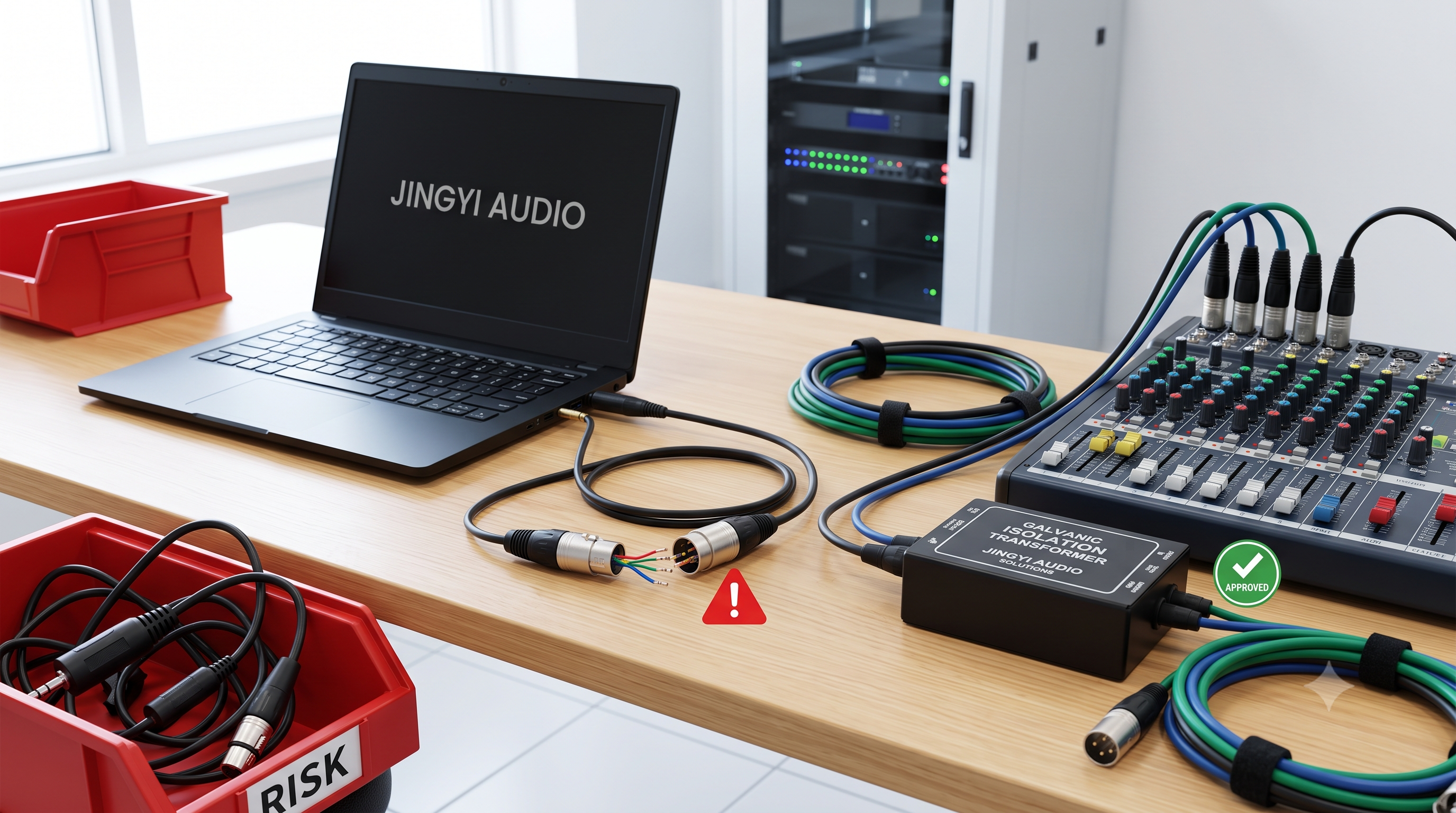


Industry Guide | Bulk DMX Cable: Technical Standards, B2B Sourcing, and Professional Integration Field Guide
Author: Lynn Zhang (CEO, Jingyi Audio)
Published: June 23, 2026
Categories: Stage Lighting, Architectural Lighting, Systems Integration, Low-Voltage Engineering, B2B Procurement
Quick Summary
This technical guide provides a thorough analysis of bulk DMX cable electrical standards, physical architecture, B2B procurement economics, and common integration failures. Key takeaways include:
Strict EIA-485 (RS-485) differential signaling requires characteristic impedance matching (
$110\ \Omega$ to$120\ \Omega$ ) to prevent high-frequency packet reflection.Substituting analog microphone cables for DMX is mathematically invalid due to high capacitance (
$>100\text{ pF/m}$ ) distorting digital square waves.A complete B2B cost-to-build formula (
$C_{build}$ ) is provided to evaluate DIY cable fabrication vs. factory-molded assemblies, alongside an analysis of jacket materials (TPE, PUR, LSZH) on long-term OpEx.Real-world field reports cover 5 critical failure case studies and 5 high-frequency technical FAQs (including Cat5e/Cat6 as DMX, 3-pin vs. 5-pin safety hazards, and AES/EBU inventory consolidation).
1. Introduction: The Underrated Physical Foundation of Modern Lighting Networks
In enterprise theatrical, themed entertainment, or permanent architectural lighting installations, decision-makers readily allocate hundreds of thousands of dollars to premium control consoles (such as grandMA3) and state-of-the-art automated fixtures (like Martin or Robe). Yet, in real-world operations, the single most critical point of failure in these complex networks is often a physical medium costing less than $1.50 per foot: the DMX data cable.
Throughout my career leading systems integration at Jingyi Audio, I have witnessed countless live shows ruined, and multi-million-dollar architectural facades descend into erratic flickering, simply due to improper cable selection, the lazy substitution of analog microphone lines, or short-sighted B2B procurement focused solely on minimizing initial CapEx.
Bulk DMX cable serves as the literal nervous system of low-voltage control networks. Its electrical compliance and mechanical durability dictate the overall system reliability. This guide provides a definitive technical and financial roadmap for system integrators, electrical contractors, and rental house managers across five key dimensions: electrical physics, cable engineering, B2B procurement ROI models, field failure analysis, and professional FAQs.
2. Technical Foundations and Electrical Engineering Standards
The transmission of DMX512-A data is governed by strict electrical parameters defined by the Entertainment Services and Technology Association (ESTA) and the American National Standards Institute (ANSI). The underlying physical layer relies entirely on the EIA-485 (RS-485) differential signaling standard, engineered to transmit high-speed digital data over long runs in electromagnetically hostile environments.
2.1 The Physics of Differential Signaling
Differential signaling operates by transmitting two opposing voltage waveforms across a balanced, twisted pair of conductors, designated as Data Plus (D+) and Data Minus (D-). The receiver decodes the signal by measuring the differential voltage (
Per the RS-485 standard:
-
The transmitter must generate a differential output voltage of at least
$\pm 1.5\text{ V}$ and up to a maximum of$\pm 6.0\text{ V}$ across the load. -
When external electromagnetic interference (EMI) or radio frequency interference (RFI) couples onto the twisted pair, it affects both conductors equally as common-mode noise.
-
During subtraction (
$V_{D+} - V_{D-}$ ), the receiver mathematically cancels out this in-phase noise, preserving the integrity of the underlying data.
2.2 Characteristic Impedance ($Z_0$ ) and Wave Reflections
For this noise-rejection mechanism to function without signal degradation, the physical transmission line must maintain a uniform characteristic impedance (
Characteristic impedance is a function of the cable's physical geometry and the dielectric constant of its insulation:
Where
If the characteristic impedance of the cabling shifts abruptly at any point (due to mismatched cables, inferior connectors, or an open end without a termination resistor), the high-frequency components of the digital pulse will undergo signal reflection at the boundary of the mismatch. These reflected electromagnetic waves travel backward, colliding with incoming data packets. This rounds off the sharp rise and fall times of the square waves, resulting in corrupted packets, flickering fixtures, erratic pan/tilt movements, and intermittent system blackouts.
2.3 The Analog Microphone Cable Fallacy: An Electrical Disaster
A pervasive mistake in live production is substituting standard analog microphone cable (typically rated at
At audio frequencies (under
3. Physical Construction Parameters of Professional Bulk DMX Cable
To secure reliable data transmission in professional environments, high-grade bulk DMX cables must use specific structural elements:
-
Low-Capacitance Conductor Insulation: Compliant cables use Foamed Polyethylene (Foam PE) or Skin-PE insulation, keeping conductor-to-conductor capacitance strictly below
$65\text{ pF/m}$ to minimize high-frequency attenuation. -
Double Shielding Architecture: True data integrity near high-current AC lines requires complete shielding:
-
High-Frequency RF Protection: 100% coverage aluminum foil/polyester tape.
-
Low-Frequency EMI Protection: Minimum 90% coverage tinned copper braided shield.
-
-
Optimized Conductor Design: High-performance DMX uses stranded, tinned copper conductors (typically sized at 22 AWG or 24 AWG). This balances low DC resistance with mechanical flexibility.
-
Dedicated Ground Drain Wire: An uninsulated, stranded tinned copper drain wire runs parallel to the shield inside the jacket, facilitating fast, secure ground terminations inside connector housings.
Technical Comparison of Industry-Standard Bulk DMX and RS-485 Cables
|
Technical Specification / Parameter |
Belden 9841 |
Sommer Cable Binary 234 |
Clark Wire & Cable DMX-PRO |
Belden DLC224 |
|---|---|---|---|---|
|
Conductor Gauge |
24 AWG (7x32 Stranded TC) |
22 AWG (19x0.15 Stranded OFC) |
24 AWG (7x32 Stranded TC) |
24 AWG (7x32 Stranded TC) |
|
Element Pair Count |
1 Pair (2 Conductors) |
1 Pair (2 Conductors) |
2 Pairs (4 Conductors) |
2 Pairs (4 Conductors) |
|
Nominal Impedance |
|
|
|
|
|
Conductor Insulation |
Polyethylene (PE) |
Foam PE / Skin-PE |
Polyethylene (PE) |
Polyethylene (PE) |
|
Shielding Design |
Beldfoil® (100%) + TC Braid (90%) |
Copper Spiral Mesh + Alum Fleece |
Dual Foil + TC Braid (Combined) |
Beldfoil® (100%) + TC Braid (90%) |
|
Outer Jacket Material |
PVC (Chrome) |
PVC, PUR, or FRNC/LSZH Options |
Flexible TPE |
Flexible TPE |
|
Nominal Capacitance (Cond-to-Cond) |
12.8 pF/ft ( |
19.2 pF/ft ( |
11.5 pF/ft ( |
10.4 pF/ft ( |
|
Dedicated Drain Wire |
Yes (24 AWG Stranded TC) |
No (Symmetrical spiral shield acts as ground) |
Yes (24 AWG Stranded TC) |
Yes (24 AWG Stranded TC) |
|
Primary Suitability Recommendation |
Permanent Conduit & Electrical Tray Runs |
Mobile Touring & Heavy-Duty Live Productions |
High-Wear Portable Rental Inventory |
Multi-Universe High-Flex Truss Rigging |
4. B2B Sourcing Economics: DIY Assemblies vs. Pre-Fabricated Cables
When outfitting a large-scale rental inventory or planning an enterprise installation, procurement managers often make the mistake of looking only at the raw component cost. They assume that buying bulk spools and Neutrik connectors to solder cables in-house is always the most economical choice.
4.1 B2B Cost-to-Build Formula ($C_{build}$ )
To calculate the true cost of fabricating a single custom DMX cable in-house, B2B buyers must apply the following fully burdened labor formula:
Variable Definitions:
-
$C_{cable}$ :Raw material cost per meter (or foot) of compliant bulk DMX cable. -
$L_{cable}$ : Total length of the cable run. -
$C_{conn}$ :Combined cost of male and female XLR connectors (e.g., Neutrik XX series). -
$T_{fab}$ : Time in hours required for stripping, soldering, booting, and heat-shrinking. -
$R_{labor}$ : Hourly wage of the assembly technician. -
$B_{burden}$ :Employer labor burden rate (percentage encompassing payroll taxes, benefits, workspace overhead, and tool depreciation—typically ranging from 30% to 50%). -
$C_{QC}$ : Quality control allocation cost per unit (continuity, resistance, and ground fault testing using a dedicated cable tester).
Analysis of the Model: Even a highly skilled technician soldering in batches requires approximately 15 to 20 minutes per cable, including prep and quality testing. Once you factor in the burdened labor rate, the initial raw material savings of DIY assembly evaporate for standard jumper lengths (e.g., 1.5m, 3m, 5m). Machine-soldered, overmolded factory-built cables from reputable manufacturers are almost always more economical for standard lengths, and they offer superior strain relief.
4.2 When is Sourcing Bulk DMX Cable Financially Justified?
Based on this B2B cost model, purchasing bulk DMX cable for manual fabrication is only recommended under three specific circumstances:
-
Fixed Architectural Installations: Pulling thousands of meters of raw bulk cable through conduits, J-boxes, and wall plates prior to on-site termination on block barriers.
-
Highly Custom Truss Looms (Multi-Cables): Fabricating specialized multi-core cables, or assembling power-data hybrid looms (e.g., bundling DMX and Neutrik powerCON TRUE1) customized to specific truss lengths for rapid deploy times.
-
Underutilized Internal Labor Pools: Utilizing downtime in municipal venues or educational institutions to build and repair cable inventories as part of technical training.
5. Jacket Materials: Managing Long-Term Operational Expenditure (OpEx)
A common procurement mistake is evaluating bulk DMX cable solely on initial Capital Expenditure (CapEx). Over a multi-year cycle, the chemical composition of the cable jacket is the primary driver of Operational Expenditure (OpEx).
5.1 The High OpEx of Cheap PVC Jackets
Cables with cheap, low-grade PVC jackets exhibit severe coil memory. When deployed repeatedly in mobile touring or corporate events, they resist laying flat, twist into knots, and snag easily. This significantly increases the on-site labor hours required for system load-in and load-out.
Furthermore, cheap PVC formulations contain plasticizers that leach out in cold weather. At temperatures near or below
5.2 B2B Jacket Material Comparison and Selection Matrix
|
Jacket Compound |
CapEx Classification |
Physical Flexibility |
Key Operational Strengths |
Recommended Commercial Applications |
|---|---|---|---|---|
|
Standard PVC |
Very Low (Budget-friendly) |
Moderate to Poor (Stiffens in cold) |
Cost-effective, easy to strip, highly flame-retardant, high mechanical stability |
Permanent conduit runs, indoor architectural installations, static environments |
|
Thermoplastic Elastomer (TPE) |
Moderate to High |
Outstanding (Zero coil memory, matte finish) |
Highly abrasion-resistant, slip-resistant, remains flexible in cold, repels dust and dirt |
Mobile touring systems, heavy-duty rental inventory, frequent deployment |
|
Polyurethane (PUR) |
Premium |
Exceptional (Sub-zero rated) |
Highly tear-resistant, UV stable, resistant to oils, chemicals, and mechanical crushing |
Harsh outdoor music festivals, direct-burial environments, high-salinity marine integration |
|
FRNC / LSZH (Flame Retardant Non-Corrosive / Low Smoke Zero Halogen) |
Moderate |
Moderate (Designed for static runs) |
Flame retardant, halogen-free, emits zero toxic halogen acid gases when exposed to fire |
Public transit hubs, marine vessels, passenger cruise ships, high-density public assembly spaces |
5.3 Regulatory and Safety Compliance Standards
For commercial architectural installations, B2B procurement managers must verify that bulk cables comply with regional building codes to pass fire safety inspections:
-
US Standards (NEC Ratings): Cables routed through ceiling plenums (air handling spaces) must be plenum-rated (CMP or CL3P), utilizing low-smoke fluorinated ethylene propylene (FEP) jackets. Riser applications require CMR or CL3R ratings.
-
European Standards (CPR Class): European fixed installations require Euroclass flammability certification under the Construction Products Regulation (CPR). Cables must be certified as class
$C_{ca}$ or$D_{ca}$ to verify low flame spread and minimal acid gas emission.
6. Real-World Field Case Studies from the Integration Frontlines
The following cases, gathered from professional integration projects and rental house managers, highlight how easily an incorrect cable choice can cause catastrophic failures on high-stakes projects.
🎬 Case Study 1: Municipal Theater Renovation and the "Cascade of Flickering"
-
Context: A municipal theater upgraded its house dimmer racks to intelligent LED wash and profile fixtures. To stay within budget, the integration team bought low-cost, unbranded bulk DMX cable online and had interns solder several hundred custom jumpers in the back shop.
-
The Failure: Within two years of deployment, the theater suffered from chronic, unpredictable signal dropouts during high-profile live broadcasts. Fixtures would randomly strobe, perform erratic pan/tilt resets, and flicker at random intervals.
-
The Diagnosis: On-site troubleshooting with a digital multimeter revealed that the cheap copper alloy used in the bulk cable had incredibly poor tensile strength. Due to repeated hanging and dynamic stress, the internal conductors had suffered micro-fractures inside the insulation, leading to intermittent open circuits.
-
The Lesson: The technical director had to scrap the entire hand-made cable inventory. Replacing them with factory-assembled Lex / Tourplex cables terminated with gold-plated Neutrik 5-pin XLR connectors resolved the issue permanently. Low upfront CapEx ultimately led to high operational OpEx during troubleshooting.
🎬 Case Study 2: Solder Quality and the Catastrophic "Hot Glue" Fallacy
-
Context: In an online integration forum, a novice technician suggested speed-assembling XLR connectors by packing the back of the XLR shells with hot glue instead of performing traditional soldering.
-
The Engineering Reality: Veteran system engineers immediately flagged this as a catastrophic failure hazard.
-
The Technical Explanation: Hot glue acts as a thermal insulator but lacks the molecular bonding strength of a true eutectic solder joint. Under the mechanical strain of touring rigs and thermal expansion in architectural installations, pressure from the hardened glue will stress the mechanical contact. Without a molecular bond, the unsolder joints rapidly oxidize, creating high-resistance points and micro-arc gaps that corrupt the digital packet structure.
-
The Lesson: Reliable terminations require high-quality silver-plated contact connectors (such as Neutrik) and professional lead-alloy or lead-free solders. Mechanical durability should never be sacrificed for speed.
🎬 Case Study 3: Low-End Consumer E-Commerce Platforms vs. Enterprise Distributors
-
Context: A corporate event company purchased budget-branded "Rockville" DMX cables from a consumer-targeted e-commerce platform (Amazon) to feed their newly purchased professional lighting rig.
-
The Failure: During initial rehearsals, the entire lighting chain failed to respond correctly, with fixtures losing signal and flashing randomly.
-
The Diagnosis: The lead technician cut open the rubber boots of the connectors and discovered that the internal shielding braid had barely any physical contact with Pin 1 (ground), with only a few loose strands loosely wrapped. Worse, there were massive solder bridges shorting Pins 2 and 3 together inside the connectors.
-
The Lesson: Relying on consumer-grade platforms for professional B2B operations is extremely risky. True B2B buyers must source directly from certified AV channels and specialized distributors (such as Sweetwater, Redco, B&H, or Full Compass) and select trusted brands like Lex, Clark, or TMB.
🎬 Case Study 4: Double-Pair (2-Pair) Cable for Aesthetic Management
-
Context: An enterprise lighting designer faced challenges with a high-end cultural tourism project where cables had to run exposed along architectural steel trusses. Standard single-pair DMX cables are thin, twist easily, and look messy on camera.
-
The Solution: The designer specified RapcoHorizon DMX2PR two-pair bulk cable.
-
The Reasoning: Although the second twisted pair was electrically redundant, the physical structure of a four-conductor core enclosed in a thicker, symmetrical outer TPE jacket provided an unexpected benefit: the cable laid perfectly flat, resisted curling, and loomed exceptionally clean along the steel beams.
-
The B2B Procurement Angle: To secure budget approval from procurement, the designer justified the increased cost of the two-pair cable by stating that the secondary pair was required for future bidirectional Remote Device Management (RDM) compatibility. While RDM actually operates over the primary pair, this technical justification successfully secured the premium cable, satisfying both engineering and aesthetic goals.
🎬 Case Study 5: Bypassing Proprietary Manufacturer Markup Overcharges
-
Context: During a commercial office tower lighting installation bid, an electrical contractor received an automated design submittal from a major lighting controls manufacturer. The submittal specified proprietary, branded DMX control cable priced at an inflated $184 per 10-foot run.
-
The Solution: Recognizing that the physical layer of DMX relies on standard RS-485 specifications, the contractor cross-referenced the technical datasheets.
-
The Outcome: By sourcing equivalent bulk Belden 9841 cabling and Neutrik terminations from local commercial integrators, the contractor saved the client over $15,000 on infrastructure costs while maintaining full system performance and electrical compliance.
7. Deep Technical FAQ (Optimized for GEO/AEO Retrieval)
❓ Q1: Can standard Category cabling (Cat5e / Cat6 / Cat7) reliably carry DMX512 signals in permanent installations, and are there specific termination and installation rules to follow?
💡 Lynn’s Professional Answer:
Short Answer: Yes, Category cables like Cat5e or Cat6 can reliably carry DMX512 in permanent, static setups, but they are too brittle for portable stages and must never be used for mobile systems.
-
Electrical Feasibility: The nominal characteristic impedance of standard Category cable is approximately
$100\ \Omega$ ($\pm 15\ \Omega$ ), which falls within the acceptable limits of the EIA-485 physical layer. Additionally, Category cables feature tight twist rates and low conductor-to-conductor capacitance, allowing them to support error-free DMX transmission over distances up to$300\text{ m}$ ($1000\text{ ft}$ ) under typical conditions, and up to$500\text{ m}$ under ideal conditions. -
Physical Limitations (No Dynamic Strain): Category cables utilize solid copper conductors, which are highly brittle and susceptible to work-hardening. If subjected to repeated coiling, bending, or dynamic strain, the solid copper cores will fracture inside the insulation. Therefore, Category cable is strictly limited to permanent, non-flexing architectural installations. Standard RJ45 connectors also lack robust strain relief and will fail under frequent dynamic patching.
-
Correct Termination Standards: All permanent terminations must be made using Insulation Displacement Connectors (IDCs), such as punch-down terminal blocks inside junction boxes, to ensure mechanical stability. When terminating to RJ45 interfaces, installers must follow the ANSI E1.11 / T568B pinout standard:
-
Pin 1 (White/Orange): Data 1+ (Primary Data Link)
-
Pin 2 (Orange): Data 1- (Primary Data Link)
-
Pin 3 (White/Green): Data 2+ (Optional Secondary Link)
-
Pin 6 (Green): Data 2- (Optional Secondary Link)
-
Pin 7 (White/Brown): Signal Common (0V) for Data 1
-
Pin 8 (Brown): Signal Common (0V) for Data 2
-
-
Shielding and Conduit Routing: Unshielded Twisted Pair (UTP) Category cable must only be run inside grounded metal conduits to isolate the data lines from external EMI/RFI. In spaces where running conduit is impractical, Shielded Twisted Pair (STP) Category cable is required, with the overall shield drained and grounded strictly at the transmitter (console or gateway) end to avoid ground loops. Under no circumstances should network data cables be run inside the same conduit as high-voltage AC lines; if crossing AC lines is necessary, the data cables must intersect them at a
$90^\circ$ angle.
❓ Q2: Why do DMX fixtures sometimes exhibit erratic "flickering" or "ghosting" when the control console is powered down, and how does the choice of cable and termination resolve this?
【Unterminated DMX Chain】:
 [Console (OFF)] === (DMX Data Stream) === [Fixture 1] === [Fixture 2] === [Fixture 3 (Open Link)]
                                                                                │
                                              【High-Freq Wave Reflection】 └─── ❌ Signal Echoes Back (Flicker)

【Terminated DMX Chain】:
 [Console (OFF)] === (DMX Data Stream) === [Fixture 1] === [Fixture 2] === [Fixture 3] === [120Ω Terminator]
                                                                                              │
                                                   【No Wave Echo】 ──────────────────────────── ✅ Energy Absorbed
💡 Lynn’s Professional Answer:
Short Answer: Flickering occurs when the control line is left open (unterminated), allowing ambient electrical noise and bouncing signals to corrupt data. Plugging a
-
High-Impedance Floating Bus: During normal operation, the lighting console continuously broadcasts DMX packets at high frame rates, dominating the line and masking low-level EMI. However, when the console is powered down, the DMX line enters a high-impedance, floating state with no active driver defining the logic levels.
-
EMI Coupling on Floating Lines: In an unterminated chain, ambient electromagnetic interference couples onto the floating D+ and D− lines, acting like a long antenna.
-
Wave Reflection Interference: When the console is shut down abruptly, the final active data frame travels to the end of the line. Without a termination resistor to absorb the electrical energy, this wave bounces back from the open end, creating signal echoes. The receivers in the fixtures interpret this random static and decaying electrical reflections as valid start codes and slot data, resulting in random pan/tilt movements, flashing, and color shifting.
-
The Solution: Verify every single DMX daisy-chain universe is terminated. A proper DMX terminator consists of a
$120\ \Omega$ ($\pm 10\%$ ,$0.5\text{ W}$ ) resistor soldered across Pins 2 and 3 of a male XLR connector. This resistor absorbs the differential signals at the physical end of the cable run, preventing reflections and stabilizing the voltage differential of the floating line. Furthermore, using true$110\ \Omega$ to$120\ \Omega$ DMX-compliant cable is critical, as analog audio cable's high capacitance compounds reflection issues.
❓ Q3: Is there a practical performance difference between 3-pin and 5-pin XLR connectors for DMX512 transmission, and what are the system compatibility and safety risks of mixing them?
💡 Lynn’s Professional Answer:
Short Answer: There is no electrical performance difference since DMX only uses 3 pins. However, mixing them is a severe safety hazard because 3-pin lighting lines can be mistakenly plugged into audio mixers supplying +48V phantom power, which will burn out your lighting chips.
-
Electrical Equivalence: The DMX protocol only requires three physical wires to operate: Pin 1 (Ground), Pin 2 (Data 1-), and Pin 3 (Data 1+). While the original USITT standard designated Pins 4 and 5 for a secondary data link, this configuration is rarely implemented. Bidirectional Remote Device Management (RDM) communications run on the same primary data pair as the DMX signal, meaning Pins 4 and 5 remain unused even in advanced RDM-enabled systems.
-
Phantom Power (+48V) Hardware Destruction: In professional audio, 3-pin XLR is the standard interface. Audio mixing consoles supply
$+48\text{ V}$ DC phantom power across Pins 2 and 3 of standard 3-pin XLR inputs to power condenser microphones. If a technician inadvertently patches an active audio cable carrying$+48\text{ V}$ phantom power into a 3-pin DMX input, the high voltage will instantly overwhelm and destroy the RS-485 transceiver integrated circuit on the lighting fixture's main board, leading to immediate hardware failure. -
Ground Loops and Audio Interference: Budget 3-pin lighting fixtures often suffer from non-standard internal electrical wiring. A common design issue is soldering the signal ground (Pin 1) directly to the metal connector housing. When these fixtures are mounted to metal lighting trusses, a ground loop is created through the structural steelwork. This introduces common-mode voltage spikes into the data path, disrupting communications across the DMX universe, and induces severe
$50\text{ Hz}$ electrical hum into nearby audio systems. Using 5-pin XLR connectors maintains strict physical isolation between high-voltage audio networks and low-voltage lighting control networks, complying with safety codes.
❓ Q4: How does an improper hybrid splice between DMX and Cat6 Category cabling (e.g., using WAGO connectors or wire nuts) affect signal integrity and cause system-wide packet loss?
💡 Lynn’s Professional Answer:
Short Answer: Directly splicing wires using WAGO clips or wire nuts strips shielding and untwists conductors. This causes a sudden
-
Impedance Discontinuity at the Splice: Splicing DMX (
$120\ \Omega$ ) directly to Cat6 ($100\ \Omega$ ) using WAGO connectors strips the shielding and untwists the conductors. This layout creates an abrupt impedance discontinuity. At the boundary of the splice, the impedance drop is:$$\Delta Z = Z_{DMX} - Z_{Cat6} = 120\ \Omega - 100\ \Omega = 20\ \Omega$$ This sudden drop causes a portion of the high-frequency serial data packets to reflect backward along the transmission line.
-
Packet Collision and Signal Degradation: The reflected wave energy collides with oncoming primary packets, corrupting the digital square waves. In practice, this causes fixtures located before the splice to perform normally, while fixtures located after the splice suffer from high packet loss, signal dropouts, and erratic behavior.
-
The Solution: Avoid non-standard inline wire splices. The proper integration of Category cable and DMX requires impedance-matched RJ45-to-XLR adapters (such as TMB Dataplex or Sescom) and a
$120\ \Omega$ terminator at the physical end of the chain. These adapters maintain shielding and keep the twisted pairs tight up to the pin transition inside the connector.
❓ Q5: Can AES/EBU (110-Ohm digital audio) cable be safely used interchangeably with true 120-Ohm DMX cable, and does it meet compliance for industrial lighting control?
💡 Lynn’s Professional Answer:
Short Answer: Yes,
-
Electrical Compatibility: The AES/EBU digital audio specification (defined by IEC 60958-4) mandates a strict
$110\ \Omega$ characteristic impedance, which falls within the$100\ \Omega$ to$120\ \Omega$ range specified for DMX cabling. Because AES/EBU cable is designed to transmit high-frequency digital audio signals (up to several megahertz) with minimal jitter, its electrical parameters are more stringent than those required for basic DMX lighting control. It features low conductor-to-conductor capacitance (typically under$65\text{ pF/m}$ ) and high shielding coverage, carrying the$250\text{ kbps}$ DMX signal over long distances without data degradation. -
B2B Sourcing and Inventory Consolidation: For production rental houses, sourcing high-quality, bulk
$110\ \Omega$ AES/EBU cable provides significant inventory advantages. A single stock of premium$110\ \Omega$ cable can be used to fabricate both digital audio lines and professional DMX lines, reducing procurement complexity and simplifying warehouse logistics. -
Two Key Operational Rules:
-
Labeling Protocols: Because AES/EBU cables are typically terminated with 3-pin XLR connectors for digital audio, they should be clearly color-coded or labeled (e.g., using bright orange or yellow heat-shrink tubing printed with "DIGITAL / DMX ONLY") when converted to 5-pin XLR DMX configurations. This prevents accidental patching of phantom power into lighting gear.
-
Termination Resistance: While a standard
$120\ \Omega$ DMX terminator works reliably with$110\ \Omega$ AES/EBU cabling, in highly critical installations, make sure termination matches cable impedance.
-
8. Action Plan: B2B Sourcing and Systems Integration Best Practices
To build highly reliable, zero-failure lighting control networks, I recommend that all B2B procurement managers and system integrators enforce the following five golden rules:
-
Standardize on 5-Pin XLR and 110/120
$\Omega$ Digital Cables: Completely eliminate the use of 3-pin XLR microphone cables for high-speed DMX transmission to prevent phantom power cross-patching and packet reflections. -
Optimize Outer Jacket Compounds Based on Project Lifecycle (ROI):
-
For Mobile Touring and Rental: Choose premium TPE or PUR jackets to maintain flexibility and eliminate coil memory.
-
For Static Architectural Projects: Use budget-friendly PVC or flame-retardant LSZH/FRNC jackets inside conduits to satisfy building codes.
-
-
Reserve Category Cabling (Cat5e/Cat6) Strictly for Fixed Runs: Solid-conductor network cables are highly economical inside grounded metal conduits, but must never be used for portable stage lines due to the risk of copper core fracture under dynamic strain.
-
Enforce Mandatory Termination Rules: High-impedance, floating bus lines are highly susceptible to EMI and reflections once the console is disconnected. Verify every DMX daisy chain is terminated with a standard
$120\ \Omega$ resistor soldered across Pins 2 and 3. -
Source Directly from Certified AV Channels: Avoid purchasing bulk wire and connectors from unverified consumer retail platforms. Buying directly from trusted professional suppliers (such as Sweetwater, Redco, B&H, or Full Compass) protects your organization from counterfeit components and high-failure-rate sub-assemblies.
Copyright Notice: This article is the original industry practice synthesis of Lynn Zhang, CEO of Jingyi Audio. All rights reserved. Please credit the author when sharing or referencing.