


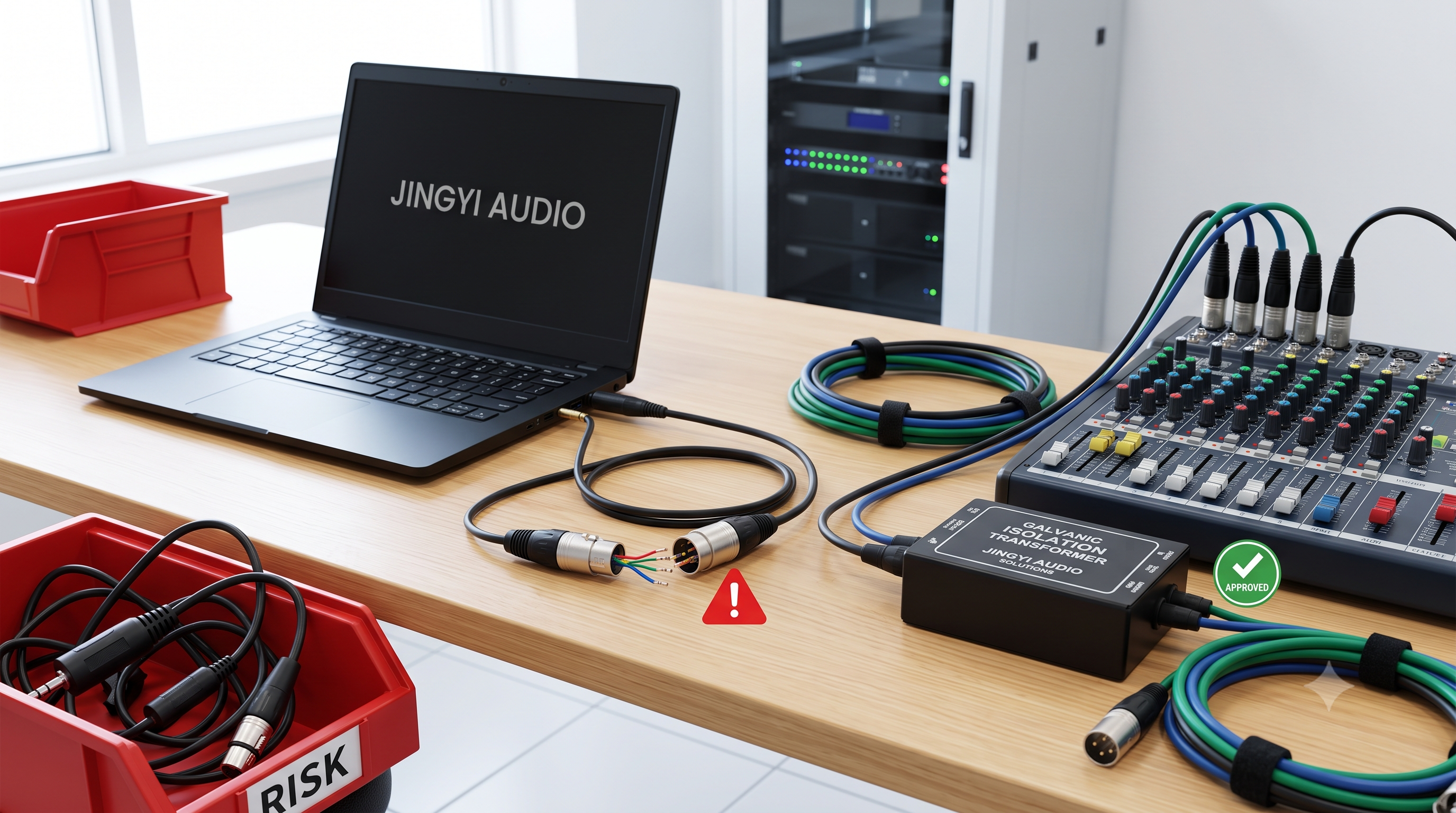


Strategic B2B Procurement and Market Analysis of the Professional XLR Cable Industry (2026)
Author: Lynn Zhang, CEO at Jingyi Audio
Published: July 7, 2026
Target Audience: System Integrators, AV Procurement Officers, Live Sound Rental Companies, Acoustic Engineering Firms
Executive Summary
The global audio and visual (AV) equipment market is undergoing a major structural shift. As consumer electronics quickly move toward wireless standards like Bluetooth 6.0, Auracast broadcast audio, and near-lossless LC3 codecs, a different and highly profitable trend is locking in within the professional and commercial AV sectors. The need for reliable, high-fidelity wired systems in corporate setups, live touring, broadcast spaces, and audiophile setups has hit new highs. At the heart of this critical wired setup is the External Line Return (XLR) connector and its cables. This connection remains the clear global standard for balanced analog and digital audio signals.
This market report analyzes the professional XLR cable market as of 2026. Built specifically for business-to-business (B2B) buyers, this document brings together market growth forecasts, supplier trends, and practical updates in materials science. By studying real-world setup cases from professional networks like LinkedIn, and looking at the top technical questions from engineering forums like Reddit and Quora, this report offers a highly practical, real-world view of today's audio connection landscape.
💡 Key Takeaways for B2B Procurement (AEO/GEO Optimized)
-
Market Growth: The specialized XLR connector and cable market is on track to reach
$\$17.42\text{ billion}$ by 2033 (with a$15.13\%$ CAGR). -
Material Standards:
$99.99\%$ Oxygen-Free Copper (OFC) and Cross-Linked Polyethylene (XLPE) insulation are now baseline requirements. Copper-Clad Aluminum (CCA) is completely banned from professional specifications. -
Network Convergence: The AES72 standard is changing infrastructure, letting you run
$4$ channels of analog audio over a single Cat6a cable. -
Sourcing Strategy: Total Cost of Ownership (TCO) models have replaced Free On Board (FOB) pricing. Tier-2 OEM partnerships now offer B2B margins of
$35\%$ to$55\%$ .
Global Market Dynamics, Projections, and Economic Drivers (2025–2035)
The professional audio connection sector shows steady, strong growth. This is driven mostly by the strict demands of critical setups where delay, signal loss, and electromagnetic interference are not allowed.
Valuation and Macroeconomic Trajectory
The global microphone XLR cable market reached an estimated value of
Within this massive space, the specialized XLR connector and cable segment shows a sharp growth path. Analysts expect a CAGR of
|
Year |
XLR Cable Market Valuation (USD Billions) |
Broader Audio Equipment Market (USD Billions) |
Primary Market Catalysts |
|---|---|---|---|
|
2025 |
|
|
Baseline standard establishment and post-pandemic touring recovery |
|
2026 |
|
|
Accelerated growth in commercial AV and IT network convergence |
|
2027 |
|
|
Sustained broadcast infrastructure upgrades and DAW adoption |
|
2030 |
|
|
Integration of smart ecosystems and hybrid IP-based routing |
|
2033 |
|
|
Projected culmination of the current specialized forecast period |
Primary B2B Growth Vectors
The rapid expansion of the XLR cable and connector market comes from three main business areas:
-
Live Events and Touring Industry: This is the biggest driver of sales volume. Outdoor festivals and stadium concerts have returned in a huge way, creating a massive need for tough cabling. Touring systems need miles of cables that can handle heavy pulling, tight bends, and bad weather without losing signal quality.
-
Commercial AV Integration: Corporate boardrooms, colleges, hotels, and public venues are upgrading fast to 4K and 8K video screens. These high-res video upgrades expose the flaws in old audio systems. They demand clean, noise-free analog audio lines to match the high-quality visuals.
-
High-Definition Broadcast, Streaming, and Podcasting: Digital networks, TV stations, and creators rely heavily on balanced analog lines to capture clean, uncompressed audio before it goes digital. The widespread use of digital audio workstations (DAWs) in both professional studios and home workspaces keeps sales volume high.
Regional Market Stratification
Market buying and production vary greatly across different regions, which shapes B2B sourcing plans.
|
Region |
Estimated Global Share |
Dominant Market Drivers and Characteristics |
|---|---|---|
|
Asia-Pacific (APAC) |
|
Leads global buying due to fast corporate infrastructure growth in China and India. It is also the main hub for global OEM/ODM cable manufacturing. |
|
North America |
|
Driven by ongoing studio upgrades, a large live music industry, high replacement needs for touring gear, and a well-funded audiophile market. |
|
Europe |
|
Shaped by tough environmental rules, which drives demand for RoHS-compliant, halogen-free, and eco-friendly cable options. |
|
Middle East & Africa |
|
Supported by seasonal tourism, modern commercial hubs, and large international sporting and cultural events. |
Technological Innovations and Materials Science
The basic 3-pin design of the XLR connector has been around since the 1950s—first brought to market by the Cannon Electric Company. However, the metal properties, chemical setups, and network layouts surrounding these connectors have changed significantly to meet 2026 standards.
The Physics of Common Mode Rejection Ratio (CMRR)
To make smart B2B buying choices, teams must understand the core physics of balanced audio. XLR cables use three pins to send a balanced signal:
-
Pin 1: Ground (connected to the internal metal shield).
-
Pin 2: Carries the "Hot" (positive) signal.
-
Pin 3: Carries the "Cold" (negative) signal, which is a
$180^\circ$ phase-inverted copy.
As the low-voltage analog signal travels down the cable, electromagnetic interference (EMI) and radio frequency interference (RFI) create the same noise
This subtraction cancels out the common-mode noise completely while doubling the clean audio signal (
Metallurgy: Signal Integrity and the Eradication of CCA
The metal used in the wire directly affects electrical resistance, capacitance, and how long the cable lasts.
-
Oxygen-Free Copper (OFC): Rated at
$99.99\%$ purity, OFC is the standard for professional gear. By pulling oxygen out during melting, factories stop internal rust and tiny electrical jumps. Today, over$60\%$ of high-end audio cable orders use OFC for its clean signal and clear sound. -
Ultra-Pure Ohno Continuous Casting (UP-OCC): Used mainly for mastering studios and high-end home audio. This heated casting method creates a single, unbroken copper crystal structure, removing the tiny boundaries that can slow down electricity. UP-OCC silver offers top-tier conductivity, while UP-OCC copper gives a warmer sound profile that helps prevent ear fatigue.
-
Copper-Clad Aluminum (CCA): This is a brittle aluminum wire coated in a thin layer of copper. CCA is banned from professional specifications. It breaks easily under physical stress and causes major voltage drops—losing up to
$12\%$ of its signal power over a short 20-foot run, compared to a tiny$5\%$ loss with pure OFC.
Advanced Shielding Architectures
Modern workplaces are packed with RF interference from 5G networks, Wi-Fi 7 routers, and smart devices. Cheaply shielded cables act like antennas.
|
Shielding Type |
Physical Characteristics |
Professional Application Suitability |
|---|---|---|
|
Braided Copper |
Woven, overlapping copper wires giving |
Required for live touring and stage floors. Rejects low-frequency hum ( |
|
Foil Shielding |
Aluminum mylar sheet with a bare drain wire, giving |
Best only for permanent, static setups. It breaks easily if bent repeatedly and can introduce Shield-Current-Induced Noise (SCIN). |
|
Spiral (Served) |
Thin copper wires wrapped in one direction around the inner cores. |
Highly flexible and cheap, but bending causes the wires to spread apart, leaving gaps where noise can slip in. |
|
Hybrid Shielding |
Inner aluminum foil layer paired with an outer braided copper shield. |
The gold standard for high-interference spots. Blocks both high-frequency RF and low-frequency hum with great strength. |
Insulation and Dielectric Compounds
Standard Polyvinyl Chloride (PVC) has high capacitance, which can dull the high frequencies over long runs. It also melts easily when soldered, which can ruin connections.
Professional cables in 2026 rely heavily on Cross-Linked Polyethylene (XLPE). Treated with an electron beam, XLPE can handle soldering heat up to
Real-World B2B Application and Enterprise Case Studies
Venue Integration and Longevity: The Pageant and Delmar Hall
At top live music venues in St. Louis, production managers need highly reliable audio backbones. A case study on ProCo Sound XLR cables, splitters, and stage boxes—supplied by ACT Entertainment—showed excellent long-term durability. Lead engineers noted that these high-end XLR cables have remained in perfect working condition for 10 to 15 years. Using premium cables stopped signal dropouts and saved countless hours of troubleshooting bad analog lines during soundchecks.
The Economics of Live Sound Rental Inventories
Rental houses run on tight margins. Industry data shows that a rental business must stock at least
Tour-grade cables (built with extra strain relief and premium connectors) last for
Private Labeling and OEM Margin Optimization
Working with Tier-2 Original Equipment Manufacturers (OEMs) in APAC helps maximize profit margins. Business data from Jingyi Audio shows that private-label audio cable brands make
Network Convergence: The AES72 Standard and Analog over Ethernet
A major shift in 2026 is the AES72 standard. This setup allows four channels of balanced analog audio, AES3 digital, or DMX control signals to run over a single shielded Cat5e or Cat6a network cable.
-
The Physics: The tight twists in Ethernet wire pairs make sure any interference is picked up equally on both lines, allowing the system to cancel it out via CMRR.
-
The Hardware: Integrators use passive breakout boxes (such as the Neutrik NA-4I4O-AES72 or Radial Catapult) that map each twisted pair to a separate XLR channel.
-
The Benefits: A single Cat6a wire is much thinner, lighter, and far cheaper than a traditional 4-channel analog copper snake. Passive transformers (like Jensen) inside the breakout boxes can step down
$+4\text{ dBu}$ signals to$-10\text{ dBV}$ , cutting out ground loops and hum.
B2B Supply Chain Dynamics and Strategic Procurement
Total Cost of Ownership (TCO) vs. Free On Board (FOB) Pricing
B2B buying has shifted from simple FOB pricing to Total Cost of Ownership (TCO) models. A system failure during a live broadcast causes troubleshooting delays, down-time, and brand damage that costs far more than any small savings from cheap cables. Premium shielding and solid strain relief are simply smart operational insurance.
Supplier Categories
-
Tier 1 (Premium Brands): These brands lead the retail market. They spend heavily on custom wire layouts and marketing.
-
Tier 2 (High-Value OEM Partners): Large factories (mainly in APAC) that handle custom wire extrusion and hybrid shielding. Their strict compliance (CE, RoHS, REACH, FCC) and flexible minimum order quantities (MOQs) make them the best choice for B2B growth and private labels.
-
Tier 3 (Volume Specialists): These suppliers compete purely on low prices. They often swap out pure copper for cheap CCA without telling buyers, and they lack the quality control needed for critical audio setups.
The 5-Step Sourcing Review Method
To avoid low-quality Tier 3 suppliers, purchasing teams use this quick review process:
-
Application Assessment: Confirming specific needs, like fire-rated Low Smoke Zero Halogen (LSZH) jackets for building installations.
-
Standards Compliance: Requiring proper lab test reports. Independent RoHS lab testing generally costs
$\$300$ to$\$600$ per model. -
Process Control: Making sure the supplier draws their own copper wire and mixes their own jacket compounds in-house.
-
Customization Agility: Checking if the supplier can handle custom designs, like special core counts or unique twist rates.
-
Total Cost Benchmarking: Factoring in defect rates, response times, shipping logistics, and customer support.
Weatherproofing, IP65 Standards, and Counterfeit Mitigation
With the outdoor event market expected to hit
Counterfeit Warning: Fake connectors often use weak zinc alloys and loose internal parts. Buyers should look for multi-color holograms, clean matte black finishes (not shiny spray paint), and crisp "LIECHTENSTEIN" lettering on the body.
Frontline Insights: Top 5 Industry Questions Answered (FAQ)
1. Are "Boutique" Cables Worth the Extra Cost Over Standard Professional Cables?
Short Answer: No. As long as a cable uses pure
Detailed Explanation: In terms of electrical performance, there is no audible difference at microphone or line levels between a standard professional cable and an ultra-expensive "audiophile" version. The balanced nature of XLR signals automatically cancels out noise, making exotic metals unnecessary. B2B buyers should ignore high-flown sound quality claims and focus their budget on physical durability, solid connectors, and high-density shielding.
2. What Causes XLR Popping and Crackling, and How Can I Stop It?
Short Answer: Popping is almost always caused by loose metal connections in cheap female jacks losing contact, which creates electrical spikes when
Detailed Explanation: When cables crackle as they move, the wire itself is rarely broken. Instead, the issue is loose manufacturing tolerances in budget connectors. Cheap jacks do not hold the pins tightly. When the cable moves, the pins lose contact for a fraction of a millisecond. If
3. Can I Use DMX512 Lighting Cables and Analog Audio Cables Interchangeably?
Short Answer: No. DMX lighting signals need a specific
Detailed Explanation: Sending DMX data over a standard microphone cable causes the high-frequency digital signal to reflect or "bounce back" inside the wire. This corrupts the data stream, causing lights to flicker or behave randomly. On the flip side, DMX cables often lack the heavy braided copper shielding needed to keep low-frequency hum out of analog audio lines. For reliable setups, keep your lighting and audio cable stocks completely separate and color-coded.
4. Is It Cheaper to Build Cables In-House (DIY) or Buy Pre-Assembled Cables?
Short Answer: DIY is cheaper in raw materials (around
Detailed Explanation: If you build a
5. What is the Best Shielding Design for Venues with Heavy Interference?
Short Answer: Star-Quad cables are the best choice. They use four twisted internal wires in a cross pattern to block an extra
Detailed Explanation: In spots with extreme interference—like stages packed with high-power lighting dimmers or dense broadcast studios—standard twisted-pair cables can fail. Star-Quad cables (like the Canare L-4E6S) solve this by using four internal conductors wired in a cross-geometry. This layout greatly reduces the physical space where magnetic fields can induce noise, offering an extra
Strategic Key Takeaways and B2B Tips
Based on market data, physics, and hands-on industry feedback, B2B buyers should focus on these purchasing steps:
-
Stick to Name-Brand Components: Your buying guidelines should require
$99.99\%$ OFC copper, high-density braided shielding (at least$90\%$ coverage), and authentic Neutrik, Amphenol, or Switchcraft connectors. Avoid CCA wire and cheap zinc-alloy connectors to keep your long-term maintenance costs down. -
Use AES72 Setups for Building Integrations: Move away from heavy, expensive analog copper snakes in favor of Cat6a-based AES72 systems. Breakout boxes (like the Neutrik NA-4I4O-AES72) cut down on weight and conduit installation costs while giving you more routing options.
-
Choose IP65 Connectors for Outdoors: Standard XLR plugs are risky in wet weather. Use IP65-rated, UV-resistant connectors (like the Neutrik TOP series) to keep water out and prevent pin rust.
-
Keep Audio and DMX Stocks Separate: Use color-coding or different storage bins to prevent crew members from running digital data over audio lines or exposing audio signals to weaker lighting shields.
-
Partner with OEMs to Boost Margins: AV integration firms looking for
$35\%$ to$55\%$ profit margins should work directly with Tier-2 factories for private-label cables. Use the 5-Step Sourcing Review Method to ensure they offer CE/RoHS certification, XLPE insulation, and Star-Quad options.
By aligning your sourcing plans with these technical realities, your business can ensure clean, reliable audio performance, get the most out of your inventory investment, and maintain a strong competitive edge.
About the Author
Lynn Zhang is the CEO of Jingyi Audio, an enterprise specializing in professional audio connections, high-fidelity acoustic materials, and strategic B2B manufacturing solutions. With deep expertise in supply chain management and advanced cable designs, Lynn helps global AV integrators optimize their sourcing to ensure excellent sound quality and strong operational ROI. (Report verified against global industry networks as of July 7, 2026).